A Victory That Refused to Be Complete
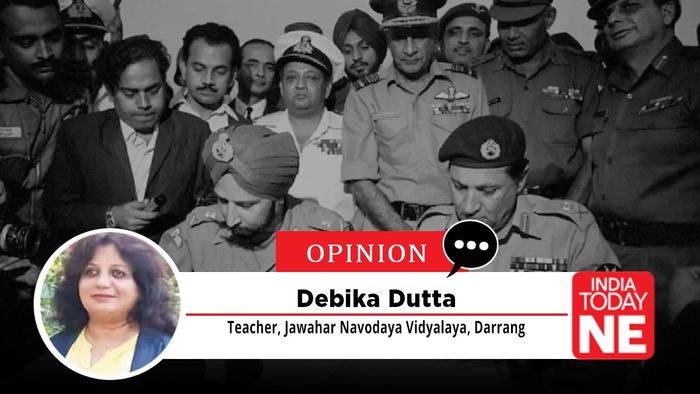
Every December, we return to 1971 with a sense of justified pride. Few moments in independent India’s history feel as clear-cut as that war. The Indian Armed Forces fought with precision and restraint. Pakistan’s eastern command collapsed. Bangladesh was born. Over 93,000 Pakistani soldiers surrendered. The outcome was decisive, the cause defensible, the sacrifice immense.
- Dec 16, 2025,
- Updated Dec 16, 2025, 3:04 PM IST
Every December, we return to 1971 with a sense of justified pride. Few moments in independent India’s history feel as clear-cut as that war. The Indian Armed Forces fought with precision and restraint. Pakistan’s eastern command collapsed. Bangladesh was born. Over 93,000 Pakistani soldiers surrendered. The outcome was decisive, the cause defensible, the sacrifice immense.
History, however, is rarely as tidy as commemorations make it appear.
For decades now, Vijay Diwas has been observed with ceremony and certainty. What has received far less attention is a quieter question that has never really gone away: what happened to the Indian soldiers who did not return after the war ended?
Officially, 54 Indian soldiers were declared missing in action. “Missing” is a bureaucratic word. It sounds temporary, even neutral. But when years turn into decades, it becomes something else entirely—a permanent state of not knowing.
Over time, fragments surfaced. Intelligence assessments. Statements by repatriated Pakistani prisoners. Occasional references from foreign intermediaries. None of these amounted to definitive proof. But taken together, they suggested a possibility that the Indian state never fully confronted—that some Indian soldiers may have been alive and held in Pakistani custody after the guns fell silent.
These reports did not emerge in a vacuum. They reached the government. Files were opened. Notes were prepared. And then, gradually, the matter lost urgency.
This was not because India lacked leverage. Quite the opposite.
When the Shimla Agreement was signed in 1972, India was negotiating from a position of extraordinary strength. Pakistan had suffered its worst military defeat. Its leadership was diplomatically isolated and eager to return to international legitimacy. India held thousands of Pakistani prisoners of war—men whose release mattered deeply to Islamabad. In the language of diplomacy, this was a moment of advantage rarely afforded to a victor.
Yet the release of those prisoners was not made contingent on a final, verifiable accounting of India’s missing soldiers. No independent inspection of Pakistani detention facilities was insisted upon. No binding mechanism was enforced to conclusively close the matter. Pakistan denied holding any Indian POWs, and that denial was accepted.
The decision was not dramatic. There was no public announcement. No debate in the open. The issue was simply allowed to fade.
Supporters of Indira Gandhi have long defended this choice as statesmanship. The argument is familiar: that India chose reconciliation over humiliation, stability over prolonged hostility. There is truth in that perspective. Wars do need endings. Regions do need peace. But peace that rests on unresolved questions has a way of ageing poorly.
Statesmanship should not require a nation to stop asking where its soldiers went.
There is also an uncomfortable irony here. India justified its intervention in East Pakistan in moral terms—speaking forcefully about genocide, human suffering, and international responsibility. Yet once victory was secured, moral language gave way to diplomatic convenience. The urgency that animated the war did not extend to its aftermath.
The cost of that choice was borne far from negotiating tables.
Families of the missing soldiers wrote letters for years—to ministries, to parliamentarians, to anyone who might listen. Some received courteous replies acknowledging their anguish. Most received silence. Parents waited and passed away without answers. Wives lived entire lives suspended between hope and resignation. Children grew up with a story that never reached a conclusion.
There is no single document that tells us exactly what happened to those men. Perhaps there never will be. But the absence of certainty does not absolve the state of responsibility. If anything, it demands greater honesty.
What makes this episode particularly difficult to explain away is the political context in which it unfolded. Indira Gandhi was not a leader constrained by weakness or instability. In the aftermath of 1971, she stood at the height of her authority—secure at home, respected abroad, and commanding enormous political capital. Pakistan, by contrast, had little room to manoeuvre.
If there was ever a moment to insist—quietly but firmly—on a full accounting of every Indian soldier, that was it.
Power was available. Resolve was uneven.
As the years passed, the issue slipped from public discourse. Successive governments, across party lines, showed little appetite to reopen it. Files remained classified. The families grew older. The nation found new concerns. History, it seemed, had been archived.
But history does not disappear because it is inconvenient. It waits.
Revisiting this chapter is not an attempt to diminish Indira Gandhi’s role in 1971. Her leadership during the war remains significant and will always invite debate. But legacies are not strengthened by silence. Democracies do not honour their past by treating it as beyond question.
Nor is this about retrieving prisoners after fifty years. That window has long closed. What remains open is something more basic: acknowledgment. The willingness of the state to say that even in moments of triumph, things were left undone. That moral clarity does not always align neatly with political calculation.
India today speaks often of honouring its soldiers, and rightly so. But honour is not only expressed through ceremonies, medals, and speeches. It is also expressed through memory. Through truth. Through the courage to confront uncomfortable chapters without defensiveness.
Vijay Diwas deserves celebration. It also deserves reflection. A victory that reshaped the subcontinent should not be remembered without remembering those who disappeared into its margins.
History will record the war by its outcome. Families remember it by the silence that followed.
And that silence, even now, asks to be acknowledged.