After the Midterms: What a Weakened Trump Means for the Iran War, India and the North East India
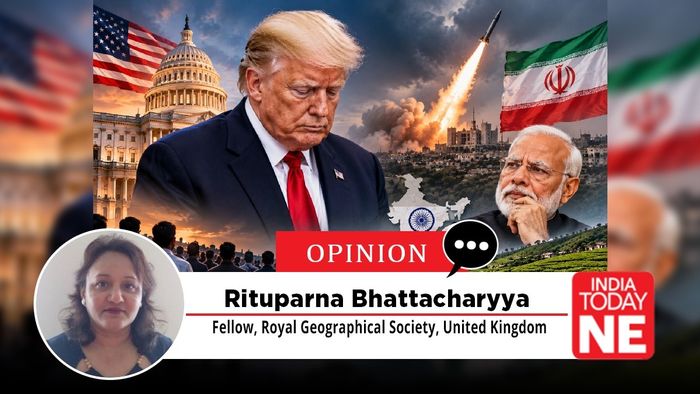
Democrats seized both chambers of Congress as voters rebuked Trump's Iran war. The result could reshape India's trade, energy and North East interests.
- Nov 08, 2026,
- Updated Nov 08, 2026, 12:22 PM IST
A Democratic sweep of both Houses of Congress, blamed by the Vice President himself on the war with Iran, leaves Donald Trump a weakened president for his final two years. For New Delhi, and for the tea gardens, fuel queues and diaspora households of the Northeast, the ripples will be felt well beyond Washington.
America has delivered its verdict on the war with Iran, and it is a harsh one. In the 3 November midterm elections, the Democratic Party wrested control of both the House of Representatives and the Senate, a sweep in which, by several counts, Republicans failed to flip a single seat. Only months after launching a war in West Asia, President Donald Trump now faces a hostile Congress that can investigate, subpoena and, in theory, impeach him.
For India, the result is neither a windfall nor a catastrophe. It is a recalibration. Trade talks, H-1B visas, oil prices and New Delhi's careful balancing between Washington and Tehran will all be shaped by what a chastened White House and an emboldened Congress do next. For the North East, a region that rarely features in conversations about American politics, the stakes are surprisingly concrete.
A blue wave, and a rare one
With counting still underway in Alaska and Mississippi, CBS News estimates that Democrats will hold between 251 and 268 House seats and have secured at least 54 seats in the Senate. Losses reached deep into territory Trump carried comfortably two years ago; India Today has reported that Democrats even flipped Texas. Midterms usually punish the party in the White House, but rarely on this scale.
Senate Majority Leader-in-waiting Chuck Schumer called it a "generational remake of the Senate map", saying: "Against all odds, we Democrats have won the Senate." House Democratic leader Hakeem Jeffries, now set to become Speaker, declared simply: "America is back."
Trump struck an unusually conciliatory note. "My message is congratulations to the Democrats, and I look forward to working with you for the good of our country," he said, while insisting: "If I was on the ballot, we would have won."
"The reason we lost is the war"
The most striking verdict came from inside the administration. Vice-President JD Vance, never an enthusiastic champion of the conflict that began with joint US-Israeli strikes on 28 February, wrote on X: "The reason we lost is the war. The president himself said so last night." In a longer post, he went further, challenging hawks in his own party: "If you'd like to argue it was worth it, that losing the Senate for the next 6 years was worth it, then do so."
According to PBS NewsHour, Vance listed the war, the cost of living, a sense that America was not being prioritised, and the US relationship with Israel as reasons Republican voters defected. The AP VoteCast survey found about six in ten voters believed the US was wrong to take military action against Iran. Vance, who has said he will decide on a 2028 presidential run after this election, is clearly putting distance between himself and the war.
Trump conceded it was "largely true" that the war cost seats, chiefly through higher petrol prices, but refused to retreat. "The Iran thing, we had to do and we continue to do it," he said. "You can't let Iran have a nuclear weapon."
Secretary of State Marco Rubio had, before polling day, accused Tehran of betting on exactly this outcome. "I think the Iranians are under this illusion that Democrats are going to win in November," he told reporters in September, adding that "the Iranians are fundamentally misreading our political system" (Fox News). That illusion has now become a reality. On the eve of the vote, Rubio said the President "would prefer to do it peacefully" but "hasn't made a decision" on further strikes, insisting "we have everything we need to be successful" (Military.com).
The new Congress cannot end the war on its own. Rep. Ted Lieu has pledged that Democrats will "pass a bill to stop the Iran war", but any such measure would face a presidential veto that Democrats lack the numbers to override. What Congress can do is squeeze funding, demand war-powers votes and haul officials before hearings. The likeliest outcome is a White House under strong pressure to convert the current uneasy pause, and Iran's offer to reopen the Strait of Hormuz if the US lifts its blockade of Iranian ports, into a negotiated settlement. Iran's Parliament Speaker Mohammad Bagher Ghalibaf has already read the results as a referendum on the war.
A third impeachment?
With the House in Democratic hands, the question on many lips is whether Trump will become the first US president to be impeached three times. The arithmetic is simple: a simple House majority can impeach, but removal requires a two-thirds vote in the Senate, which Democrats are nowhere near. Without a substantial bloc of Republican defectors, impeachment would be largely symbolic.
The party is divided, as Forbes reports. Rep. Alexandria Ocasio-Cortez backs impeachment, citing "a lot of crimes being committed". Rep. Steve Cohen has already tabled 26 articles. Rep. Ro Khanna points specifically to military action against Iran without constitutional approval. On the other side, Kamala Harris has called it a poor use of limited resources, and Senator Tammy Duckworth says Democrats should not impeach "anybody". Jeffries is keeping his options open: "We haven't ruled anything in, and we haven't ruled anything out."
Trump, for his part, has told rallies he has "become very good at beating them on impeachment". The more probable path is a long season of investigations into the war's conduct, tariffs and the Trump family's business dealings, rather than an early impeachment vote. That distinction matters for India and, as we shall see, even more for Pakistan.
What it means for India
As India Today's Abhishek De argues, a weakened Trump will be eager for a foreign-policy win to reassure his base, and a swift trade deal with India is likely to be high on his list. New Delhi, which has held out for tariff terms better than those given to China and Vietnam, now has more room to wait rather than rush. Yet Trump retains executive power to impose tariffs, and a Section 301 investigation into India and others remains live. A Democratic Congress cannot undo tariffs automatically; it can only hold hearings on their cost to American businesses and consumers.
On immigration, the change may matter more over time. Indians receive roughly three in every four approved H-1B visas, and the administration's USD 100,000 H-1B fee has unsettled Indian professionals and the firms that hire them. Several Democrats have criticised these moves, and greater congressional scrutiny could, in the longer run, help Indian techies, even if there is no immediate relief.
There is a flip side. Democrats have historically been more vocal about India's human rights and religious freedom record, an area where New Delhi has pushed back sharply. Pakistan, meanwhile, faces a different headache. Islamabad cultivated Trump's inner circle through an MoU with an affiliate of World Liberty Financial, the Trump family's crypto venture; a drone deal with Powerus, a firm close to Trump's sons; a USD 500 million critical-minerals MoU; and the Roosevelt Hotel renovation deal. With Democrats promising to probe the Trump family's business dealings, Field Marshal Asim Munir's courtship of Washington could be dragged into congressional hearings.
The largest effect on India, however, runs through the Iran war. About 90 per cent of India's LPG imports pass through the Strait of Hormuz. Brent crude jumped from about USD 80 to USD 120 in the first week of March, and India raised fuel prices for the first time in four years in May. Indian sailors have been killed, and Indian-flagged ships have been fired on. If the midterms push Washington toward a settlement, India stands to gain more than almost any other major economy.
At home, the opposition has seized on the moment. Congress leader Pawan Khera described Trump as "America's Modi", while Priyanka Kakkar posted "Today POTUS. Tomorrow LOTUS." BJP spokesperson Pradeep Bhandari retorted: "POTUS can come and go. LOTUS wohi rahega" (DNA).
The view from the North East
Nowhere in India is the link between Washington's politics and household economics more direct than in Assam's tea gardens. Iran has long been one of the most important buyers of Assam orthodox tea. India exported 11.25 million kg of tea to Iran in 2025, and West Asia as a whole took nearly half of India's 280.40 million kg of exports (Northeast Now). Guwahati Tea Auction Buyers' Association secretary Dinesh Bihani warned in March that this "significant exposure makes the Indian tea industry vulnerable to prolonged instability in the region."
The state has already had to step in. In March, the Assam government released Rs 94.70 crore under its tea industry special incentive scheme to 486 gardens, and Chief Minister Dr Himanta Biswa Sarma announced a rise in the orthodox tea subsidy from Rs 10 to Rs 15 per kg. A negotiated end to the war, which the midterms make more likely, is the single best outcome for the gardens, their workers and the small growers who feed bought-leaf factories.
Fuel is the second channel. The North East, reached largely through the narrow Siliguri corridor, pays a premium for anything moved by road. The LPG shortages and price rises of this year, with black-market cylinders reported in parts of the country, bite harder in hill districts where supply chains are long and alternatives few. The region's own refineries at Digboi, Guwahati, Bongaigaon and Numaligarh offer some cushion, but cannot insulate it from national price decisions. Any easing in Hormuz would show up quickly in the region's kitchens and transport fares.
Third, there are people. Many young people from Assam, Meghalaya, Manipur, Mizoram and Nagaland study or work in the United States, and many more aspire to. A Congress more sceptical of H-1B curbs offers them modest long-term hope. At the same time, a Democratic majority more attentive to human rights and religious freedom may revisit questions about the North East itself, Manipur's prolonged ethnic conflict in particular, which has drawn international attention before. New Delhi should expect more such questions, not fewer.
Finally, there is geography. The North East's Act East ambitions run through Bangladesh, Myanmar and Bhutan, neighbours India has been supplying with fuel through this crisis. A calmer West Asia and steadier energy markets would free New Delhi to give these eastern corridors the attention they need.
A lame duck with sharp teeth
Trump remains in office until January 2029, with his executive powers on tariffs and war largely intact. A lame-duck president facing hostile hearings can become more cautious, or more unpredictable. India's task is to use the breathing room wisely: hold firm on a fair-trade deal, press quietly for a settlement in West Asia, and prepare for a Congress that will ask harder questions about rights at home.
For the North East, the lesson is that distant ballots matter. A vote in Ohio or Texas, cast partly over the price of petrol, may yet decide the price of a cup of Assam tea in Tehran and an LPG cylinder in Kohima.
The writer is a human geographer, Founding Editor-in-Chief of Space and Culture, India, and Chartered Geographer and a Fellow of the Royal Geographical Society, United Kingdom. Views are personal.
Sources
• India Today: Trump weakened at home. What it could mean for India and Pakistan
• CBS News: 2026 midterm election live updates
• PBS NewsHour: Vance blames Iran war for GOP midterm losses
• Fox News: Rubio says Iran is misreading US politics
• Military.com: Rubio says Trump wants peaceful end to Iran war
• Forbes: Will Democrats impeach Trump after winning midterms?
• DNA India: Opposition takes a dig at BJP after Trump's midterm setback
• Northeast Now: US-Iran conflict casts shadow on Assam's orthodox tea exports