Assam And Meghalaya: We Have More To Preserve Than We Have To Prove Lead in
“When a dispute between two states begins to divide ordinary people, what happens to the relationships that generations have built across the boundary?”
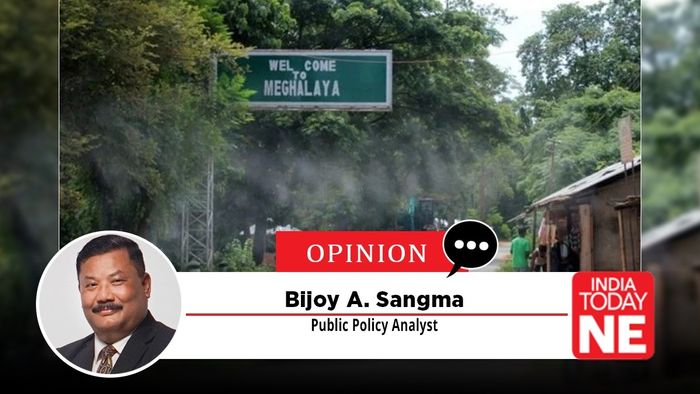
- Sep 02, 2026,
- Updated Sep 02, 2026, 5:03 PM IST
Just a week before the recent tension between Assam and Meghalaya, six friends from Assam had visited my home in Shillong, in two separate groups. They came as friends have come to my home over the years. We talked, shared meals and remembered old times. There was nothing unusual about their visits, and nothing in those meetings suggested that we belonged to different sides of anything.
A few days later, the atmosphere had changed. A protest in Shillong turned violent. People were injured, vehicles were damaged, and public property was vandalised. The Meghalaya government later said that 31 vehicles had been targeted during the violence, including eight Assam- registered vehicles.What struck me was how quickly an incident involving a protest could begin to affect how people saw one another. Within days , Assam and Meghalaya were being spoken of less as neighbouring states with a complicated relationship and more as opposing sides. Restrictions on movement between the two states added to the unease.
I found that difficult to watch because my own life has never fitted neatly on one side of that boundary.
I am a Garo from Meghalaya, but much of my childhood was spent in Assam, where my father was working. I went to school there and grew up with the Assamese language, culture and everyday life around me.While our family was still based in Assam, I came to Shillong for college. After my father retired, our family returned to Meghalaya. Assam shaped my childhood and early years. Meghalaya is my home.
My professional journey also began in Assam. As a young man, I worked as a Special Representative for the Assamese children’s magazine Mouchak, edited by Shantanu Tamuli and published from Jorhat. Later, I began my career as a Special Correspondent with the Assamese newspaper Mahajati, edited by Dr Purna Narayan Sinha and published from Tezpur. I was also among those involved in establishing the Udalguri Press Club on 20 January 1988.
Those years brought me into contact with people who had already made their mark in Assam’s media, including Dhirendra Nath Bezbaruah, Kanaksen Deka, Wasbir Hussain, Prashanta Rajguru and Mihir Deori. As a young writer, I learned from them
and from the Assamese journalistic world in which I was beginning to find my own voice. My connection with Assam was not limited to childhood and journalism. As a young man, I became involved in public life there, served as a regional leader of the All Assam Students’ Union, took part in the Assam Agitation and was active during the transition from the student movement to the formation of the Assam Gana Parishad.
That background has shaped the way I look at questions of identity. I have seen how deeply people can feel about belonging, culture and political rights, and I understand why these questions matter. For many people, identity is tied to history, land, culture and the future they want for their children. There is nothing wrong with holding those concerns strongly. The difficulty begins when an argument about these questions changes the way we regard people who happen to belong to the other side.
Assam and Meghalaya have real differences. Some have existed for decades. The boundary question remains unresolved in parts, and there are continuing concerns about land, identity, migration, employment, development and natural resources. These are serious matters, and they deserve serious discussion. But a dispute over an issue is different from a dispute between peoples.
An issue can be argued, negotiated and eventually resolved. Once people themselves become the object of suspicion, the consequences are harder to contain. An Assamese person can stop being a traveller, student, trader, colleague or friend and become, in someone’s mind, simply “an Assamese”. The same can happen to someone from Meghalaya on the other side. An incident involving a few people then begins to carry a meaning far beyond those actually involved.
That is when a disagreement starts taking a toll on relationships that had nothing to do with it.
The recent violence in Shillong must be dealt with according to law, and those responsible for unlawful acts must face due process. The Meghalaya government has constituted a Special Investigation Team, and FIRs have been registered in connection with the violence. At the same time, people who had nothing to do with the incident should not have to answer for it simply because of where they come from. The tensions that followed showed how quickly a local incident can spill into the lives of people on both sides.
Since then, the two governments have taken steps to restore movement and improve coordination, including arrangements for stranded travellers and vehicles and mechanisms for continued coordination between the two states.A further round of discussions is expected around September 10 on longer-term arrangements. These steps are necessary, but restoring movement is only part of the task. People also need to feel that crossing the boundary has not changed the way they are regarded.
The relationship between Assam and Meghalaya is much older and wider than the disagreements of the moment. For decades, people have crossed the boundary for college, work, healthcare, trade and family. Students study in one another’s institutions. Patients go where they can find treatment. Families visit one another. Traders and transporters depend on the roads. Friendships develop in schools, workplaces and neighbourhoods without anyone asking which side of the boundary the other person belongs to.
Most of us have seen something similar within a family. Brothers can disagree over property, responsibility or other matters, and sometimes those disagreements become serious. They may take years to settle. But a disagreement does not automatically end the relationship. Assam and Meghalaya have disagreements of their own, some of them difficult and longstanding. That should not make the people of the two states strangers to one another.
I keep returning to those six friends who came to my home in Shillong only days before the incident. They came in two separate groups, as friends do. They did not come as representatives of Assam, and I did not receive them as a representative of Meghalaya. We were simply people who had known one another for years. Whatever our views might be on the difficult questions between the two states, those friendships existed before the present tension and should not be defined by it.
This is what I worry about when a political disagreement begins to acquire a social meaning. A young person may start wondering whether visiting a neighbouring state makes them somehow disloyal to their own. A family may become cautious about where its children travel. A friendship may be viewed through the politics of the moment. None of this resolves a boundary question, protects an identity or advances a legitimate interest.
A child growing up in Meghalaya should be able to learn Assamese, have Assamese friends and visit Assam without having to explain why. A young person in Assam should be able to come to Meghalaya with the same ease. These are small things in themselves, but they are part of what makes neighbouring societies live comfortably with one another.
My own life is difficult to separate into an Assam part and a Meghalaya part. Assam gave me my childhood, my schooling, my early public life and the beginning of my professional journey. Meghalaya is my home, my roots and the place to which my family returned. I have never felt that one had to cancel the other.
That is why I find the language of choosing sides uncomfortable. I can belong to Meghalaya and still carry affection for the place where I grew up. I can care deeply about Meghalaya’s interests without regarding Assam or Assamese people as a threat. I can also understand why people in Assam have their own concerns and expect them to be treated seriously.
None of this means that legitimate grievances should be ignored. Nor does it mean that difficult questions can be settled by sentiment. They still require negotiation, evidence, law and political judgement. What sentiment can do, however, is remind us what should not be allowed to disappear while those questions are being argued.
Over generations, people in Assam and Meghalaya have built connections through family, friendship, education, work and everyday life. Much of that has happened quietly, without governments directing it and without anyone making a political claim over it. We inherited many of these relationships from those who came before us. We should think carefully before allowing a dispute of our time to become something that the next generation inherits as hostility.
I grew up in Assam, and I belong to Meghalaya. I have friends on both sides. For most of my life, I never had to explain how those things could exist together. I would not like to reach a point where the next generation has to ask that question.
There will be disagreements between Assam and Meghalaya. There will be difficult negotiations, competing interests and political arguments. Those are part of public life. What should not become part of that process is the idea that ordinary Assamese and Meghalayans have to look at one another with suspicion because their governments or political groups are in disagreement.
We have more to preserve than we have to prove.