Between Grief and Glory: What Post Malone in Guwahati Says About Us
The Guwahati of 2001 was afraid. Not in any way we'd admit, of course. We dressed our fear in the language of cultural preservation, wrapped it in the legitimacy of post-insurgency trauma, called it pride. But underneath all those student protests and editorial think-pieces was a city that wasn't sure it could survive contact with the wider world.
- Dec 09, 2025,
- Updated Dec 09, 2025, 2:22 PM IST
I was fourteen when they cancelled the Vengaboys concert. Some of the ones relishing the Post Malone Concert were not even born.
I remember the grainy newspaper photos, students with placards, angry faces, righteous proclamations about protecting Assamese culture from Western pollution. I remember my parents nodding along, saying something about how "these things" weren't for us, not yet, maybe not ever. I remember feeling a strange shame, like wanting to hear "Boom, Boom, Boom, Boom" made me a traitor to something I couldn't quite name.
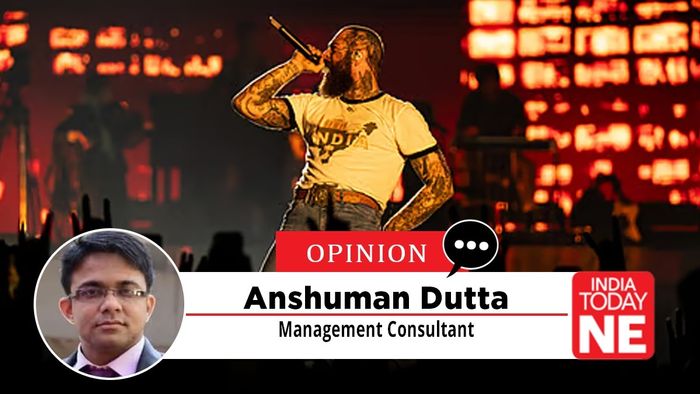
I'm thirty-eight now and yesterday night Post Malone performed in Guwahati.
Twenty-four years between two concerts. A lifetime, really. My lifetime. And somewhere in that span of time, everything changed and nothing changed and my city, our city, my hometown, became both unrecognizable and more itself than ever before.
The Guwahati I Grew Up In
The Guwahati of 2001 was afraid. Not in any way we'd admit, of course. We dressed our fear in the language of cultural preservation, wrapped it in the legitimacy of post-insurgency trauma, called it pride. But underneath all those student protests and editorial think-pieces was a city that wasn't sure it could survive contact with the wider world.
We were recovering. Still are, in many ways. The wounds of the Assam Movement, the violence of the insurgency years, the constant feeling of being forgotten by the rest of India, it all made us protective, defensive, turned inward. When Vengaboys announced their concert, some part of us panicked. What if our young people forgot who they were? What if Assamese became a language spoken only by grandparents? What if we opened the door and lost ourselves in the flood?
So we shut the door. We said no. We told ourselves it was strength.
But I remember looking at those protest photos even then and noticing something strange: the students holding signs about protecting Assamese culture were wearing western outfits . They were protesting Western against influence. The contradictions were everywhere, but we couldn't see them yet. Or maybe we could, and that's precisely what scared us.
Fast forward two decades. I'm scrolling through my phone, and suddenly there it is: Post Malone. In Guwahati. Not Shillong, not some place we'd have to travel to, pretending we didn't care about missing out. Here. In our city.
Over 20,000 tickets sold. The Chief Minister himself talking about concert tourism policies, about competing with Meghalaya, about making Guwahati a destination. The same government that, in different iterations, once would have found a hundred bureaucratic ways to ensure such a concert never happened, was now actively recruiting it.
What changed?
We did.
Somewhere between 2001 and 2025, Guwahati grew up. We stopped believing that loving Zubeen Garg and listening to Post Malone were mutually exclusive. We realized that our kids could rap along to "Rockstar" and still weep during "Mayabini" at a Bihu function. We learned, slowly and painfully, that identity isn't a dam that breaks under pressure, it's a river that flows, absorbs, changes course, but keeps moving.
The Guwahati that said no to Vengaboys was afraid of disappearing. The Guwahati that said yes to Post Malone had learned something profound: we were never that fragile to begin with.
Then Zubeen da Died
September 19, 2025. The day the music stopped.
I was in a meeting when a news push on my laptop read.Zubeen Garg dies at 52. Zubeen Garg. Drowned. Singapore. The words didn't make sense. They still don't. How does someone so alive, so present in every corner of our lives, just... stop?
I grew up with his voice. We all did. He wasn't just a singer; he was the voice of every emotion we'd ever felt about being Assamese in a world that barely knew we existed. He sang our love songs and our protest anthems. He made us laugh and made us weep. He sang in forty languages because he contained multitudes, but his heart always beat in Assamese.
When he died, we didn't just lose an artist. We lost a mirror, a witness, a part of ourselves.
And then came the whispers, the arrests, the word nobody wanted to say: murder. The Chief Minister calling it "plain and simple" foul play. Seven people arrested. Our grief turned sharp-edged, metallic with anger. They didn't just take Zubeen from us. They ripped him away.
The whole of Assam went into mourning. Real mourning, the kind where you can't imagine music mattering again.
The Concert We Didn't Want
So when Post Malone's concert approached, scheduled before Zubeen's death but happening after, the city hesitated.
It felt wrong. Disrespectful. How could we dance to "Circles" when Zubeen's voice still echoed in the silence? How could we welcome an American artist when we were burying our own? Some called for cancellation. Others questioned the timing, the appropriateness, the optics.
And I understood. God, I understood.
But here's the thing that broke me: Post Malone began his set by saying, "I am grateful to be back in India and in Zubeen Garg's homeland."
Because he saw us. He acknowledged our grief. He understood that he was walking into a city in mourning and he honored it. He didn't pretend the pain wasn't there. He named it. He named *him*. Obviously someone, updated him on it, it was the right thing to do.
What This All Means
The difference between 2001 and 2025 isn't that we stopped caring about Assamese culture. It's that we finally understood what Assamese culture actually is.
In 2001, we said no to Vengaboys because we were afraid of losing ourselves. In 2025, we hesitated about Post Malone because we had already lost something, someone, irreplaceable. The first response came from fear. The second came from love.
That's growth. That's what two decades of living, struggling, surviving, and slowly opening up looks like.
We learned that Zubeen could contain forty languages and Post Malone could honor him in our homeland, and neither diminished the other. We learned that our children could grow up multi-lingual, multi-cultural, multi-everything, and still come home to the sound of dhol and pepa. We learned that identity isn't a museum piece to be protected behind glass, it's a living, breathing thing that evolves or dies.
The Guwahati of 2001 was afraid of the world. The Guwahati of 2025 is grieving and growing and somehow still showing up. We're hosting international concerts while mourning our greatest artist. We're crying and dancing, sometimes in the same breath. We're allowing ourselves to be complicated.
For those of us who span both eras who remember the cancelled Vengaboys concert and attended or watched or just welcomed the Post Malone show there's a particular bittersweetness to all this.
We're the generation that grew up being told to choose: local or global, traditional or modern, Assamese or everything else. We're the ones who felt guilty for loving both Zubeen and Eminem, who learned to code-switch not just between languages but between entire identities.
And now we're watching our city finally, finally, say: you don't have to choose.
But it came at such a cost. We lost Zubeen just as we were learning this lesson. He never got to see the Guwahati that could hold space for both him and the world, because in many ways, he built that Guwahati. His fusion of styles, his linguistic range, his refusal to be contained—he showed us that we could be rooted and boundless at the same time.
He died just as his homeland was learning to breathe the way he always had.
Someday, when my kids ask me about this time, I'll tell them about three concerts.
The one that never happened, because we were too afraid.
The one that did happen, because we learned to be brave.
And the thousands of concerts in between, in small auditoriums and college festivals and Bihu grounds, where Zubeen Garg taught us that loving your roots and reaching for the sky aren't opposites. They're the same thing.
I'll tell them that grief and growth often arrive together, that you can mourn and celebrate simultaneously, that a city can hold both loss and possibility in the same wounded, hopeful hands.
I'll tell them that Post Malone came to Guwahati and said Zubeen Garg's name, and in doing so, made us realize, to do what Assamese people have always done best: endure, adapt, remember, and keep going.
Guwahati today is not the city that cancelled the Vengaboys concert. But it's not trying to forget that city either. We carry both versions, the fearful and the bold, the closed and the opening, because that's what growth looks like. It's not erasing who you were. It's expanding to hold who you're becoming.
We're a city that can fill a stadium for Post Malone while Zubeen's songs still play from every car, every phone, every heart. We're a place where traditional Bihu dancers perform at international music festivals. We're people who cry in Assamese and dream in English and somehow make it all mean something.
We're complicated now. Messy. Contradictory. Grieving and ambitious and uncertain and alive.
We're finally, finally growing up.
And maybe that's what Zubeen would have wanted. Not for us to stop at his loss, but to keep moving, to keep fusing, evolving, becoming. To honor him not by freezing in grief but by continuing the work he started: showing the world that Assamese culture isn't fragile. It's flexible. It's fierce. It survives.