Beyond the “Melodi” Moment
Indian politics has always understood the power of spectacle. From mass rallies and slogans to carefully staged diplomatic optics, perception often becomes as influential as policy itself. But there are moments when the distance between image and reality becomes too visible to ignore.
- May 21, 2026,
- Updated May 21, 2026, 4:52 PM IST
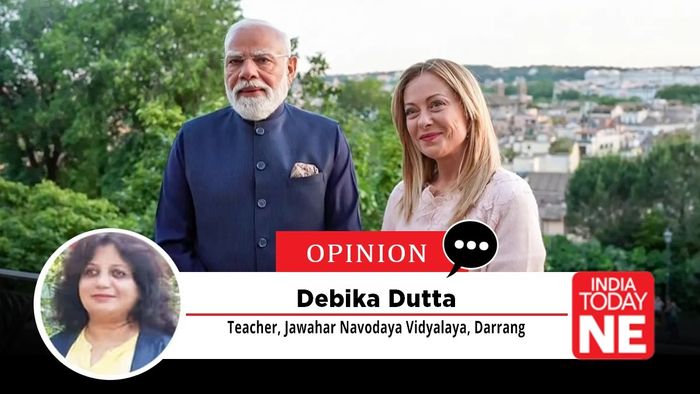
Indian politics has always understood the power of spectacle. From mass rallies and slogans to carefully staged diplomatic optics, perception often becomes as influential as policy itself. But there are moments when the distance between image and reality becomes too visible to ignore. Rahul Gandhi’s latest remarks targeting Prime Minister Narendra Modi over the now-viral “Melodi” moment with Italian Prime Minister Giorgia Meloni have triggered precisely such a moment in India’s political discourse.
Predictably, the reactions were immediate and deeply polarised. Supporters of Rahul Gandhi described his criticism as a necessary challenge to an increasingly imagedriven political culture. The Bharatiya Janata Party, on the other hand, accused him of irresponsibility, immaturity, and undermining India’s global standing. Yet reducing the controversy to another routine political clash misses the deeper truth hidden beneath the outrage.
The real issue is not a photograph, a slogan, or a social media trend. The real issue is the growing unease among ordinary Indians who increasingly feel trapped between political performance and economic uncertainty.
No fair observer can deny that Narendra Modi has transformed India’s international visibility. Over the last decade, India has emerged as a far more assertive geopolitical actor. Whether through the G20 Presidency, strategic engagement with the United States and Europe, outreach to West Asia, or India’s expanding influence in the IndoPacific, the Modi government has successfully projected the image of a confident and ambitious nation. India today speaks internationally with greater clarity and selfassurance than it did a decade ago.
This diplomatic rise matters enormously. In a fractured world shaped by wars, energy insecurity, supply-chain disruptions, and intensifying great-power rivalry, India cannot afford global hesitation. Strong diplomacy strengthens trade opportunities, strategic partnerships, technological cooperation, and investment confidence. For a rising power aspiring to become the world’s third-largest economy, international engagement is not vanity; it is necessity.
Yet even the most successful diplomacy cannot erase domestic anxiety. For millions of Indians, the everyday reality remains deeply complicated. Inflation continues to strain household budgets. The prices of essential commodities, fuel, education, and healthcare remain a source of constant pressure for middle-class and lower-income families. Youth unemployment continues to generate frustration despite optimistic growth projections. Many small businesses have still not fully recovered from
years of economic disruption caused by the pandemic, inflationary pressures, and
changing market conditions.
India’s economic story, therefore, is paradoxical. The macroeconomic indicators inspire confidence, while sections of society continue to experience insecurity at the personal level.
It is precisely this contradiction that Rahul Gandhi is trying to politically capture. His recent remarks repeatedly invoked the language of economic distress, arguing that the government appears more invested in image management than in confronting the anxieties of ordinary citizens. Critics may dismiss his tone as theatrical, but politically, his intervention reflects a larger shift underway in Indian democracy: economic discomfort is slowly returning to the centre of national politics.
This matters because Indian elections are ultimately decided not by diplomatic photographs but by lived experience. Citizens may admire global prestige, but they vote through the realities of employment, inflation, income stability, and social mobility. No political narrative, however powerful, can indefinitely overpower economic perception.
At the same time, Rahul Gandhi himself faces a challenge equally serious. Criticism alone does not create credibility. Modern Indian voters increasingly demand not merely outrage against the government but coherent alternatives. Raising concerns about inequality, unemployment, or inflation is politically effective, but governance requires specificity. Voters eventually ask difficult questions: What is the alternative economic roadmap? How will jobs be generated? What industrial model will sustain
growth? How will welfare coexist with fiscal discipline? What reforms will strengthen agriculture without deepening rural distress?
This is where the opposition still appears incomplete. Rahul Gandhi has undeniably evolved as a political figure. Compared to previous years, he now appears more confident, sharper in communication, and more capable of influencing national debate. But his politics often remains emotionally persuasive rather than institutionally persuasive. Headlines may be won through aggression; trust is built through clarity and consistency.
The BJP, meanwhile, must recognise a reality that accompanies every long period of political dominance: expectations become heavier than slogans. After more than a decade in power, the Modi government is no longer judged against the failures of previous administrations. It is judged against its own promises of transformation.
Citizens now expect not merely stability or welfare delivery, but sustained prosperity, employment generation, and rising living standards. That naturally produces sharper public impatience during periods of economic strain. The larger danger, however, lies elsewhere — in the steady erosion of seriousness within Indian political culture itself.
Public discourse increasingly rewards outrage over depth. Social media algorithms reward emotional provocation rather than intellectual substance. Viral moments now shape political narratives more quickly than parliamentary debate or policy discussion. As a result, Indian politics risks becoming trapped in a cycle where symbolism replaces substance and performance replaces reflection.
This is unhealthy for any democracy. It is especially dangerous for a country as large, diverse, and strategically important as India.
India today stands at a historic crossroads. It is simultaneously a civilisational state, a developing economy, a technological power, and a geopolitical balancing force in an unstable world order. The challenges before the country — artificial intelligence, employment transitions, climate vulnerability, demographic pressure, urbanisation, energy security, and geopolitical instability — require extraordinary political maturity.
The ongoing conflicts in West Asia and Europe have already demonstrated how interconnected the modern world has become. Wars thousands of kilometres away affect fuel prices, shipping routes, inflation, food security, and financial markets within India. In such a fragile global environment, neither blind triumphalism nor perpetual outrage can provide durable leadership. India requires something more difficult: seriousness.
Rahul Gandhi is right to raise questions about economic anxiety. Narendra Modi is equally justified in emphasising India’s expanding global stature. But democracy suffers when either side substitutes political theatre for meaningful engagement.
The country deserves an opposition that critiques with intellectual responsibility and a government that responds with democratic humility. It deserves political disagreement without personal trivialisation. It deserves debate that informs rather than merely inflames.
Because in the end, citizens do not permanently live inside narratives, hashtags, or carefully curated optics. They live inside realities. And realities, unlike political choreography, cannot be edited