Building an Assam-Japan Flood Resilience Partnership
A long-standing India-Japan partnership in the Northeast could now expand from infrastructure development to flood forecasting and climate resilience.
- Aug 14, 2026,
- Updated Aug 14, 2026, 5:29 PM IST
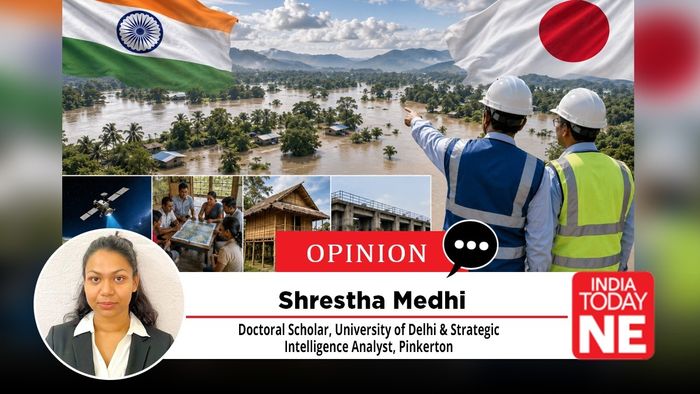
Every year, monsoon floods devastate Assam. This year, the Disang, Dikhow, and Jhanji rivers swelled after relentless rain in the Naga Hills, submerging homes across Sivasagar and Charaideo. Unregulated mining, weak drainage planning, and years of deforestation turned heavy rain into a humanitarian emergency again. Over 44,000 people sought shelter across 101 relief camps by late July. The Assam government has not been passive. It repaired embankments early, deployed drones and GIS mapping, and ran gender inclusive relief operations well before the floods peaked. This effort deserves recognition, but recognition alone will not stop the water. India needs a partner with proven engineering discipline in disaster science, and Japan is that partner, not a benefactor but an equal partner.
India’s bilateral relationship with Japan reflects a deep strategic alignment, as evidenced by the high-level diplomatic rapport displayed during the 16th India-Japan Annual Summit in New Delhi. The two nations signed their first joint defence co-development project during that summit, the Unicorn Naval Radio Antenna System, proving that India and Japan now build things together rather than one handing technology down to the other. Disaster management deserves the same equal footing. India’s National Disaster Management Authority (NDMA), Japan’s National Research Institute for Earth Science and Disaster Resilience (NIED) and Ministry of Land, Infrastructure, Transport and Tourism (MLIT) have expertise worth exchanging, and Assam is where that exchange should begin in earnest.
What Japan Actually Offers Assam
Japan remains the sole foreign partner permitted by India to participate in the strategic development of its sensitive Northeastern border region, and such a degree of bilateral trust is extended to no other sovereign nation. Since 1981, the Japan International Cooperation Agency (JICA) has financed more than 750 kilometres of road networks across the region, alongside foundational investments in energy, municipal water, and forestry management. This collaboration was formalised through the establishment of the India-Japan Act East Forum in 2017, providing an institutionalised mechanism for joint project identification. Extending this collaborative framework into predictive flood forecasting and climate-resilient infrastructure represents a logical evolution of the partnership. Practical avenues for bilateral cooperation include :
1. Co-Developing Real-Time Early Warning Systems: Researchers at the University of Tokyo built a real-time flood forecasting system that extended warning windows from a few hours to a full day. This was tested successfully during Typhoon Hagibis and Japan's own devastating floods. Notably, the system operates by optimising existing hydro-gauge data rather than requiring additional physical infrastructure. The steep catchment basins of Assam are highly susceptible to flash floods induced by localised cloudbursts and present an optimal empirical environment for deploying this model. But rather than acquiring this technology through traditional transfer mechanisms, India should pursue a co-development framework, building upon recent bilateral defence initiatives such as the joint development of the UNICORN naval communication antenna system to demonstrate functional parity.
2. Adapting Local-Level Preparedness Frameworks: Complementary insights also exist within community-level disaster risk reduction (DRR). Japanese municipal disaster management strategies emphasise household self-reliance, mandating the distribution of localised hazard maps and the maintenance of emergency supply stockpiles. In Assam, Village Disaster Management Committees (VDMCs) possess the organisational architecture to identify vulnerable populations but lack standardised emergency kits and cartographic resources. Adapting elements of the Japanese framework within local governance structures offers a path toward institutionalising grassroots resilience without reliant replication.
3. Blending Indigenous and Modern Engineering: Nothing captures the spirit of an equal partnership better than housing and structural engineering. The indigenous Chang Ghar, a stilt-supported bamboo housing structure developed by Assam's Mising community, demonstrates historical adaptability to seasonal inundation. Conversely, Japanese flood-resilient architecture utilises engineering solutions such as float-valve vents and hydrostatic pressure-resistant frames designed to withstand significant water depths. Assam can adopt an integrative strategy that would preserve the Chang Ghar framework for rural residential construction while adapting Japanese hydrostatic sealing technology for critical public infrastructure, including healthcare facilities, educational institutions, and emergency shelters. Such an approach synthesises localised traditional knowledge with advanced engineering to address shared environmental vulnerabilities.
Assam offers an optimal operational context to serve as the primary implementation site for the existing bilateral commitments, most notably the Joint Vision framework. To operationalise this objective, the Revenue and Disaster Management Department of the Government of Assam, in coordination with the National Disaster Management Authority (NDMA), should establish a state-specific track within the overarching India-Japan framework. Initial technical collaboration should prioritise the empirical testing of real-time flood forecasting systems along the affected river basins. Concurrently, a joint panel of Indian and Japanese structural engineers and architects should develop standardised design and certification protocols for hybrid Chang Ghar architectural models designated for public and emergency infrastructure. Rather than relying on unilateral assistance, this collaborative mechanism positions the region as a functional proving ground for the execution of the bilateral strategic partnership.
Given the recurrent vulnerabilities of the Brahmaputra basin, reactive post-disaster relief efforts must be complemented by preventive structural and predictive measures. Japan’s established engineering capacity and historical respect for Indian territorial sensitivity in the Northeastern region mitigate traditional geopolitical friction. The conversion of diplomatic alignment into proactive institutional resilience ultimately depends on coordinated policy execution by central and state authorities prior to subsequent monsoon cycles.
(The views expressed in this article are those of the author and do not necessarily reflect the views of India Today NE or its affiliates.)