Building Assam’s Blue Cluster Bioeconomy: Institutions, Compliance, and Global Opportunity
The global fragrance and flavour market is projected to grow about USD 30 billion to 47 billion by 2034 at CAGR of 4.82%, represents a pivotal moment with enormous potential for biodiversity rich states like Assam.
- Jun 26, 2026,
- Updated Jun 26, 2026, 2:49 PM IST
The global fragrance and flavour market is projected to grow about USD 30 billion to 47 billion by 2034 at CAGR of 4.82%, represents a pivotal moment with enormous potential for biodiversity-rich states like Assam.
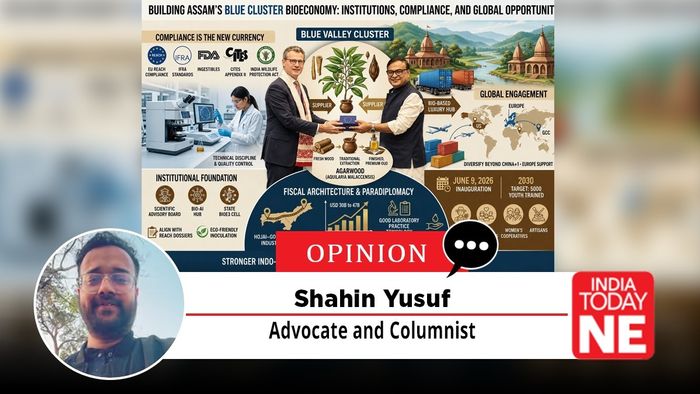
It was against this backdrop that Guwahati, on June 9, 2026, witnessed a pivotal moment with the inauguration of the Blue Valley Cluster by European Union Ambassador Hervé Delphin and Chief Minister Himanta Biswa Sarma.
The initiative spans fragrances, flavours, cosmetics, wellness, and AYUSH traditional health system. It seeks to make Assam a luxury bio-economy hub rather than a supplier of raw materials wherein European companies can work directly with the farmer supply chain without intermediaries. Delphin pledged Europe’s support for research, innovation, skills, investment, and marketing.
For decades, North East India was viewed from Delhi as a distant frontier, associated with security concerns, inhospitable terrain, and poor infrastructure. That narrative is, however, undergoing metamorphosis, with the region now positioned as part of India’s developmental and economic discourse.
The Market Reality: What Blue Valley Is Actually Entering
Paradiplomatic ambitions must be turned into a competitive, self-sustaining industry. This requires strict administration, technical discipline, and clear regulatory standards. The fragrance sector is highly structured and subject to scientific scrutiny. The European Union(EU) acts as the main regulator and gatekeeper as it shares lion’s share in the consumer market, Assam’s producers must master EU standards before gaining entry.
The flavour industry has three parts: savoury for processed foods, fruity for drinks and sweets, and cheese & dairy for foods, each with strict rules. Fragrances follow a note system: top notes like citrus, heart notes like rose and lavender, and base notes like sandalwood and musk, where Assam’s agarwood fits as premium. Raw materials come from agriculture, petrochemicals, and bio-fermentation.
Assam, blessed with biodiversity, holds the resources to build a sustainable ecosystem for both flavour and fragrance. Therefore, a partnership with farm-level economic analysis of costs, margins and export premiums should be accessed by the Horticulture and Agriculture department in the Industrial corridor.
Compliance is the New Currency
Here is the part of the Blue Valley story often overlooked in policy circles, and its omission has cost Indian fragrance companies dearly. In the United States, aroma chemicals face regulation by multiple agencies— Food and Drug Administration (FDA) for ingestibles, the Environmental Protection Agency (EPA) for environmental impact, Occupational Safety and Health Administration(OSHA) for workplace safety, and the Consumer Product Safety Commission for non-body products.
In Europe, Registration, Evaluation, Authorisation and Restriction of Chemicals (REACH) and International Fragrance Association ( IFRA standards) impose further compliance.
Most Indian firms lack FDA approval and compliance infrastructure, restricting global access. Since this is a science-driven, regulation-intensive industry, capital investment in certification is essential. Therefore, the compliance investment needs to be the centerpiece of Blue Valley’s fiscal strategy.
Assam’s current position
Aquilaria malaccensis (Agarwood) trade shows how Assam’s biodiversity wealth is trapped in a low-value cycle. Despite supplying most of India’s raw agarwood, the state captures less than 10% of the final value, while perfume hubs abroad multiply profits 8–12 times. To break this disparity, the Blue Valley Cluster proposes a Public-Private-People Partnership. This model brings together government, research institutions, industry, investors, farmer groups, tribal communities, women’s cooperatives, artisans, healers, and youth entrepreneurs.
By embedding local communities into the value chain, ensuring compliance with Appendix II of the Convention on International Trade in Endangered Species and India’s Wildlife Protection Act, and building processing capacity within Assam, the state can shift from raw material supplier to a globally competitive hub for finished oud perfumes and bio-based luxury products.
A Scientific Advisory Board
Chief Minister Sarma’s plan must begin with a Scientific Advisory Board to set product molecule roadmaps, align with REACH dossiers, and guide R&D. Assam must recruit global experts before opening Common Facility Centres, then build skills through apprenticeships. The State BioE3 Cell will drive policy, secure funding, establish a Bio-AI hub and Nano hubs for aroma chemistry, and support eco-friendly agarwood inoculation. By 2035, the program aims to train 45,000 youth, mobilize USD 1000 million into State resources. Further, the State Universities should prepare a syllabus on Fragrance, Perfumery and Aroma chemistry and play an intellectual backbone in the cluster.
FFDC, Kannauj as Mentor to Singimari Cluster
The Fragrance & Flavour Development Centre (FFDC) in Kannauj, under the Ministry of MSME, trains students in perfume formulation, essential oil technology, and aroma chemistry. Assam students can join these programmes and, on returning, they can be given access Common Facility Centre at Singimari free of cost for three years. With Startup India registration, they also gain tax exemptions and seed funding, making fragrance startups viable along with innovation grants, global mentorship with perfumers, toxicologist.
FFDC’s temple flower waste model gives Blue Valley a low-cost stream of marigold, lotus, rose, hibiscus, tuberose, and jasmine for fragrance notes. Scaling needs pesticide, microbial, and IFRA allergen checks, but offers Assam a distinctive, affordable commercial edge as it hosts numerous temples, naamghars and mazhaar.
The Fiscal Architecture
Assam can strengthen its fragrance and flavour industry by adopting fiscal tools used in Karnataka and Tamil Nadu playbook to attract Global Capability Centres and specialty chemical investment. The State Government could offer land subsidies, co-fund REACH dossier purchases, share Good Laboratory Practice toxicology costs, support IFRA compliance, and fast-track Biodiversity Board approvals.
Industrial corridors thrive when geography, raw material, and logistics converge. Anchoring distillation and trading units along the Hojai–Golaghat–Guwahati Corridor, with upgraded infrastructure and mentoring for traditional oil units, can catalyze growth. By embracing nature-based solutions, Assam can generate credits under the Gold Standard while aligning with India’s Carbon Credit Trading Scheme. These credits, in turn, can attract World Bank and ADB financing, linking rural incomes with climate resilience and global competitiveness.
Shaping Global Engagement
Global manufacturing is shifting due to geopolitics and supply chain disruptions, the multinational companies are working to diversify sources beyond traditional production centres and shift toward China+1 manufacturing strategies and Europe’s demand for sustainable bioeconomy products. This opens space for India to position itself as a reliable, sustainable alternative supplier.
For Blue Valley, it needs a solid legal foundation—ownership of resources, intellectual property, and traditional knowledge safeguarded under the Biological Diversity Act and the Nagoya Protocol. There shall be no commercial utilization of Assam’s biological resources should occur without a legally enforceable ‘Access and Benefit’ mechanism ensuring equitable returns to indigenous communities. Its true measure will be judged whether farmers, women, youth, and indigenous entrepreneurs capture high-margin wealth, safeguard heritage, and shape global engagements on their own terms—transforming ecological riches into enduring economic sovereignty.