Caring for Assam from afar: The difference between speaking up and showing up
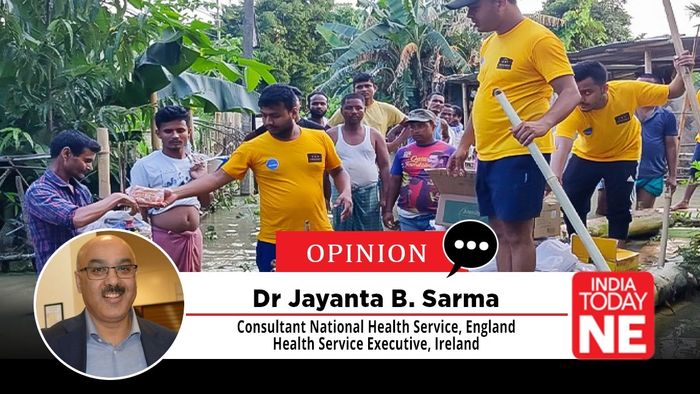
Recent conversations among Assamese people abroad during the Assam floods have raised a question about when speaking up becomes a substitute for doing something tangible. The piece examines how social media rewards expressive concern while asking what actually crosses from safety into consequence.
- Aug 02, 2026,
- Updated Aug 02, 2026, 7:00 PM IST
I've noticed some interesting conversations among Assamese people living abroad. I should be upfront: I'm one of them.
I live far from Assam. I talk about Assam. I write about what happens there. Sometimes, I post on Facebook about things I've been part of. I've also made some of my small donations public—not big enough to impress anyone, but just enough, I hoped, to show that I've done my bit. Maybe you can do yours too.
Whether that distinction exists anywhere except in my own mind is a question I cannot entirely answer. That is important, because this is not an essay about virtuous doers and hypocritical talkers. If that were the argument, I would immediately have to ask which category I belong to.
The question troubling me is different.
When does communication become part of action, and when does communication become a substitute for action?
Recent floods in Assam gave me two small specimens through which to examine the question.
They touched a nerve.
The epidemic that arrived in a conversation
In one diaspora discussion, somebody asked whether animal carcasses were being removed from flood-affected areas and whether people were being adequately informed.
A legitimate question.
Then came the answer: probably not yet.
Almost immediately, the conversation took on the confidence of an epidemiological briefing. There would be disease. Urinary tract infections were apparently "already" rising. Gastroenteritis and skin infections were concerns. Then dengue entered the discussion, followed by encephalomyelitis and malaria, with neighbouring Nagaland somehow making an appearance in the epidemiological geography.
Some of these are perfectly reasonable diseases to consider after flooding. That isn't what interested me.
What interested me was the transformation of uncertainty into knowledge.
How does somebody sitting in Britain know that urinary tract infections are "already" increasing among a particular flood-affected population in Assam? Perhaps there was surveillance information unavailable to me. Perhaps somebody on the ground had reported it. But none was offered.
Instead, professional vocabulary itself seemed gradually to establish authority.
That subtle transition is from expertise to epistemic authority without evidence.
This is especially noticeable among professionals living abroad. Doctors, scientists, engineers, and academics have real expertise in their fields. But on social media, it's easy for that authority to shift. A scientist can suddenly sound like an expert in epidemics, disaster management, water issues, or public policy—not always out of arrogance, but because using professional words can make regular concern sound like expert advice.
Being far away brings another strange advantage.
The person living through a flood encounters realities: the road is submerged; drinking water is contaminated; a cow has died; medicines are running out; the health worker cannot reach a village.
The person thousands of miles away encounters something much more manageable:
"The Assam floods."
The lived event has become a conceptual object.
And conceptual objects are wonderfully easy to solve.
The farther one is from the operational problem, the easier the solution can appear.
The person on the ground sees constraints. The distant observer sees deficiencies.
Someone should remove the carcasses. Government should warn people. Health authorities should monitor infections. Mosquitoes must be controlled. Clean water must be supplied.
Quite possibly all true.
But somebody else must do all of it.
There is a phrase for the peculiar position this can create: responsibility without burden.
You get to feel like a responsible citizen without actually taking on the real work that usually comes with it.
And yet I hesitate to call this hypocrisy.
The concern may be entirely sincere.
That is precisely why the phenomenon interests me.
When concern does something for the concerned
Diasporic concern performs several functions even before it does anything for the homeland.
Talking about Assam is one way of continuing to belong to Assam.
For somebody who has lived away for years or decades, Assam is no longer the environment in which every inconvenience must actually be negotiated. Yet it remains part of identity. A flood, political controversy, cultural dispute, or tragedy suddenly activates that sense of belonging.
So, caring about Assam becomes a way to hold on to your identity.
There is also helplessness.
When something happens far away in a place you still care about, there's often not much you can do right away. Feeling helpless is hard. Analysing the situation helps you feel in control again.
We diagnose.
We recommend.
We tell institutions what they ought to do.
We tell Assamese society what it has forgotten.
We identify failures.
Something important happens for us, even if nothing changes in Assam.
Which leads to an uncomfortable proposition:
A conversation can be functionally useless to the people being discussed while psychologically useful to the people having it.
That does not make the participants bad people.
Diaspora concern can be a way to keep our identity, manage our worries, and feel like we're taking action—even if we're not.
And social media has built an extraordinarily efficient machine around all three.
The social reward arrives first.
A second example clarified the mechanism.
Another member of the scientific diaspora in America posted repeatedly about the floods. There was anguish. There were appeals to political leaders. Assamese people were urged to act. The global Assamese community should mobilise. Books, notebooks, pens and clothes could be collected for affected children. Educational institutions could coordinate. The government could provide a common platform.
One post attracted thousands of reactions, comments, and shares.
Again, none of these suggestions is objectionable. Some are admirable ideas.
But I found myself asking a systems question:
Where does the output go?
Consider the first loop:
Flood → distressing information → diaspora concern → Facebook post → likes/shares/comments → emotional reinforcement → another post.
It's a very efficient feedback loop.
Everyone receives something.
The author receives recognition and reinforcement.
Readers receive an opportunity to express solidarity.
Commenters affirm shared concern.
The diaspora briefly experiences itself as a morally mobilised community.
There is only one possible omission.
Assam can remain outside the loop.
For Assam to enter it, something must cross a boundary:
Facebook mobilisation → money/materials/expertise → identifiable recipient → delivery → measurable consequence.
Or perhaps:
Professional expertise → verified problem → responsible institution → useful intervention.
Then the system has produced an output beyond itself.
This is the distinction between expressive concern and instrumental concern.
Expressive concern says:
This matters to me.
Instrumental concern asks:
What can I cause to happen?
Social media is extraordinarily good at rewarding the first while allowing it to feel like the second.
This means being seen online can become separate from actually being useful.
That does not require conscious virtue signalling. Indeed, "virtue signalling" has become such an easy accusation that it explains almost nothing. People respond to reinforcement. If eloquent expressions of concern repeatedly generate thousands of approving reactions, the environment itself teaches us what behaviour is rewarded.
On social media, what gets rewarded is the statement itself, not what actually happens.
Someone can write tonight:
Let us rebuild the lives of our flood-affected children.
The applause can arrive before bedtime.
Actually helping twenty children requires identifying them, determining what they need, finding reliable people locally, raising money, purchasing materials, transporting them, maintaining accounts, discovering that some of one's assumptions were wrong, correcting mistakes, and perhaps receiving no applause whatsoever.
This leads to one of the oddest things about social media and morality:
The praise can come before any real work even starts.
Are we ants—or are we watching the ants?
Then came an Assamese proverb.
মাউখে উঠিলে গুটি পৰুৱাৰো মৰণ নাই।
Its invocation stopped me.
It is a beautiful expression of collective survival. When everyone rises together, even the tiny ant need not perish.
But suddenly I wondered:
When a diasporic speaker invokes the proverb, does he imagine himself as one of the ants—or is he looking at the rest of the ants?
I do not know the answer. Nor do I need to know what any particular individual privately contributes. Someone who posts prolifically may also quietly donate a fortune. To infer otherwise would be unfair.
But the uncertainty is what interests me most.
If I genuinely understand myself as one of the ants, certain questions follow naturally:
What can I carry?
Whom can I lift?
What is my share of the burden?
But from outside the anthill, the questions subtly change.
Why aren't the ants organised?
Government should organise them.
Educational institutions should lead.
The global Assamese community must come together.
And during all this, people still use the word we.
That is one of the peculiarities of diasporic moral discourse: Grammatical inclusion can coexist with operational distance.
Emotionally, one remains inside the anthill.
Operationally, one may be standing safely on the riverbank.
There is nothing inherently dishonourable about the riverbank. Quite the contrary. The person there may possess money, safety, professional connections, international networks, institutional access, and time that those struggling in the water do not.
Distance itself can become a resource.
The problem begins elsewhere: The difficulty arises when the riverbank is mistaken for the mound.
Perhaps the more honest diasporic position is: I am not one of the ants in the immediate sense. I am safe. Precisely because I am safe, I may possess something useful. Let me see what I can send across.
Now, being far away is no longer about sharing the same risks. It becomes a real advantage.
My own small grain
At this point I have to turn the microscope around.
Why does all this irritate me?
Am I merely another commentator irritated by other commentators?
Possibly.
I too write about Assam from afar. I too have opinions about what institutions should do. I too post on Facebook. I sometimes mention work I participate in collectively, including initiatives through organisations such as the Assam Healthcare Cooperative Society.
I have also publicly disclosed some small donations.
Even that can be a kind of performance.
I cannot declare my own motives pure while examining everybody else's motives sceptically.
But I know what I have been trying, however imperfectly, to express.
I have never believed in my ability to change Assam.
The idea itself feels too big.
I can contribute something. On my next visit, I can do my very small bit on the ground, alongside others trying to rebuild lives. I can offer professional knowledge where it is useful. I can contribute what I can within my means. Through collective organisations, my small contribution may become more consequential.
But I cannot mistake contribution for capacity.
There is an Assamese formulation that captures my philosophy far better than any vocabulary of activism: সকলোৰে কল্যাণৰ কাৰণে সাৰ্বজনীন দুৰ্গা পূজাত নিৰ্মালি দিব পাৰোঁ, কিন্তু পূজাভাগ পাতিবলৈ অপাৰগ।
I can offer my নিৰ্মালি to a community Durga Puja undertaken for everyone's welfare.
I am unable to organise the পূজাভাগ.
There is no humiliation in that distinction.
There's a sense of balance.
The নিৰ্মালি does not become meaningless because it is small. Nor does offering it confer ownership of the Puja.
Maybe this is what I've been trying to say.
I know the difference between contributing to something and solving it.
The seduction of the পূজাভাগ
Social media makes that distinction unusually difficult to maintain.
Performance lets us feel like we're doing something big, even if what we can really do is much smaller.
The text box places everybody on the same stage.
The person donating £20 can announce a reconstruction programme.
The professor thousands of miles away can prescribe administrative reform.
The scientist can diagnose an epidemic.
The commentator can reorganise disaster management.
And I can write an essay about all of them.
That's why it's hard to find a comfortable place outside this debate.
The problem is not that people talk.
Speech itself can be action. Accurate information can save lives. Advocacy can change policy. A Facebook post can raise substantial money. Professional advice can prevent an error. Publicising one's own modest contribution can persuade ten others to contribute theirs.
The relevant question therefore cannot be: Did you post about it?
Nor even: How much did you donate?
A big public donation can turn into another way to show off. A small act can sometimes make a big difference.
The better question is:
What crossed the boundary between concern and consequence?
Money? Materials? Time? Knowledge? Labour?
A useful introduction? An accurate warning? A changed decision? A box of notebooks? A pair of hands?
In the end, something real has to move from the safe place to where it's needed.
What did I actually carry?
Perhaps that is why the proverb continues to trouble me.
মাউখে উঠিলে গুটি পৰুৱাৰো মৰণ নাই।
The ant does not have to save the anthill.
It does not need a strategic plan for Assam.
It does not have to demonstrate the depth of its anguish.
It carries what it can.
And perhaps the question should therefore never have been, 'What are these diaspora commentators actually doing?'
That question is too easy because it lets us focus on others instead of ourselves.
The more difficult question is:
What did I actually carry?
Not how much.
Not whether anybody noticed.
Not whether my contribution was worthy of Facebook.
Not whether I cared more deeply than somebody else.
Perhaps I carried only a grain.
Maybe that's enough.
Because মাউখে উঠিলে গুটি পৰুৱাৰো মৰণ নাই only makes sense if none of us imagines himself standing above the anthill directing the ants.
Talk. Care. Criticise. Advise. Organise. Donate. Persuade. Mobilise. There's space for all of it.
But we should maintain a reasonable balance between what we say we are doing and what we are actually capable of doing.
I can offer my নিৰ্মালি.
I cannot conduct the পূজাভাগ.
And when the water rises, perhaps solidarity begins with an even smaller admission:
I cannot save the anthill. But I can carry my grain.
(Author's Note: Each essay begins with a question, observation, experience or public event worth examining beyond its immediate controversy. I determine the argument, structure and final prose, drawing on professional experience and research. I use AI as an editorial collaborator to research, develop structure, clarify, draft and edit until a piece accurately reflects my thinking and intent. The final wording and responsibility remain mine.)