Communicating Layoff Episode: Optics Vs Reality
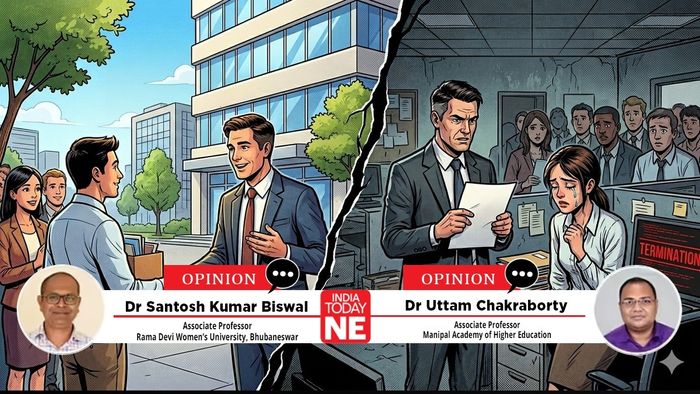
What if layoffs aren’t just economic corrections, but carefully staged performances designed to signal power, control, and efficiency to the world? Beneath the language of “realignment” lies a deeper shift—one that quietly redefines who holds power, what work truly matters, and where the future of employment is headed.
- Apr 03, 2026,
- Updated Apr 03, 2026, 3:03 PM IST
A layoff often arrives wrapped in cold, impersonal corporate communication, an abrupt end to what once felt stable. Yet, as Alexander Graham Bell reminds us, when one door closes, another opens. In that difficult moment, it helps to remember Albert Einstein’s insight that “in the middle of difficulty lies opportunity.” Even Bill Gates has, at times, reframed major life transitions as a kind of “early retirement,” hinting that unexpected pauses can create space for reinvention. What feels like an ending may quietly be the start of something more aligned, meaningful and new.
From a communication perspective, how a layoff is conveyed matters just as much as the decision itself. Transparent, empathetic, and timely messaging can preserve dignity and trust, even in difficult circumstances, whereas abrupt and impersonal language often deepens the sense of loss. Organisations that communicate with clarity and compassion not only support those affected but also reinforce credibility with those who remain.
The most recent cycle of layoffs, whether by Oracle or any of the giants like Google, Amazon, or Meta, is being packaged to us in the same way: strategic realignment, cost optimisation, and future readiness. These lines are refined, nearly unavoidable. However, remove the jargon and what you are left with is much less graceful. Firms are fixing the excesses that were generated during a period of easy money and uncontrolled growth. However, this is not the place to stop this explanation. This is not just an economic adjustment that we are witnessing; it is something much more performative and systemic.
Efficiency or Performance
In the current financial ecosystem, layoffs are not only internal decisions anymore, but they are based on performance. Companies are not merely becoming efficient; they are telling investors that they are efficient. Markets compensate for visible action, as opposed to thoughtful strategy. The stock of a company that makes an announcement of thousands of layoffs often increases, rather than decreases. This establishes a sick incentive system in which layoffs become a quick fix for punishment. In this light, layoffs have become a form of corporate theatre- very visible performances that are meant to appease shareholders that the management is in charge, regardless of the long-term outcomes.
The Global Background
In order to comprehend the present, it is necessary to refer to the post-pandemic boom. Capital was cheap and plentiful, with interest rates at historic lows. Technology companies were growing aggressively, and the rate at which they were employing was based on the assumption that they would never stop growing. Roles were developed not necessarily because they were needed, but because of strategic anxiety, hire before the competitors can. This growth is now excessive, given the tightening of monetary conditions. The tide has receded, and structural inefficiencies are now exposed that were once camouflaged by growth. As Warren Buffett once remarked, it is only when things become tight that one sees the cracks in the wall. The layoffs being carried out today in most parts are actually the delayed outcome of the over-excitement of yesterday.
The Paradox of Talent Power
Layoffs in the South-Asian context have a more fundamental asymmetry. The South-Asian countries are touted as a talent powerhouse in the world, with millions of skilled workers and the engine of the digital economy. However, when multinational companies reorganise, South Asian workers are the ones to suffer the brunt of the blow. The work does not vanish, just the positions do. This is a form of structural imbalance. The countries are supplying execution but not control. The major strategic choices are being made in remote headquarters, and the local talent is still exposed to global realignments. What ensues is a paradox where South-Asian countries are indispensable, but not influential enough to protect themselves against volatility.
The Real Motive
This is where the unpleasant yet important point of view is located. Layoffs nowadays are not only about saving money. They have to do with a managerial takeover. Remote work, increased wages, and increased mobility put employees in a position of unequalled power during the pandemic, turning the balance of power. In most instances, organisations were not able to adjust. Layoffs are currently serving as a reset button, bringing back order and structure. It is not so much about economic need but a cultural re-tuning. Essentially, businesses are not merely cutting the budgets; they are re-authorising power.
The AI Myth
Artificial intelligence has frequently been placed as the main cause of job losses, yet this justification fails to pass the test. The vast majority of layoffs are not a replacement of engineers with algorithms; rather, it is the removal of management levels and vague positions. At this point, AI is not a replacement force but rather an augmenting force. The actual problem is in the organisational design- decades of growth resulted in redundancies, the lack of roles, and bloated hierarchies. AI is a convenient story, yet the bigger issue is structural inefficiency, rather than the disruption of technology.
A Crisis of Meaning
In addition to economics and strategy, there is another deeper problem when it comes to layoffs, which is a crisis of meaning in contemporary work. Most of the positions that appeared to be necessary are under scrutiny. These were the jobs that made calendars, made presentations and kept a corporate routine, but the actual effect of the work was less obvious. Layoffs are compelling organisations to face an ugly reality: not everything that seems significant is so. It is not a business correction; it is an existential correction of what value actually is in modern organisations.
In the future, there are three trends that are emerging. Firstly, the companies will shift to a leaner core, which will be based on contractual and flexible talent. Secondly, the concept of a safe corporate job will keep on wearing out; employability will take precedence over employment. Thirdly, South-Asian countries are at a crossroads, either to be a cost-efficient execution centre or become a centre of strategic decision-making. Its course of action will make or break it, so that it starts absorbing shocks or starts shaping the outcomes.
The Cycle We Refuse to Break
Firing is not a new phenomenon. It is a cycle that repeats over time: Hire aggressively, expand fast, panic under pressure and then cut to the bone. The novelty, however, is that this cycle has become normalised as a strategic virtue. Efficiency is no longer about intelligent optimisation, but rather it is about action that is visible. This cycle will continue to exist until organisations are able to strike a balance between efficiency and stability, and between discipline and humanity. What is now termed as restructuring might actually be an expression of a more underlying failure to come up with resilient and meaningful systems of work.