Corrupt Leadership: Losing Ground Support
When those sworn to fight for the people begin to resemble the powers they once resisted, who really holds the moral ground—and for how long? As trust erodes and patience thins, a silent question gathers force: will the people continue to be the “water,” or will they finally choose to reshape the tide themselves?
- Mar 31, 2026,
- Updated Mar 31, 2026, 3:25 PM IST
Mao Tse-Tung famously compared guerrilla fighters to fish and the people to water, signifying that a revolutionary army can only survive and thrive with the support of the local population. This analogy, often phrased as “the guerrilla must move amongst the people as a fish swims in the sea,” emphasises that the population provides the “water” for sustenance and protection. Mao noted that only disciplined troops can exist in this environment; if troops make the people their enemy, they become like fish out of water. This philosophy highlights the strategic focus on winning the hearts and minds of the people rather than merely winning battles.
Che Guevara, a key figure in the Cuban Revolution, is known for his quote: “I am not a liberator. Liberators do not exist. The people liberate themselves.” These ideas resonate today in the Naga regions, especially amid the social churning that Tangkhuls in Ukhrul district are currently experiencing.
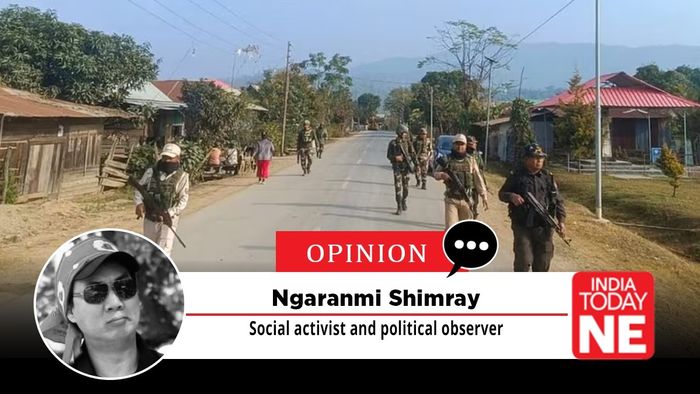
Currently, with the taxation of commercial vehicles by Kukis on the Imphal–Ukhrul highway, passenger vehicles are preferring the nine-hour journey on safer roads rather than risking kidnapping by Kuki militants. At the same time, Sinakeithei Tangkhul village is facing a siege by surrounding Kuki villages and militants, and the morale of the Tangkhuls is at its lowest. This was followed by reports of internecine killings of four Eastern Flank fighters, who were gunned down at point-blank range by NSCN cadres. The conflict reportedly arose over control of cross-border smuggling, allegedly benefiting certain influential individuals who denied involvement, even as an NSCN commander claimed he had been ordered by higher authorities to carry out the shooting.
Social media is a powerful force. It played a significant role in the Arab Spring. The 2010–2011 Tunisian Revolution, also known as the Jasmine Revolution, began with Mohamed Bouazizi’s self-immolation in December 2010 in protest against police brutality, unemployment, and corruption. Nationwide protests, supported by labor unions, forced President Zine El Abidine Ben Ali to flee to Saudi Arabia on January 14, 2011, after 23 years in power. Similar to the Tunisian uprising, several global events have involved mass protests against authoritarianism, corruption, and economic hardship.
There is one key similarity between these events and the ongoing churning in Ukhrul district: corruption among leaders who, as freedom fighters, are not expected to indulge in self-enrichment. Unlike elected representatives, who are often perceived as recouping election expenses and preparing for future campaigns, freedom fighters are held to a different moral standard. However, since the 1997 ceasefire, many within the movement and their extended networks appear to have adopted similar practices, enriching themselves and encroaching upon domains once dominated by politicians.
After nearly three decades of influence over contracts and supplies, they have accumulated significant power. Any deal involving money rarely escapes their attention. The problem has deepened as they, along with their families, increasingly display their wealth publicly, changing public perception about their involvement in corrupt practices. Lavish weddings rivaling or exceeding those of politicians have become more common. This raises an obvious question: where does the money come from?
The public may tolerate corruption among elected representatives, but freedom fighters are viewed differently. They are seen as individuals who sacrificed comfort and safety for a larger cause. This perception earns them respect and admiration. However, when they are seen engaged in corrupt practices or flaunting wealth, their standing in society diminishes. This contrast is further highlighted by the common observation that privately owned high-end SUVs are often associated either with politicians or senior members of such groups.
People openly discuss the business interests of various leaders and the educational institutions their children attend. Allegations of involvement in cross-border trade and smuggling are widely circulated. It is this perception that led to immediate speculation about who might have ordered the killing of the Eastern Flank fighters. Although denials have been issued, suspicion persists. Increasingly, these leaders are known less for their cause and more for their ability to influence contracts and outcomes.
There was a time when freedom fighters in Naga areas were widely respected for their sacrifices. However, as Bob Dylan observed in his song “The Times They Are a-Changin’,” times do not remain static.
Released in 1964, the song is an anthem declaring that societal and political change is inevitable, urging people to adapt or be left behind. Its message, that the old order is fading and a new one is emerging, is particularly relevant today. The line “you better start swimmin’ or you’ll sink like a stone” underscores the consequences of resisting change.
This is where civil society voices, such as the Concerned Naga Forum, have begun articulating what many ordinary Nagas feel: that the time for prolonged deliberation has passed, and the time for decisive action has arrived. Extortion has become intolerable, and the prevailing environment discourages young, educated individuals from pursuing entrepreneurial ambitions. There is a growing demand to conclude the peace talks and move forward, to the extent of hinting that each state has its own distinct challenges, and the focus should now shift toward addressing these with the central government. For the Nagas of Manipur, some argue that a separate state could address concerns about land security, reduce tensions with Meitei groups, and mitigate conflicts involving Kukis.
With earlier demands such as integration and sovereignty having been widely debated, there is increasing skepticism about whether issues like a separate flag and constitution remain genuine priorities. Critics argue that prolonging negotiations may serve the interests of those benefiting from the status quo. The people are no longer swayed by euphemisms and want concerted, tangible settlements. The fish may have no water to swim in if talks are not concluded soon, and the people may decide to liberate themselves as their patience runs out.
The killing of the four Eastern Flank fighters, reportedly driven by greed, has further shaken public confidence. For many, it has been a moment of clarity. There is now a growing sentiment that the public must push peace negotiators toward concrete, state-specific solutions. For some, this includes the demand for a separate state for the Nagas of Manipur, as this route will obviate the longstanding political and security concerns for all three communities: Nagas, Meiteis, and Kukis to be considered simultaneously.