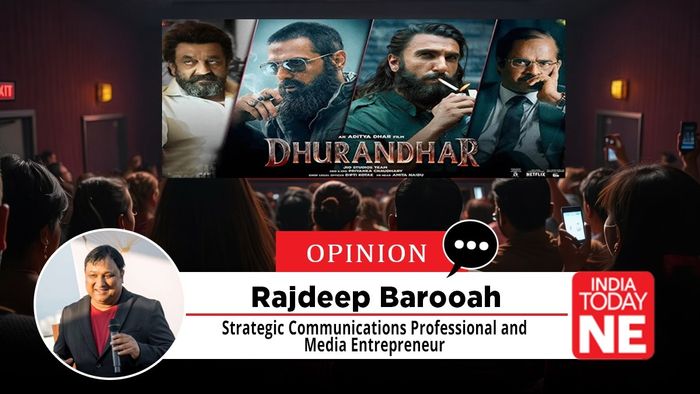
Dhurandhar: The Revenge Brings Long-Form Storytelling Back With a Vengeance
Being in the media business, I grew up on a simple, enduring belief — Content is King. It was instinctive. If the story was strong, audiences would come, stay, and engage.
- Apr 04, 2026,
- Updated Apr 04, 2026, 2:36 PM IST
Being in the media business, I grew up on a simple, enduring belief — Content is King. It was instinctive. If the story was strong, audiences would come, stay, and engage.
Then came the digital age — the era of YouTube, Netflix, content on the go, and an overwhelming abundance of choices.
And as it evolved into what we now call the “reel age”, a new belief began to take shape — that patience was fading, especially among younger audiences. That content had to be shorter, sharper, and almost instant to survive. Endless scrolling became the norm, and attention was measured in seconds. Like many others in the industry, I too began to believe that perhaps attention spans were shrinking — and with it, the appetite for long-form storytelling.
And then came Dhurandhar: The Revenge. For nearly four hours, nobody scrolled.
Translated into today’s content viewing parameters — that’s close to 14,000 seconds of uninterrupted attention.Nobody switched. If anything, audiences sat through, absorbed every moment — and many came out wanting more.
That, in itself, tells a story.
True to its name, The Revenge feels less like a sequel and more like a statement — a quiet but firm pushback against the idea that depth no longer works. A subtle reclaiming of storytelling that values immersion over immediacy.
Even the name “Dhurandhar” carries weight. In Hindi, it refers to someone formidable — a master of their craft, powerful and dominant in their domain. And in many ways, the film lives up to that very definition.
It doesn’t rush.
It doesn’t dilute.
It doesn’t seek shortcuts.
Instead, it stands firm — confident in its storytelling, expansive in its vision, and unapologetic in its scale.
What we are witnessing is not merely box office success; it is a powerful contradiction of a widely accepted assumption. With Dhurandhar: The Revenge nearing the Rs 1500 crore mark worldwide (as this opinion piece is being penned), it has firmly established itself as a phenomenon.
But beyond the numbers lies an even more compelling insight.
A runtime of nearly 4 hours.
Four hours — in an era defined by seconds.
And yet, audiences showed up. They stayed. They engaged.
Which brings us to the heart of the matter.
It was never that patience disappeared.
It was only that truly good, relatable content had become a scarce commodity in what we call Bollywood — often caught in safe, set formulas.
It shows that audiences today are willing to invest time — but on content that truly deserves it.
This is where the age-old adage — Content is King — reasserts itself. Not as a cliché, but as a contemporary truth.
Dhurandhar: The Revenge succeeds because it respects its audience. It offers scale without losing substance, emotion without excess, and patriotism that feels authentic rather than imposed. It does not demand attention; it earns patience.
For those of us in the business of creating and shaping content, this is both reassuring and instructive.
In adapting to changing consumption habits, we may have overemphasised brevity, assuming it to be the only path to engagement. But the success of Dhurandhar: The Revenge suggests otherwise. When content connects, time becomes secondary.
Good content does not chase attention.
It commands patience.
Credit must go to Aditya Dhar for backing conviction over convention, and for trusting that audiences would respond to substance over speed.
For communicators, marketers, and storytellers alike, this is more than a cinematic milestone. It is a quiet but powerful reminder — that while formats evolve, the fundamentals endure.
Content was king then.
Content is king now.
And if you’ve read this article till the end, I know one thing for sure — the content worked. And that would have taken you about three minutes — another proof that good content still holds attention. (Just joking 🙂)
(The author is Managing Director at Project F Enterprise, a Mumbai-based media consultancy firm with operations spanning Assam and the Northeast)