Didactic Learning versus Student-Centred Learning: Classroom reflections from Geography and Logic Teaching at Cotton University
On 10 January 2026, Professor Suren Talukder of Cotton College (now Cotton University) celebrated his 83rd birthday. Another teacher who shaped my years at Cotton was the late Professor Animesh Medhi. Today, I find myself thinking of both of them, of their clarity, their discipline, and their mastery of the didactic approach to teaching. Their methods are especially relevant now, as debates among educators and policymakers intensify over which model best serves students: traditional didactic learning or student-centred learning.
- Feb 01, 2026,
- Updated Feb 01, 2026, 4:15 PM IST
On 10 January 2026, Professor Suren Talukder of Cotton College (now Cotton University) celebrated his 83rd birthday. Another teacher who shaped my years at Cotton was the late Professor Animesh Medhi. Today, I find myself thinking of both of them, of their clarity, their discipline, and their mastery of the didactic approach to teaching. Their methods are especially relevant now, as debates among educators and policymakers intensify over which model best serves students: traditional didactic learning or student-centred learning.
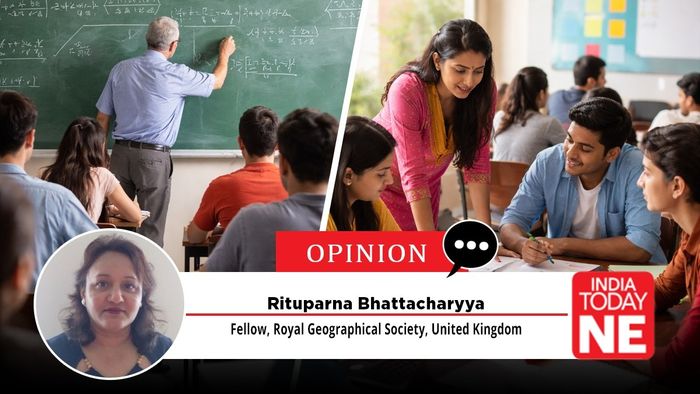
Didactic learning is a traditional, teacher-centred method in which the teacher serves as the primary source of knowledge. Lessons are carefully structured; content is delivered directly through lectures or demonstrations; and students primarily receive information passively. Its strengths lie in clarity, efficiency, and systematic coverage of complex material, especially when time is limited or foundational concepts must be firmly established.
This approach was well illustrated in Suren Talukder Sir’s Cartography lessons and in courses in undergraduate Geography. Both Cartography and Statistics require precision, demanding a high level of technical accuracy: understanding map projections, scales, symbols, and coordinate systems leaves little room for ambiguity. Talukder Sir typically explained concepts step by step on the board, demonstrated map-drawing techniques, and worked through examples while students followed closely and took notes. For instance, when teaching scale conversion, Talukder Sir would walk the class through multiple worked examples, demonstrating how to convert a representative fraction into a verbal scale or how to adjust the scale when enlarging or reducing a map. Students copied the steps, practised them repeatedly, and internalised the logic through repetition and clarity. Although the classroom dynamic was teacher-centred, the learning outcomes were strong: students developed confidence in technical tasks requiring precision and discipline.
In a subject like cartography, where errors can distort spatial understanding, Talukder Sir’s didactic approach ensured conceptual stability before students moved on to more interpretive or analytical tasks. His teaching exemplifies how didactic methods can be not only effective but necessary in certain domains. Such structured delivery ensures that all learners acquire the same technical foundations before proceeding to application.
At the 10+2 level, logic often serves as students’ first formal encounter with structured reasoning. Concepts such as propositions, truth tables, syllogisms, and fallacies can be abstract and intimidating. In this setting, Animesh Medhi Sir’s didactic teaching style provided students with a firm intellectual anchor. With limited access to literature in philosophy and logic during our time in the late 1980s and early 1990s, and no access to the internet, Medhi Sir, without a microphone, would walk between the rows from the back of the room (packed with more than 200 students) to the front, dictating notes on various topics of logic. His clarity and control of pace were crucial for ensuring students grasped abstract principles efficiently.
However, didactic learning also has limitations. Because students primarily listen and observe, opportunities for independent thinking, discussion, and exploration may be reduced. Research indicates that this method can foster passive learning and place less emphasis on higher-order skills, such as critical thinking and problem-solving.
In contrast, student-centred learning shifts the focus from teacher to learner. Students actively participate through discussion, projects, collaboration, and inquiry. The teacher acts more as a facilitator than a lecturer, encouraging learners to take responsibility for their education. This approach promotes deeper understanding, confidence, and critical thinking by connecting learning to real-world contexts and peer interaction.
While student-centred strategies are powerful for developing analytical and collaborative skills, they can be time-consuming and require highly skilled facilitation. They may also be challenging to implement when students first need strong conceptual grounding.
In practice, effective teaching often lies in balance. The didactic methods used by Suren Talukder Sir and Animesh Medhi Sir demonstrate that teacher-centred instruction remains invaluable for building core competencies in technical subjects such as Cartography and Logic. Once these foundations are secure, integrating student-centred activities, such as map interpretation projects or group logical problem-solving, can further enrich learning.
Ultimately, neither approach is inherently superior. Didactic learning provides structure and clarity, and student-centred learning nurtures independence and critical thought. Thoughtful blending of both allows educators to meet curricular demands while also preparing students for lifelong learning.