From Bandhs to the Tiranga: A New Dawn in North-East India
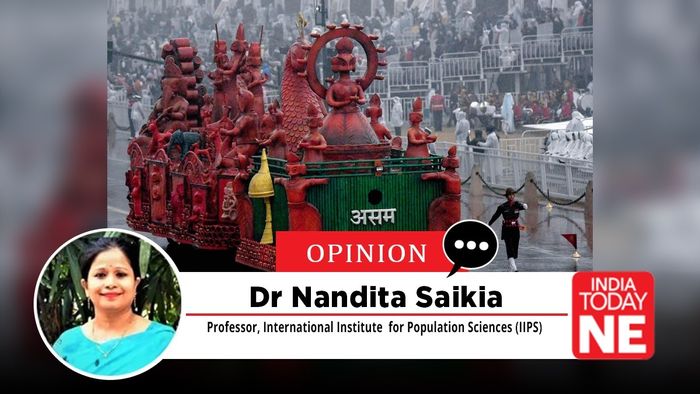
As India celebrates its 77th Republic Day in 2026, an atmosphere of happiness and festivity is felt across the country—from north to south and east to west. In the last week, I was travelling through rural Tripura and Assam, two North-Eastern states of India, where I observed that Indian flags were already being sold and people were actively preparing for Republic Day celebrations in a joyful mood.
- Jan 26, 2026,
- Updated Jan 26, 2026, 3:04 PM IST
As India celebrates its 77th Republic Day in 2026, an atmosphere of happiness and festivity is felt across the country—from north to south and east to west. In the last week, I was travelling through rural Tripura and Assam, two North-Eastern states of India, where I observed that Indian flags were already being sold and people were actively preparing for Republic Day celebrations in a joyful mood.
On this special occasion, people from North-East India are uploading patriotic songs, dances, and similar programmes on social media and organising events in schools, colleges, residential societies, village neighbourhoods, and even in the most remote parts of the country.
However, this was not the same environment earlier in this region of India.
Today, after the flag-hoisting programme in Mumbai, a flood of old memories came back to me. As a child of the 1990s raised in Assam, I grew up during a time when insurgency demanding separate countries was at its peak in almost all North-Eastern states of India. As a school-going child, I remember that on almost every Republic Day or Independence Day, at least 30 or more organisations would call for an “Assam Bandh.” People would remain indoors due to fear of bomb blasts or arbitrary arrests by army personnel. Bomb blasts, abductions, and extortion were common during those days. Although government offices remained officially open, employees often chose not to go due to uncertainty, lack of transportation, and an overall atmosphere of fear. Carrying the Tiranga with pride in these states was almost non-existent at that time. Instead, people were filled with questions such as: “Are we really part of India? Is our Assamese or Naga identity more important than our Indian identity?”
Naturally, the question arises: Why was it so? Why did many North-Eastern Indians deny their association with India for decades?
Also Read: Bhagawad Gita and a life with happiness, success and full of purpose
In my understanding, the problem was twofold.
First, until recently, there was systemic neglect of these states by the central leadership. Even today, it is common to find Indians who do not know the names or major cities of North-Eastern states. Beyond Kolkata, many believe everything is Nepal. When I first came to Mumbai 20 years ago, some people even joked that everything beyond Kolkata belonged to China. These states were poorly connected by roads and railways. For instance, the bi-weekly train journey from Guwahati to Mumbai officially took around 54 hours, but delays often extended it to 64 hours.
The diverse cultures and peoples of these states were barely mentioned in school textbooks, rarely featured on the tourist map despite immense heritage and natural beauty, and largely absent from the national narrative. Most importantly, an inclusive vision from political leadership at the centre was missing—evident in issues such as unchecked illegal infiltration and the unresolved border dispute between India and China since 1962.
Second, a carefully crafted narrative was propagated by a small group of so-called intellectuals claiming that the North-East was never historically part of India because it was not under Mughal rule, and therefore had the right to be a separate country. These narratives were meticulously promoted by intellectual terrorists aligned with actual insurgent groups. They frequently portrayed Bharatiya Sanskriti as regressive, attacking Hindu scriptures, rituals, and festivals without any genuine study or understanding of the Bharatiya Guru-Parampara system. Under this narrative framework, Bharat itself was depicted as a coloniser.
However, in recent years, I see a clear wave of change. Insurgency has significantly declined, and North-Eastern states are increasingly taking centre stage in national discourse. During his tenure as Prime Minister, Narendra Modi has visited the North-East more than 60 times for conflict resolution, infrastructure development, and electoral rallies—a record unmatched by any previous Prime Minister. Beyond visits, he has actively carried North-Eastern culture to the rest of the country by wearing the Assamese gamocha and repeatedly referring to the region as “Ashtalakshmi in the Ishan Disha” during his Mann Ki Baat speeches. Road and rail connectivity, even in rural and border areas, has improved tremendously.
Economic investment and tourist arrivals are increasing at a faster pace. Except for Manipur, most states in the region are politically stable and peaceful, with strong hope for further progress. Most importantly, people are increasingly feeling integrated with the rest of India—a reality clearly visible during Republic Day and Independence Day celebrations in recent years.
The narrative that North-Eastern states were not part of India is also gradually weakening, largely due to the rise of social media. This narrative was deliberately propagated to fragment India with the help of external forces. During the era of print and limited electronic media, voices with anti-India sentiments dominated public space through powerful intellectual ecosystems, while truth-based perspectives were marginalised.
The digital revolution has changed this. Social media has allowed people to revisit traditions, customs, local histories, and cultural connections between the North-East and the rest of India. People are now rediscovering that the entire North-East has deep Sanatan roots, dating back to the time of the Mahabharata.
While it is true that these regions were not ruled by a single emperor based in mainland India, historically, linguistically, culturally, and geographically—regions once known in Mahabharata time as Pragjyotishpur, Kamrup, or Manipuram—they have always been part of the broader Sanatan civilisation. There is abundant archaeological, scriptural, and cultural evidence supporting this. At the same time, migrants from Southeast and Central Asia found homes in these regions and lived peacefully while preserving their own traditions. Alongside this historical foundation, India’s recent economic and welfare policies are enabling common people in the North-East to take pride in their Indian identity.
As India dreams of becoming “Viksit Bharat” by its centenary year, it is essential to remember those days of uncertainty and confusion. These stories must be told repeatedly to younger generations so they understand that India’s economic prosperity depends on political stability, and political stability arises from a deep sense of patriotism—an understanding of rights and duties within one of the most diverse lands on Earth. Patriotism does not emerge on its own; it is built through the sacrifices of soldiers, the vision and inclusivity of leaders, and the collective acceptance by citizens of the idea of “Ek Bharat, Shreshtha Bharat.”