From coalition India to Modi’s civilisational India
The article traces India's political shift from coalition-era bargaining to Modi-led civilisational politics. It argues that leadership, welfare networks and organisational power have recast Centre-state relations.
- May 20, 2026,
- Updated May 20, 2026, 2:17 PM IST
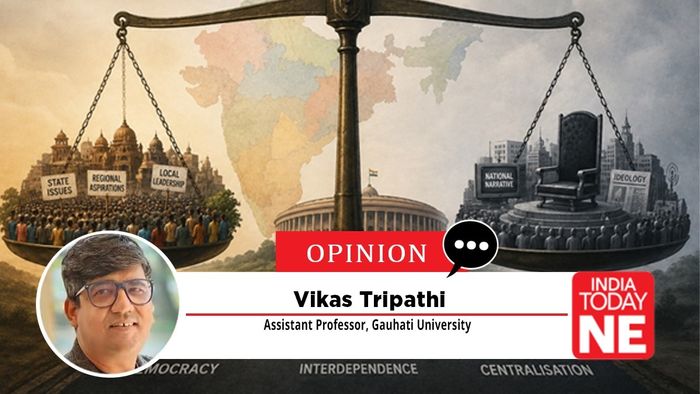
The disruptive phase of greater electoral volatility and consequent political instability during the 1990s eventually normalised coalition culture amidst growing ideological convergence and stabilisation of state-level politics. By the early 2000s, this process brought into salience the role of regional leaders who became more prominent than national leaders as elections witnessed the return of several incumbents in states. National narratives became inapt in swinging voting behaviour as elections tilted towards state-level leadership and issues. Informal consultation mechanisms like Coordination Committees and formal mechanisms like the Group of Ministers were instrumental in bridging ideological divergence among parties at the centre. They contributed to evolving consensus over programmes, policies and governance models, imparting greater bargaining leverage to the states as the latter were represented in the alliance. The identity of states became distinct from each other, and regional parties were on the front foot in centring this distinctiveness of states in politics in India.
The deepening of coalition politics thus worked well with flattening of the ideological boundaries as coalition structures became the transactional node in politics. Electoral volatility persisted, yet politics stabilised. Paradoxically, regional parties, which were perceived to be the factor responsible for party system fragmentation and consequent political instability, evolved coalition norms that were more transactional than ideological, and more leader-centric than issue-driven. During deep coalition phase, parties got stabilised yet not institutionalised, which became a potent factor for concentration of power in the leaders of political parties. The persona, policies and the governance model of leaders overshadowed ideology and issues. Thus, the stability which emerged at the centre was largely a bottom-up process rather than being driven by the centre.
However, this phase also triggered personalisation of politics across states. Party and leader became inseparable from each other at the centre too. Barring a few exceptions, almost all state-based parties and national parties are now anchored around the persona, programmes and perceptions of their respective leaders. Political stability at the centre and across states became mutually reinforcing, but the deeper question remains what caused this cycle of mutual stability. Leader centrism, in part, may be a function of the kind of constitutional architecture of parliamentary system which we adopted. Thus, politics in India since Nehru had a blend of leadership and majority, but its character varied mostly according to personality and political circumstances.
However, the regionalisation of politics consequent to the fragmentation of Congress dominance in the early 1990s led to the consolidation of state-level leadership. There were two other reasons responsible for political stability in the states. Firstly, the impact of the SR Bommai judgement of 1994 became a restraint on the way the President’s Rule was frequently imposed across states in India. Secondly, the 91st Constitutional Amendment Act, which made the act of defections and merger stringent, imparting greater stability to politics at the state level. Given the non-institutionalised character of political parties across states, the latter strengthened the grip of parties over its organisational structure, eventually leading to personalisation of politics.
Thus, structures of coalitions established a framework of complex interdependence between the centre and states. Leaders have remained at the centre of this transnationalism. The elections of 2014 brought in once again the centrality of ideology-driven politics, yet the transactional character of coalition politics, primarily driven along leadership lines, also opened up spaces for negotiations in the name of narratives and counter-narratives. Nonetheless, the resurfacing of a deeper ideological divide with the rise of Modi as Prime Minister, primarily driven by successive leader-centric mandates, fundamentally reshaped the relationship between centre and state from being transactional to hierarchical. It became apparent in the way Chief Ministers were elected by legislatures in states where BJP came to power since 2014. Barring rare exceptions, most of the Chief Ministers, even those with decisive popularity, could be elected by state legislative parties only with the backing of top leaders of the party.
BJP’s ideological shift from emphasis on Hindu nationalism to Hindu civilisation proved most vital in its eastern expansion in Assam and West Bengal, for two crucial reasons. First, it caused massive religious polarisation owing to the presence of Muslim population in both these states. Secondly, it could act as a transcendental cover for BJP as religious polarisation could outweigh ethno-linguistic and regionalist mobilisation strategies of opposition parties/alliances in these states. The dominance which BJP acquired is systemic, given its top-down organisational, leader-centrism across states, and ideological anchoring in politics of Hindu civilisation. Civilisation politics contributed to the BJP’s expansion in new states as well as its consolidation in several of those states, leading to the gradual withering of the distinctness that states assumed as autonomous sites of electoral contests previously.
However, civilisational politics on its own is insufficient to woo voters, and thus, its interplay with beneficiary politics assumes importance in determining voting behaviour. The web of service delivery, DBT and party mobilisation deepened the access to public service delivery at the grassroots level across states, making the reach of beneficiary politics wide and deep. It proved crucial for the cultivation of leader-centred politics at the state level. Organisational networking of political parties and its well-knit coordination at grassroot level reinforces the trend towards beneficiary politics and leader centrism in politics.
The growing domination of leader-centric politics and personality cult has contributed to the personalisation of politics. Thus, beneficiary politics and leader centrism are deeply integrated, and their convergence exhibits different shades of personalised politics across states in India and is in the process of shaping the relationship between the centre and states in India. Thus, both TMC and BJP being leader-centred, enjoying organisational dominance, and with distinct ideological anchors, relied heavily on beneficiary politics. While the latter worked in Assam, its impact was nominal owing to religious polarisation, and thus, the BJP could comfortably win both states.
The presence of Prime Minister Modi along with Chief Ministers of 22 states during the swearing-in ceremony of Himanta Biswa Sarma was projected as a victory of a Civilisation. However, in reality, it is the culmination of the political processes which started with the deeper nationalisation of state-level politics in 2014. The challenge before the opposition is not merely to ideologically counter the civilisational narrative but also to match the BJP’s organisational dominance and its hold over the web of beneficiary politics in states where it enjoys power. The civilisational voter is transactional, and it underlines both the contradictions as well as possibilities of civilisational politics.
(Vikas Tripathi is Associate Professor, Department of Political Science, Gauhati University.)