Global economy on a tightrope: IMF warns of slump as Iran conflict rattles markets
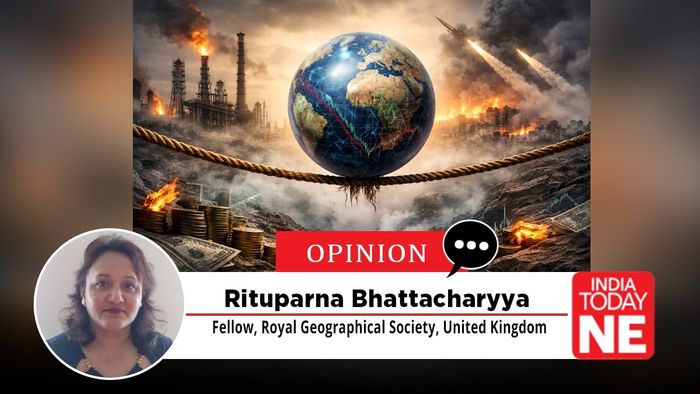
The global economy, which had shown surprising resilience following the post-pandemic recovery and recent trade wars, is now facing a new "energy crisis of an unprecedented scale."
- Apr 18, 2026,
- Updated Apr 18, 2026, 1:49 PM IST
As the drums of war beat louder in the Middle East, the International Monetary Fund (IMF) has delivered a sobering reality check to the global economy. In its latest World Economic Outlook (WEO) report, the IMF has downgraded its global growth forecasts for 2026, citing the destabilising effects of the ongoing conflict involving Iran and Israel.
The global economy, which had shown surprising resilience following the post-pandemic recovery and recent trade wars, is now facing a new "energy crisis of an unprecedented scale."
The numbers: A growth squeeze
According to the IMF’s "reference forecast"—which assumes the conflict remains limited in duration, global growth is projected to slow to 3.1% in 2026, down from 3.4% in 2025. This represents a 0.3-percentage-point drop compared to pre-conflict estimates.
However, the Fund warned that if the war drags on, the outlook could darken significantly:
- Protracted conflict scenario: Growth could slide to 2.5%.
- Severe scenario: Growth could plummet to 2%, effectively pushing the global economy into a recession.
The following table shows the latest forecast
| Entity | Jan 2026 Forecast (%) | Apr 2026 Forecast (%) | Change (p.p.) |
| World | 3.3% | 3.1% | 📉 -0.2 |
| India (IN) | 6.4% | 6.5% | 📈 +0.1 |
| China (CN) | 4.5% | 4.4% | 📉 -0.1 |
| United States (US) | 2.4% | 2.3% | 📉 -0.1 |
| United Kingdom (GB) | 1.3% | 0.8% | 📉 -0.5 |
| Germany (DE) | 1.1% | 0.8% | 📉 -0.3 |
| France (FR) | 1.0% | 0.9% | 📉 -0.1 |
| Russia (RU) | 0.8% | 1.1% | 📈 +0.3 |
| Japan (JP) | 0.7% | 0.7% | ➡️ ±0.0 |
Regional fallout: Middle East and beyond
The Middle East and North Africa (MENA) region is bearing the immediate brunt. The IMF sharply reduced the 2026 growth forecast for the region to a meagre 1.1%, down from a January prediction of 3.9%.
Hardest hit are the commodity exporters. Iran’s economy is expected to contract by 6.1% this year due to extensive infrastructure damage. Qatar and Iraq are also facing sharp declines of 8.6% and 6.8%, respectively, as energy production facilities and the vital Strait of Hormuz transport route face disruptions.
The India factor: Resilient but not immune
While the West and the Middle East face stagnation, India continues to be a "bright spot" in the global landscape. Even amidst the global turmoil, India remains the fastest-growing major economy, with a forecast of 6.2% growth for 2026.
However, for a major energy importer like India, the conflict poses significant risks. The IMF warns that if oil prices remain above $100 per barrel through 2027, inflationary pressures could force central banks to keep interest rates high, potentially dampening domestic consumption and investment.
The "energy shock" of the modern age
The IMF and World Bank have characterised this as the "biggest energy shock of the modern age." Unlike trade tariffs, which can be reversed with a pen stroke, the destruction of energy infrastructure and the "scarring" of trade routes like the Strait of Hormuz create long-term economic damage.
"Should the conflict become more protracted... the impact on growth would be larger," the IMF report noted. Beyond GDP, the conflict is stoking a food security "timebomb" as fertilizer prices surge, disproportionately affecting low-income nations.
The road ahead
IMF Managing Director Kristalina Georgieva has urged global leaders to avoid "go-it-alone" protectionist actions, such as export controls and price caps, which could exacerbate the crisis. As finance officials gather in Washington for the Spring Meetings, the message is clear: the global recovery is under threat, and the path to stability depends entirely on the de-escalation of the fires in the Middle East.
Key takeaways from the IMF report:
- Global Growth: Cut to 3.1% for 2026.
- Inflation: Expected to rise to 4.4% globally due to energy spikes.
- Oil Prices: Could stay elevated if the Strait of Hormuz remains disrupted.
- Recession Risk: A "severe scenario" puts the world at risk of a 2% growth floor.