How Ambedkar and Gandhi differed in their approach to manual scavengers
Dr B R Ambedkar and Mahatma Gandhi stressed cleanliness as vital for dignity and social justice. Their advocacy against manual scavenging inspires ongoing efforts for equality and swachhta in India
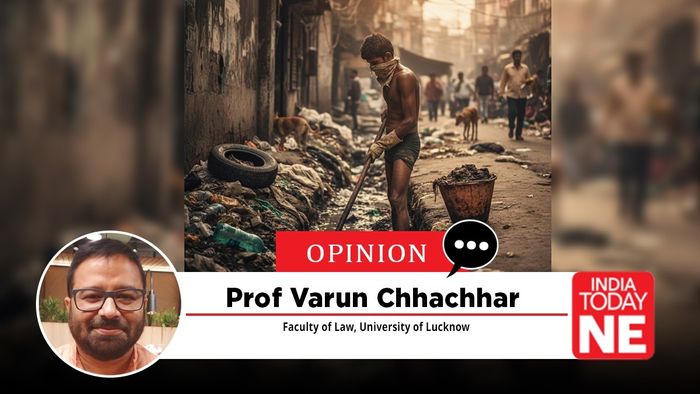
- Dec 04, 2025,
- Updated Dec 04, 2025, 5:25 PM IST
The idea of cleanliness or swachhta occupies a central space in India’s moral and political imagination. From the spinning wheel to the toilet, from ritual purity to civic sanitation, the language of cleanliness has been both a metaphor and a movement. Two of modern India’s most influential thinkers - Mahatma Gandhi and Dr. B.R. Ambedkar - articulated powerful yet profoundly different visions of cleanliness. For Gandhi, swachhta was a moral and spiritual discipline integral to self-purification and national regeneration. For Ambedkar, cleanliness was inseparable from dignity, equality, and the annihilation of caste. Their contrasting approaches reveal two distinct philosophical projects: one rooted in moral reform within Hindu society, and the other in radical social reconstruction beyond it.
Gandhi’s Spiritualisation of Cleanliness
Mahatma Gandhi’s idea of cleanliness was inseparable from his ethical vision of the ideal society. In his ashrams, cleanliness was a daily practice and a test of moral character. Gandhi insisted that every individual, regardless of social status, must engage personally in the act of cleaning - be it one’s room, surroundings, or latrine. His insistence on this duty stemmed from his belief in the unity of body, mind, and spirit. Cleanliness, for Gandhi, was not merely hygienic but profoundly moral: “Cleanliness is next to godliness,” he often repeated, but added, “It is the outward expression of inner purity.”
Gandhi’s campaign against untouchability was deeply intertwined with this ethos. He saw the removal of untouchability as a matter of moral regeneration rather than merely social reform. He admired the work of manual scavengers and called them “keepers of public health.” He sought to elevate the social status of sweepers not by abolishing their occupation but by sacralising it - transforming the act of cleaning filth into an act of service to God. In Harijan (1932), he wrote, “If I were born a scavenger, I would not be ashamed of my work, but I would do it as my sacred duty.”
For Gandhi, therefore, the solution to uncleanliness and untouchability lay in changing hearts - by encouraging upper-caste Hindus to perform “unclean” tasks themselves and to recognise the divinity in service. His was a moral pedagogy that sought to reform caste from within by spiritualizing labour and inculcating humility.
However, this idealism contained contradictions. Gandhi’s praise for the scavenger as a “divine worker” did not challenge the structural inequalities that produced and sustained that role. By moralising the work of cleaning and framing it as seva(service), Gandhi risked romanticising an occupation born of systemic exclusion. His approach sought equality in dignity, but not necessarily in the distribution of labour.
Ambedkar’s Social Realism and the Politics of Cleanliness
Dr BR Ambedkar approached the question of cleanliness from a radically different standpoint. For him, cleanliness was not a matter of moral uplift or spiritual purity - it was a political and social question rooted in caste oppression. His writings, especially Annihilation of Caste (1936) and The Untouchables: Who Were They and Why They Became Untouchables (1948), expose the cruel irony of a society that considered certain bodies and tasks “polluting,” even while depending on them for its survival.
Ambedkar rejected Gandhi’s glorification of manual scavenging as seva. To him, the work of cleaning human waste was not divine but dehumanising. The very idea that an entire community was condemned to such labour was, for Ambedkar, a manifestation of the Hindu social order’s moral failure. “You cannot build anything on the foundations of caste,” he declared, “You cannot build up a nation, you cannot build up morality.”
Ambedkar’s idea of cleanliness, therefore, was inseparable from the idea of dignity. He demanded not reverence for the scavenger’s work but the abolition of the conditions that forced them into it. He argued that true cleanliness required social equality - freedom from the stigma that made one group “unclean” in the first place. To cleanse Indian society, one must annihilate caste, not merely clean latrines.
Ambedkar’s critique also extended to the notion of spiritual purity that underpinned Gandhi’s discourse. For him, such notions perpetuated the very hierarchy they claimed to transcend. In his 1932 correspondence with Gandhi over separate electorates, Ambedkar insisted that the so-called untouchables were “a people apart” not by choice but by systemic exclusion. His call for political representation, education, and access to sanitation was an assertion of equal citizenship - a secular, rights-based framework of cleanliness that contrasted sharply with Gandhi’s moral vision.
Ambedkar’s commitment to cleanliness as social justice found concrete expression in his public works as a lawmaker. As a Labour Member of the Viceroy’s Executive Council, he drafted policies for urban sanitation, workers’ housing, and public health. Later, as the chief architect of the Constitution, he embedded the principles of equality, dignity, and the abolition of untouchability into the legal foundation of the Republic. Cleanliness, for Ambedkar, was therefore not a symbol of inner virtue but a measure of public justice.
Intersecting Ideals and Divergent Paths
Despite their profound differences, Gandhi and Ambedkar shared an awareness that the question of cleanliness lay at the heart of India’s civilizational crisis. Both saw the filth in India’s streets and the moral filth of untouchability as reflections of deeper social decay. Both believed that a clean India required not only clean surroundings but a clean conscience. Yet their roads to that ideal diverged.
For Gandhi, the locus of reform was the individual conscience and the Hindu community. He believed in transforming society through the moral awakening of its members - by persuading upper castes to assume moral responsibility for the oppressed. His emphasis was on duty, not rights.
For Ambedkar, the locus of reform was the structure of society itself. He rejected the assumption that caste could be reformed through goodwill or spiritual awakening. His emphasis was on rights, not duties. He saw in modern law, education, and political representation the tools to dismantle caste and to restore dignity. In that sense, Ambedkar’s idea of cleanliness was revolutionary - it called for a clean break with the past.
From Gandhi’s Broom to Ambedkar’s Constitution: The Modern Swachh Bharat Paradox
Contemporary India’s Swachh Bharat Abhiyan (Clean India Mission), launched in 2014, invokes Gandhi’s image with the broom, symbolising the national moral duty to cleanliness. Yet, the persistence of manual scavenging - even decades after it was outlawed—reveals that India’s cleanliness drive still carries the imprint of Gandhi’s idealism without Ambedkar’s structural realism.
The paradox is stark: millions clean streets and latrines in Gandhi’s name, while the caste-based assignment of sanitation work continues to haunt the nation Ambedkar sought to liberate. The Swachh Bharat discourse celebrates the broom as a symbol of national pride but often neglects the people who wield it - the descendants of those whom Ambedkar called “the most oppressed of the oppressed.”
To reconcile Gandhi’s moral appeal with Ambedkar’s political realism is perhaps the unfinished task of India’s democracy. True swachhta requires both: Gandhi’s ethical discipline that personalises responsibility, and Ambedkar’s demand for structural justice that institutionalises equality.
Conclusion
Gandhi and Ambedkar approached cleanliness from two ends of India’s moral spectrum. Gandhi spiritualized it as a pathway to inner and social purification; Ambedkar secularised it as a demand for dignity and rights. Gandhi sought to cleanse the heart of prejudice; Ambedkar sought to cleanse the system of oppression.
Their visions together invite a deeper understanding of cleanliness - not as mere sanitation but as a moral and social principle that defines the health of a democracy. A truly clean India would not only sweep its streets but also sweep away the hierarchies that render some lives unclean. Between Gandhi’s broom and Ambedkar’s Constitution lies the promise of a nation that is both pure in spirit and equal in dignity.