How Many of You Have Heard of Meghalaya?
Before Nandini Ishvi O. Sangma asked that question in Sydney, she had already stood before an audience in Tura. The journey from a Youth Parliament in Garo Hills to the Commonwealth Youth Parliament was not only about how far she travelled. It was about what happened when a young person was given the opportunity to be heard.
- Aug 14, 2026,
- Updated Aug 14, 2026, 11:23 AM IST
In Sydney, at the Commonwealth Youth Parliament, a young delegate from Meghalaya asked a simple question."How many of you have heard of Meghalaya?"
I have been thinking about that question since I first came across the account of her participation.
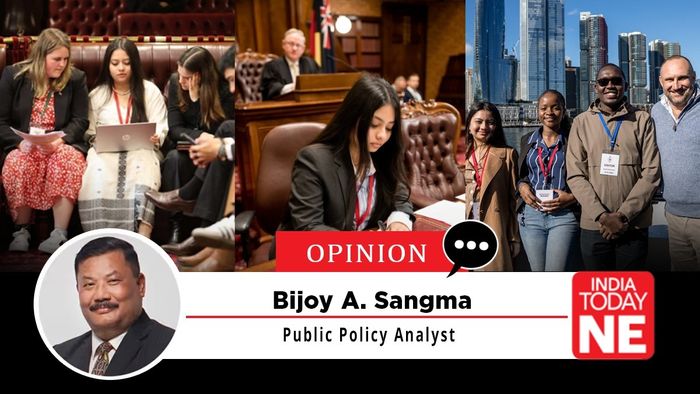
Nandini Ishvi O. Sangma, a Political Science student from Don Bosco College, Tura, reached Sydney after being selected to represent India at the 13th Commonwealth Youth Parliament. Her international appearance had a much more local beginning. She had first participated in the Youth Parliament held in Tura, Garo Hills, where she was adjudged Best Speaker. The programme, held in March 2026, was organised by Tura Christian College in collaboration with the Meghalaya Legislative Assembly.
The sequence is worth noticing. Before Sydney, there was Tura. Before an international audience, there was a local platform. Before the photograph and the news report, a student had to stand up and speak.
After returning from Sydney, Nandini reflected on the experience in simple terms. "I wanted to leave an impact," she said. "I wanted to make my State proud." She described the experience as "everything that I dreamt of as a young leader." Her words stayed with me, partly because behind the achievement is a much larger group of young people still waiting for their first serious opportunity.
Before the world hears a young person
Public achievements usually have a visible ending. There is a stage, a certificate, a photograph, and sometimes a news report. The beginning is much less visible. It may be a teacher asking a student to participate in a debate, a college forming a youth parliament, a parent encouraging a daughter to travel for a programme, or a mentor reading a student's speech and asking for another draft.
These things rarely become news. They are often what make the news possible.
At the World Congress of Young Farmers in Orlando, Florida, many years ago, I met a young woman from a rural community in El Salvador. She spoke quietly about growing up in a place where international gatherings seemed to belong to another world. Standing among young leaders from different countries, she wondered whether she truly belonged there. But when she began talking about farming families in her community, their struggles and the realities of rural life, the room listened. She knew her community well, and what she brought into the conversation came from experience that no textbook could have provided.
I remember that encounter because her ability was not the issue. She needed to believe her experience mattered beyond her community. Once she spoke, the gap between her rural community in El Salvador and the international gathering seemed smaller. She did not suddenly become more capable. She simply allowed what she already knew to be heard.
Years later, during an international leadership programme in Singapore, I saw something similar. One young participant remained almost silent through the first few sessions, listening carefully but rarely entering the discussion. There was a sense that others were better prepared and had more to contribute. With some encouragement, the participant began to speak, first cautiously and then with increasing confidence. The ideas had been there from the beginning. What changed was the willingness to place them in the room.
Those experiences changed the way I think about international exposure. It does not begin when a young person boards a plane. It begins much earlier, when a teacher takes a student's question seriously, when a mentor says, "You should try," or when a parent encourages a child to pursue an opportunity that initially seems beyond reach. Confidence grows through such encounters. A young person begins to understand that where they come from does not determine whether they can participate, lead or be heard.
The voices behind the headlines
Much of India still recognises the Northeast through several familiar images. Assam is linked to tea, the Brahmaputra, floods and Kaziranga; Arunachal Pradesh to its mountains and frontier; Manipur to sport, culture and recent political events; Mizoram and Nagaland to their distinctive community and cultural traditions; Sikkim to its mountains and environmental efforts; Tripura to its history; and Meghalaya to its hills, rain, music, waterfalls and living root bridges.
Behind them are young people in schools, colleges, and communities across eight States, preparing for debates, applying for scholarships, organising events, researching, competing, and deciding whether to pursue opportunities beyond home. Most of these moments will never be reported. They do not need to be. What matters is whether the opportunity exists and whether someone encourages the young person to take it.
A student cannot discover an ability that they are never allowed to test. A young person cannot develop public speaking skills without somewhere to speak.
Responsibility cannot be learned if every decision is made on their behalf.
This is where schools, colleges, parents, teachers, civil society organisations and public institutions matter. They cannot guarantee success. They can create places where young people can attempt something, make mistakes and try again. Often, that is where confidence begins.
In Meghalaya, opportunities should not only belong to Shillong or a few better-known towns. They matter equally in Tura, Jowai, Nongstoin, Nongpoh, Williamnagar, Baghmara, Ampati, and in the many smaller towns and communities across the State. Young people there are studying, competing, pursuing education, and looking beyond their immediate surroundings. The difference is often not ability. It is whether someone opens a door and whether the young person believes the opportunity is meant for them.
Where a voice begins
International Youth Day was observed on August 12. But young people do not need recognition for a single day. They need opportunities throughout the year to speak, participate and take responsibility.
A youth parliament gives a young person something that speeches about youth empowerment cannot: a real opportunity to participate.A debate gives a student somewhere to test an argument. A competition gives another the experience of standing before an audience. A mentor can help a hesitant participant prepare. A teacher can insist that a quiet student take the microphone. A parent can make it possible for that student to travel.
Nandini's story shows what can happen when these pieces come together. Her achievement is a Meghalaya story but also a Northeast story. Young people notice when someone from a similar place reaches a broader stage. Students in Kohima, Aizawl, Imphal, Itanagar or Agartala can see their own circumstances in others' journeys, as can those in Gangtok and across Meghalaya. The achievement belongs to the person who earned it. What it makes possible for others is something different.
Nandini did not begin in Sydney. She began in Tura, where students were given a serious platform and she was recognised for what she did with it. The Commonwealth Youth Parliament then provided another platform, this time alongside young people from across the Commonwealth. That sequence matters.
A first opportunity does not have to be international. It can begin in a school, a college, a youth organisation or a community programme. What matters is that the opportunity is real and that the young person is taken seriously.
The young person we cannot see
There is one person missing from Nandini's photograph. We do not know who that person is.
It could be a school student who read about her in a newspaper, a college student who watched a clip of her speech, or someone who had never considered applying for a youth programme because such opportunities seemed meant for other people. The story may pass without making much difference. Or it may stay somewhere in that student's mind. Nandini may never know.
She knows what she wanted when she went to Sydney.
"I wanted to leave an impact."She did.
The impact may not be in Sydney. It may be somewhere in the Northeast, in a classroom where another young person has just discovered that someone from home can stand before an unfamiliar audience and speak.
That young person may one day stand in another room, perhaps in India or somewhere much farther away. Someone may ask where they come from. They may name their State and begin to speak.
And somewhere in that room, the question may return. "How many of you have heard of Meghalaya?"