How the West Misread Bangladesh and Opened the Door to Radical Chaos
The turmoil in Bangladesh is often framed in Western capitals as a familiar story of “democratic correction” and “human-rights advocacy.” Yet this framing collapses under closer scrutiny. What unfolded was not a principled defence of democracy, but a profound strategic and moral misreading , one that weakened the very forces holding radicalism at bay. In doing so, the West helped uncork a volatile mix of extremism, cultural erasure, and targeted violence, with consequences that now extend far beyond Bangladesh’s borders.
- Dec 24, 2025,
- Updated Dec 24, 2025, 2:37 PM IST
The turmoil in Bangladesh is often framed in Western capitals as a familiar story of “democratic correction” and “human-rights advocacy.” Yet this framing collapses under closer scrutiny. What unfolded was not a principled defence of democracy, but a profound strategic and moral misreading , one that weakened the very forces holding radicalism at bay. In doing so, the West helped uncork a volatile mix of extremism, cultural erasure, and targeted violence, with consequences that now extend far beyond Bangladesh’s borders.
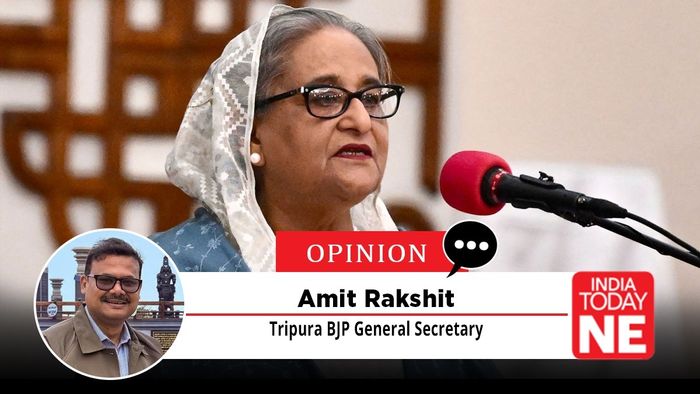
At the centre of this miscalculation stood Sheikh Hasina, a leader repeatedly criticised abroad for being “too strong,” yet indispensable at home for keeping violent radical networks in check.
Western pressure was largely justified through a selective human-rights narrative - one that focused almost exclusively on procedural democracy while ignoring the lived reality of minorities, secularists, and cultural custodians inside Bangladesh. The irony is glaring, as pressure mounted on the Hasina government, human rights violations worsened, not improved.
Bangladesh’s Hindu community, historically integral to the nation’s social and cultural fabric has borne the brunt of this shift. Allegations of blasphemy, often flimsy or fabricated, have been weaponised to incite mob violence. Homes have been torched, temples vandalised, livelihoods destroyed, and lives lost sometimes in full public view, with little fear of consequence.
Women from minority communities have faced sexual violence and intimidation, not merely as criminal acts but as instruments of terror meant to force silence, migration, or submission. These crimes are rarely isolated incidents, they are symptoms of a broader radicalisation where identity itself becomes a target.
Under Sheikh Hasina, such forces were constrained by firm policing, intelligence coordination, and zero tolerance for jihadist mobilisation. Once that authority weakened, impunity grew.
The misuse of religious sentiment has become one of the most corrosive trends. Accusations of blasphemy often spread through social media have triggered lynchings, arson, and communal riots. This mirrors patterns seen elsewhere in South Asia, where law is replaced by the mob, and fear becomes the dominant social currency.
The West’s failure lies in not recognising that human rights are indivisible. Protecting free expression and minority life requires a state capable of enforcing order. Undermining that capacity in the name of abstract ideals does not liberate society, it hands power to those who despise pluralism altogether.
Perhaps the most alarming development is the systematic attempt to undermine the legacy of 1971, the very foundation of Bangladesh as a nation.
Demolition of memorials commemorating the Liberation War have been vandalised or neglected. The Statues, murals, and cultural installations celebrating the struggle against Pakistani military atrocities are being erased or defaced. The role of secular nationalism in the birth of Bangladesh is being deliberately diluted, if not outright denied and it is not accidental. It is ideological.
The Liberation War of 1971 stood for linguistic identity, secularism, and resistance to religious authoritarianism. For radical Islamist groups, that history is an obstacle. By erasing it, they seek to rewrite Bangladesh not as a plural nation born of sacrifice, but as a theocratic project aligned with transnational Islamist narratives.
Bangladesh’s rich tradition of art, literature, music, and theatre long a counterweight to extremism is under assault. Cultural festivals have been disrupted, progressive artists threatened, and institutions intimidated. The message is clear, conform or be silenced.
What is being destroyed is not merely art, but cultural confidence, the idea that Bangladesh can be proudly Bengali, secular, and inclusive.
Beyond Bangladesh, this episode fits a troubling regional pattern. Destabilisation in Bangladesh, alongside persistent volatility in Nepal and Pakistan, creates a ring of instability around India.
A stable, secular Bangladesh under Sheikh Hasina was a cornerstone of eastern South Asian security cooperating closely with India on counter-terrorism, border management, and connectivity. Weakening Dhaka inevitably forces India into perpetual crisis management, diverting energy from its emergence as a major global player.
Whether by design or by negligence, the outcome serves one purpose: keeping India boxed into its neighbourhood, distracted by chaos rather than shaping global outcomes.
The West believed it was correcting an imbalance. Instead, it committed a strategic own goal empowering radicals, endangering minorities, erasing history, and destabilising a region.
Sheikh Hasina was not a perfect leader, but she was a necessary stabiliser. She understood a hard truth many foreign observers missed. In societies facing organised extremism, the absence of authority does not produce freedom, it produces fear.
By undermining Bangladesh’s strongest secular firewall, the West let the genie out of the bottle. The forces now unleashed religious vigilantism, cultural destruction, historical revisionism are not easily contained, nor are they amenable to diplomatic sermons.
Bangladesh stands at a crossroads between its plural, hard-won identity of 1971 and a descent into Islamic chaos driven by radical intimidation. The lesson for the world is stark and urgent.
You cannot defend human rights by empowering those who trample them. And you cannot build democracy by dismantling the very structures that protect society from extremism.