Inside the massacre of Thadou Christian leaders: Motives, narratives, and unanswered questions
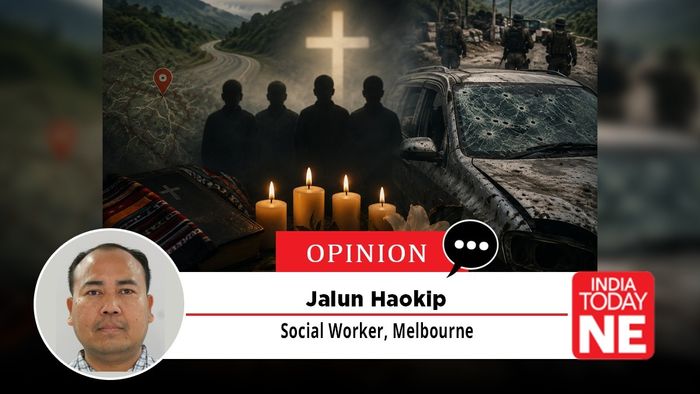
Three leaders of the Thadou Baptist Association India (TBAI), its President, Rev. Dr. Vumthang Sitlhou; Finance Secretary, Rev. Kaigoulun Lhouvum; and Pastor Paogoulun Sitlhou, were killed in the targeted ambush while returning from a church gathering in Churachandpur. Five others were injured, including Rev. S. M. Haopu (Executive Secretary of TBAI), Rev. Hekai Simte, Rev. Kaikhothang Singsit, and two drivers, Thangtinlen Sitlhou and Goumang Lhouvum.
- Jun 05, 2026,
- Updated Jun 05, 2026, 6:05 PM IST
The massacre of Thadou Christian leaders on 13 May 2026, an unprecedented incident in Northeast India, shocked the Thadou community and beyond. Yet the central questions remain unanswered: Who carried out the attack? Who ordered it? Who provided intelligence? And who benefited? Why has the search for truth become entangled in propaganda and competing political narratives?
This was not a random act of violence. The available facts and circumstances suggest planning, intelligence gathering, and a clearly identified target, meeting the definition of a massacre. The victims were church leaders from the Indigenous Thadou community who dedicated their lives to work related to faith, language, literature, peacebuilding, intercommunity relations, and community development.
Three leaders of the Thadou Baptist Association India (TBAI), its President, Rev. Dr. Vumthang Sitlhou; Finance Secretary, Rev. Kaigoulun Lhouvum; and Pastor Paogoulun Sitlhou, were killed in the targeted ambush while returning from a church gathering in Churachandpur. Five others were injured, including Rev. S. M. Haopu (Executive Secretary of TBAI), Rev. Hekai Simte, Rev. Kaikhothang Singsit, and two drivers, Thangtinlen Sitlhou and Goumang Lhouvum.
Early narratives and competing claims
Within hours of the deadly attack, attention shifted to competing allegations. Kuki organisations and affiliated voices quickly blamed Naga groups, despite no verified evidence. Less than two hours after the incident, Kuki Inpi Manipur (KIM) issued a predated and seemingly pre-drafted press release naming certain Naga militant groups, including the ZUF-Kamson Group, and linking the incident to the NSCN-IM.
Both groups denied involvement. While denial does not prove innocence, and accusation does not prove guilt, responsibility must be determined through evidence and credible investigation. Meanwhile, Kuki militant groups actively operating in the area and surrounding regions have largely remained silent.
Location and security concerns
The ambush occurred between Kotlen and Kotzim villages, an area dominated by Kuki militant groups operating under the Suspension of Operations (SoO) framework, including the Kuki Revolutionary Army (KRA) of the Kuki National Organisation (KNO). Reports indicate the presence of a nearby KRA/KNO checkpoint where passing vehicles were registered, as well as an Assam Rifles post in Kotlen village.
Many Kuki militant organisations operating under the SoO Agreement with the Government of India and the Government of Manipur receive financial assistance, stipends, logistical support, and other forms of assistance from the government. Critics argue that this arrangement has fostered a culture of violence and impunity, effectively allowing these armed groups to operate with state backing or state sponsorship.
Against this backdrop, serious questions arise: How did a coordinated daylight ambush occur in a closely monitored area? How did the attackers obtain precise intelligence on the victims' movements? And why was there no effective intervention or response?
The massacre also appears highly selective. Vehicles ahead of and behind the TBAI convoy reportedly passed unharmed, and only the two vehicles with clearly visible TBAI plates carrying TBAI leaders were targeted. The second vehicle, carrying Rev. Vumthang Sitlhou, bore the heaviest gunfire, with at least fifteen bullets recovered from his body, suggesting he was the primary target.
Burial and Identity Contestation: Attempted Rebranding of Thadou Victims as “Kuki Martyrs”
In what appeared to be a pre-planned and coordinated effort, Kuki organisations and propaganda actors referred to the deceased as “Kuki church leaders” immediately after the incident. The label was subsequently repeated by sections of the media and by some individuals without verification. Reports also emerged of attempts to bury the victims as Kuki martyrs at Kuki Martyrs’ Park in Kangpokpi. However, the families, the TBAI, and Thadou community leaders—reflecting the broader position of the Thadou community—laid them to rest at the TBAI Centre in Motbung, recognising them as Thadou Christian leaders. Significantly, Thadou Inpi Manipur, the apex body of the Thadou community in Manipur, declared them as “Thadou Martyrs”.
Plausible motives
Were they killed because of their Thadou identity and efforts that challenged Kuki supremacist narratives?
Plausible motives behind the deadly attack include:
• Suppressing distinct Thadou identity, one of the world’s longest-surviving cultures
• Retaliation against Thadou language and Bible translation work
• Weakening independent Thadou Christian institutions
• Misrepresenting Thadous as part of Kuki identity
• Dragging the Thadou community into Kuki–Naga violent conflicts, and forcing Thadous to participate, suffer, or die under the “Kuki” label in order to reinforce the narrative that Thadous are part of Kuki identity and are perceived as such regardless
• Escalating inter-community tensions to strengthen Kuki narratives and the 2003 “Any Kuki Tribes” framework and related Kuki structures
The Victims and Their Work
Rev. Vumthang Sitlhou was a leading figure in Thadou language, literature, and Christian heritage. Under his leadership, the Thadou Bible project was completed, culminating in the publication of the full Bible in Thadou and building on the legacy of Pu Ngulhao Thomsong, who first translated and published the Thadou Bible in 1942.
His work also sought to preserve the distinct indigenous identity of the Thadou people and language amid longstanding efforts to rebrand it as Kuki. Those efforts date back to 1971, when Rev. T. Lunkim of the Kuki Christian Church (KCC) rebranded the Thadou Bible as the “Kuki Bible,” a move many Thadous regard as a landmark attempt to subsume their identity. The launch at Molvom, Nagaland, was mired in litigation and controversy, and T. Lunkim was reportedly later jailed for contempt of court.
Beyond his church leadership, Rev. Vumthang served as Secretary of the Thadou Christian Literature Society and Advisor to the Thadou Linguistic Forum. He was widely known for promoting peace and opposing corruption, illegal poppy cultivation, drug abuse, and violence.
His vision extended beyond Manipur, supporting Thadou Christian fellowships and churches across India and abroad while advocating worship spaces free from political influence. This stood in contrast to concerns that Kuki Worship Service (KWS) centres and other Kuki churches had evidently become more like hubs for Kuki political mobilisation and radicalisation rather than places of Christian worship. Preparations were also underway for the Global Thadou Christian Congress. At the same time, efforts to reconnect Thadous who had been absorbed into radicalised Kuki socio-political structures with independent Thadou institutions increasingly met resistance from the Kuki establishment.
Wider context
Two injured survivors of the ambush had participated in the Thadou Convention Guwahati 2024, which reaffirmed Thadou identity as distinct from the Kuki label and was strongly opposed by Kuki militant organisations, including the KNF, with death threats issued against the organisers and participants. The fact that individuals associated with it later became victims of one of the deadliest attacks on Thadou church leaders raises questions investigators cannot ignore.
The brutal killing of Thadou leader Nehkham Jomhao in August 2025 in Assam by Kuki SoO militants (Kuki Revolutionary Army, Kuki Liberation Army, and United Kukigam Defence Army) adds to these concerns. A peace advocate and Chairman of the Thadou Literature Society Assam, he was allegedly targeted in a similar manner, and his body was later disposed of in a river in an attempt to prevent recovery. It was eventually recovered after days of searching by Thadou and Karbi volunteers, with assistance from security forces. Arrests were later made, including active cadres of the Kuki Revolutionary Army (KRA), all of whom confessed to the crime.
His murder bears disturbing similarities to the attack on the TBAI leaders. In both cases, respected Thadou figures were targeted after openly defending their community’s distinct identity and rights. The attacks appear to have been designed not only to eliminate individuals but also to intimidate the wider community, particularly the Thadou.
These incidents have raised concerns about pressure on Thadous to conform to the diktats of Kuki militant groups, the 2003 “Any Kuki Tribes” framework, and related Kuki structures.
Additional context
Reverend Dr. Vumthang was listed as the main minister for a “Kuki flag” hoisting ceremony on 9 May 2026, but on 8 May he clarified that he had not consented to it and would not attend. The flag had been adopted earlier by Kuki militant groups under the KNO and UPF on 3 May 2026, marked as Kuki “Separation Day”. He maintained his position as a Thadou Christian leader committed to peace and rejected the misrepresentation.
Final reflection
Taken together, these events raise a difficult question: are these isolated killings, or part of a broader pattern targeting advocates of indigenous Thadou identity, language, and institutional independence?
For many, Reverend Dr. Vumthang and the other victims of the horrific crime were respected and inspiring leaders, mentors, and family men, and great champions of peace, justice, and the Gospel; for others, they represented a challenge to competing narratives. TBAI represented an independent religious space at a time of intensified identity politics.
The question is therefore not only who carried out the massacre, but also who feared what these Thadou Christian leaders represented, and who stood to gain from their silencing.
Until a credible and transparent investigation is conducted, the killings remain not only an unsolved crime but also a test of truth, justice, and accountability.