Institutional gravity: Why Bangladesh’s crisis returned to party politics
Political crises often begin with a moment of collective hope. Institutions falter, public anger spills into the streets, and the existing political order suddenly appears fragile. In such moments societies frequently search for a figure who appears to stand above ordinary politics, someone whose reputation suggests integrity, neutrality, and wisdom. Bangladesh’s recent political turbulence illustrates both the power and the limits of this instinct.
Dr Jayanta Biswa Sarma
- Mar 10, 2026,
- Updated Mar 10, 2026, 11:46 AM IST
Political crises often begin with a moment of collective hope. Institutions falter, public anger spills into the streets, and the existing political order suddenly appears fragile. In such moments societies frequently search for a figure who appears to stand above ordinary politics, someone whose reputation suggests integrity, neutrality, and wisdom. Bangladesh’s recent political turbulence illustrates both the power and the limits of this instinct.
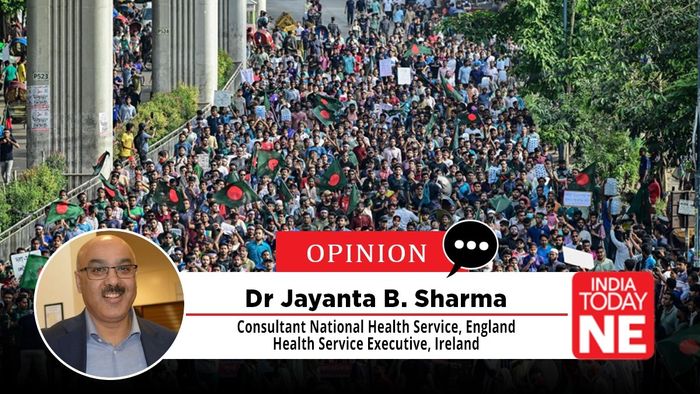
By the middle of 2024, Bangladesh had entered one of the most turbulent phases in its political life since the restoration of electoral democracy in the 1990s. Student-led protests that began as demonstrations against government policies soon expanded into broader anti-establishment mobilisation. University campuses in Dhaka, Chittagong, and Rajshahi became centres of activism, with students and civic groups arguing that the political system had become overly centralised and unresponsive.
In that atmosphere of uncertainty, public discourse gravitated toward the search for a credible intermediary who could guide the country through the crisis. Muhammad Yunus emerged as such a figure. By August 2024, amid escalating protests and growing demands for political reset, he was invited to lead an interim administration tasked with stabilising the country and preparing the ground for elections.
At first glance, the choice seemed almost ideal. Yunus was Bangladesh’s most internationally recognised citizen, a Nobel laureate celebrated for pioneering microfinance through the Grameen Bank. For decades he had cultivated an image of ethical entrepreneurship and social innovation. To many students and civil society activists disillusioned with party politics, he appeared to represent the possibility of a new political culture.
Yet the expectations surrounding him contained a deeper structural misunderstanding. Political systems are not easily transformed by individuals, however credible they may appear. They are shaped by institutions, networks, and historical patterns that exert powerful constraints on leadership.
To understand what unfolded in Bangladesh over the next eighteen months, it is therefore necessary to look beyond personalities and examine the institutional structure of the country’s political system.
Institutional embeddedness and party dominance
Since independence in 1971, Bangladesh’s political landscape has evolved through cycles of authoritarian rule, military intervention, and democratic restoration. Despite these disruptions, electoral politics gradually consolidated around two dominant parties: the Awami League (AL) and the Bangladesh Nationalist Party (BNP).
Over decades these parties became deeply embedded within society. Their influence extended far beyond elections. Party networks permeated student unions, professional associations, local governance, and business communities. Political affiliation often became intertwined with social identity, access to resources, and pathways to influence.
In this sense, political parties in Bangladesh function not merely as electoral organisations but as social infrastructures. They organise political participation, distribute patronage, and provide citizens with channels of representation.
From an institutional perspective, such structures are remarkably resilient. They persist even when widely criticised for corruption, inefficiency, or polarisation. Their endurance reflects what scholars describe as institutional embeddedness and path dependence, the tendency of established structures to reproduce themselves because they are woven into everyday social life.
Political parties therefore operate as what might be called “sticky institutions.”
They persist not because they are universally admired, but because they are deeply integrated into the functioning of society. Citizens may complain about them, distrust them, or even protest against them, yet they remain the primary vehicles through which democratic representation operates.
Nor is Bangladesh’s political embeddedness confined to the Awami League–BNP binary. The broader political field has also long included Islamist currents, most notably Jamaat-e-Islami. While often viewed primarily through the lens of ideological contestation, Islamist politics in Bangladesh also reflects deeper social roots. It draws support from mosque networks, student activism, social conservatism, and moral narratives that resonate with sections of the population, particularly during periods of political uncertainty.
The political opening that followed the 2024 uprising made this dimension more visible. Having been heavily repressed under the previous government, Islamist political actors were able to re-enter public political space more assertively. For some observers this development raised concerns about the potential resurgence of religious politics. Yet analytically it also demonstrated that these currents were not external anomalies. They were part of the same social ecosystem.
In other words, the same society that produced secular-nationalist party dominance also contained constituencies receptive to Islamic political mobilisation. The transition did not create these forces anew. It simply revealed how plural, layered, and unresolved the country’s political embeddedness had always been.
The transitional moment
When the interim administration took office in August 2024, it was widely understood as a temporary arrangement. The aim was not to replace party politics but to stabilise the system long enough for a credible electoral process to take place.
Nevertheless, public expectations were extraordinarily high. Many participants in the protest movement hoped that the crisis would lead to a deeper transformation of political culture. Discussions in universities and civic forums frequently centred on the possibility of breaking the cycle of partisan polarisation that had dominated Bangladeshi politics for decades.
Yet governing a transitional system quickly revealed the complexity of the situation.
By late 2024, the interim administration faced multiple pressures. Law and order concerns emerged in different parts of the country. Student groups demanded institutional reforms before elections, while established political parties argued that the restoration of electoral legitimacy should come first. Minority protection and communal tensions became subjects of public debate. Foreign policy observers questioned how the interim government would navigate Bangladesh’s delicate geopolitical balance between India and China.
Meanwhile, public discourse on digital platforms and YouTube political forums increasingly scrutinised the government’s performance. Critics alleged administrative weaknesses, questioned policy direction, and raised concerns about decision-making within the advisory council.
These debates were part of a familiar dynamic in transitional politics. Governments that assume authority during crises inherit institutional fragility and heightened expectations simultaneously. Even minor shortcomings can quickly become symbols of broader dissatisfaction.
The advisers’ dilemma
Another dimension of the transition concerned the structure of the interim administration itself. The Chief Adviser worked with a council of advisers drawn largely from academia, civil society, and professional sectors.
This design was intended to reinforce neutrality by avoiding established party politicians. Yet it also highlighted a deeper paradox.
The advisers were themselves products of the same society that had produced the political elites they were expected to replace. They represented a different social segment — universities, NGOs, professional communities — but they shared the same broader institutional environment, cultural norms, and political constraints.
Expecting such a group to suddenly produce flawless governance underestimated the complexity of systemic change. Political culture cannot be transformed simply by replacing one set of individuals with another. Institutions, incentives, and historical patterns continue to shape behaviour.
In this sense, the interim administration was less a revolutionary break with the past than another expression of the same national ecosystem.
The three legitimacy deficits
A central difficulty facing the interim government lay in the nature of democratic legitimacy itself. Political theorists often distinguish between input legitimacy, throughput legitimacy, and output legitimacy.
Input legitimacy derives from elections, from the act of citizens choosing their leaders. Yunus did not possess this form of authority. His leadership rested on appointment and public trust rather than electoral mandate. From the beginning, therefore, his authority was provisional, intended to last only until elections could restore a normal democratic mandate.
Yet the deeper problem was that the government also struggled to secure the other two forms of legitimacy.
Throughput legitimacy depends on whether power is exercised fairly, transparently, and according to consistent procedures. Yunus initially seemed well positioned to earn this form of legitimacy. His reputation for neutrality gave him an advantage over party politicians. However, transitional governments are judged not only by their intentions but by their decisions under pressure. Controversies surrounding election timing, disagreements with political parties, protests over administrative decisions, and broader criticisms of governance gradually weakened the perception of a smooth and impartial transition.
At the same time, output legitimacy, legitimacy derived from performance, proved equally difficult to achieve. Governments earn this form of legitimacy by delivering tangible results: maintaining law and order, protecting minority communities, stabilising the economy, and projecting confidence in foreign policy. Transitional administrations, however, inherit the most fragile moments of political life. They must operate with weakened institutions, divided political actors, and enormous expectations from the public.
In Bangladesh, these pressures were visible throughout 2025. Debates about security, communal tensions, economic uncertainty, and administrative capacity became recurring themes in public commentary. The interim government had inherited a damaged state apparatus but was nevertheless judged as though it commanded a fully functioning one.
Without electoral legitimacy, Yunus needed to compensate by demonstrating exceptional procedural fairness and governing effectiveness. Yet the very conditions that brought him to power made both goals extraordinarily difficult to achieve.
The return of institutional politics
By early 2026, the transitional process reached its conclusion. National elections were held, restoring the familiar rhythm of party competition. Political parties mobilised supporters, contested power, and reclaimed their central role in the political system.
The interim leadership stepped aside quietly after the elections.
This transition illustrates a broader institutional pattern. Despite moments of upheaval and the temporary prominence of non-party actors, the underlying structure of Bangladeshi politics remained intact. The deeply embedded party system reasserted itself once electoral competition resumed.
Such outcomes should not necessarily be interpreted as failures of transitional leadership. Rather, they reveal the strength of institutional structures within democratic systems.
Beyond the search for saviours
The Bangladesh experience highlights a recurring feature of political crises: societies often search for individuals who appear capable of transcending ordinary politics. Yet durable political change rarely arises from individuals alone.
It emerges from institutions, incentives, and collective political processes that evolve gradually over time.
In this sense, the transitional period between 2024 and 2026 can be understood less as a struggle between personalities and more as a demonstration of institutional resilience. Political parties, despite their imperfections, remained the primary vehicles through which democratic legitimacy ultimately re-emerged.
The crisis briefly elevated the possibility of outsider leadership, but the deeper structures of political life eventually reasserted themselves.
Yunus entered office without input legitimacy and left without fully securing throughput or output legitimacy. In the end, moral authority could not overcome procedural controversy, weakened state capacity, and the enduring pull of Bangladesh’s deeply embedded party system.
And that system, contentious, imperfect, yet resilient, continues to shape the country’s democratic trajectory.
MORE NEWS
Read more!