Kanaklata: A Silent Legacy
Kanaklata Baruah’s bravery during the Quit India Movement remains a symbol of sacrifice in Assam. Her legacy continues to inspire through personal stories and historical remembrance.
Biraj Das
- Apr 04, 2026,
- Updated Apr 04, 2026, 2:24 PM IST
My visit to Gohpur in Biswanath district of Assam was meant to be purely official. On the 30th of March, 2026, I left my headquarters with a clear schedule in mind, as I had an assignment to complete on the 1st of April. Yet, even before I reached Gohpur, there was a quiet, unexplainable pull within me. It was as if the land itself was calling.
Gohpur is not merely a location on the map of Assam. For many of us who were born and grew up in Assam, it holds a deeper meaning. History does not feel distant in this place. It lives in the air, settles in the soil, and echoes through its silence. Above all, it carries the immortal legacy of Shaheed Kanaklata Baruah, who laid down her life at the tender age of seventeen during the Quit India Movement in 1942.
Every child of Assam, especially those of my generation and earlier, has grown up listening to her story. A young girl, barely seventeen, standing fearlessly before armed British forces, holding the tricolour with resolute determination. At an age when most are still discovering life, she had already embraced a purpose greater than herself. Fear could not reach her. She walked forward, fully aware of the consequences, yet unwilling to step back.
On the evening of the 31st of March, after completing my necessary supervision, a strange heaviness settled within me. It was not fatigue. It was a quiet reminder that I was standing so close to the land of her sacrifice, yet had not visited her home. That thought did not allow me to remain still.
With my team, I decided to visit Barangabari, her native village. The place carried a serene simplicity. The presence of namghars in almost every household reflected the deep spiritual roots of Assamese culture. There was a calmness that could not be described in words.
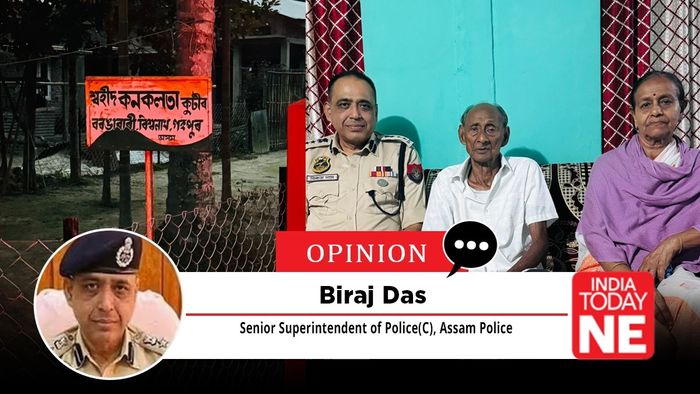
On the way, we met a woman. After offering my pranam, I enquired about Kanaklata’s residence. She returned my greeting with warmth and then introduced herself as the wife of Kalicharan Baruah, the youngest brother of Shaheed Kanaklata. It felt less like coincidence and more like destiny guiding us.
I expressed my desire to see the house and, after taking a photograph from outside, mentioned that I would leave. But she gently stopped me and said, “How can you leave without entering Kanaklata’s home?” There was such sincerity in her voice that I could not refuse, and I stepped inside.
There, I met Kalicharan Baruah, a man well over eighty years of age. His presence was calm, his words simple, yet they carried the weight of history. He told us he was only three years old when his sister was martyred. There was no trace of bitterness in his voice, only remembrance.
While leaving, he pointed to a place and quietly said that this was where Kanaklata’s bullet-ridden body had been kept after she was brought back. At that moment, something within me fell silent. I could not step onto that spot. Instead, I bowed my head in deep respect. It was not just a place, it felt sacred.
He then spoke about the surroundings during those days. There were only three houses in the entire vicinity. The area was covered with dense forests. Even during daylight, wild animals such as leopards, wild cats, foxes, and wolves would enter the area, often attacking their livestock. In those very surroundings, young Kanaklata would chase them away with nothing but a stick.
Listening to this, it became clear that her courage was not born in a single moment of sacrifice. It was always within her. Boldness was part of her character. The same fearless spirit that drove away wild animals later stood firm before the guns of an empire. She did not become courageous that day. She simply lived what she always was.
What we experience today, the freedom to live, to speak, to express, and to breathe with dignity, has come at the cost of such lives. It is because of souls like Kanaklata that we are able to experience this freedom with a sense of peace and quiet pride.
That visit was not just a meeting. It was a connection with a living legacy.
I must express my heartfelt gratitude to ASI Tapan Bharali, whose sincere guidance helped me reach Kanaklata’s residence. Without his support, this deeply meaningful experience would not have been possible. Later, even when I could not return the next day as I had intended, he helped me reconnect with the family through a video call.
The video call interaction was virtual, through cyberspace, yet it carried a warmth that felt real and close. During that call, I had the opportunity to meet their family once again, including Abhijit, the son of Kalicharan Baruah. Even though we were separated by distance, the connection did not feel distant. There was a quiet grace in his presence, something simple, pure, and pious that stayed with me even after the call ended.
As I reflect on this experience, one realization remains clear.
Freedom was never given. It was earned and carried forward by countless individuals who chose not to step back, even when they knew the price. Today, the freedom of thought, speech, and action that we experience in our democratic nation stands firmly on the silent sacrifices of such brave and pious souls.
Some sacrifices may not always find detailed space in history books, yet they continue to live quietly in the dignity of those who remember and in the soil that still carries their story. The carefree life we live today rests upon the courage of those who gave everything without asking for anything in return. This visit of mine made me feel that true sacrifices never fade, they continue to shape the life we live every day.
What I realised was this, she walked forward with the tricolour so that we could walk freely today.
MORE NEWS
Read more!