Let's talk about: Who is more powerful, the people or the government in a democracy?
Why is the government not listening? Or at least, why is it not sitting across the table for a dialogue with its own citizens?
- Jul 18, 2026,
- Updated Jul 18, 2026, 2:44 PM IST
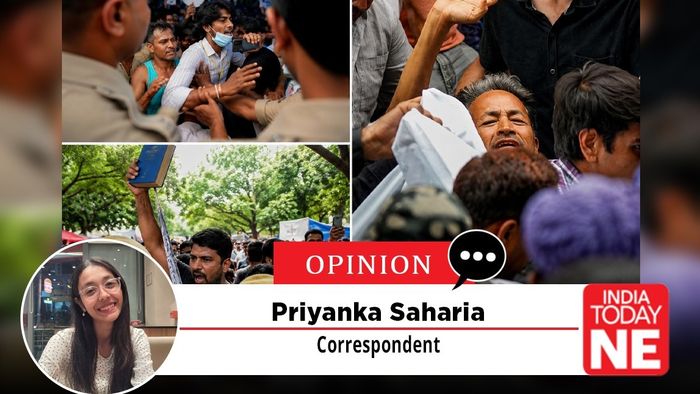
Activist Sonam Wangchuk was taken to a government hospital by the Delhi Police on the 21st day of his hunger strike after his health deteriorated, with the police citing medical advice and directions of the Delhi High Court.
As I watched the visuals from Jantar Mantar, I saw students, protesters, police personnel, and a man who had chosen one of the most peaceful forms of protest available in a democracy, a hunger strike. And one question kept coming back to me:
Who is more powerful in a democracy, the people or the government?
India has witnessed hunger strikes throughout its history. We have read about them in our textbooks. Mahatma Gandhi used fasting as a moral and political tool. Bhagat Singh undertook hunger strikes while in prison. Anna Hazare fasted against corruption. From Northeast India, Irom Sharmila spent nearly 16 years on an intermittent hunger strike demanding the repeal of the Armed Forces (Special Powers) Act, 1958, and was force-fed for years while in custody.
History tells us that fasting is not merely about refusing food. It is about demanding to be heard.
So today, I ask:
Why is the government not listening? Or at least, why is it not sitting across the table for a dialogue with its own citizens?
A government is elected because people trust it. Citizens cast their votes and hand over power with the expectation that those in office will remain accountable. Democracy is not just about winning elections; it is about answering difficult questions even after the votes have been counted.
After weeks of protest, shouldn't the country still be asking what went wrong in the NEET controversy? What failures allowed the situation to reach this point? If young lives have been lost amid the wider controversy, who carries the moral and institutional responsibility? Who answers to their families? Accountability cannot simply disappear because public attention moves on.
If a citizen chooses a peaceful hunger strike to seek answers and demand dialogue, should the response be silence? Or should the first response of a democratic government be engagement?
These are not questions about one individual alone. They are questions about the nature of democracy itself.
Can people no longer raise their voices without fear?
Can asking questions become a reason to be removed, detained, or ignored?
When citizens peacefully demand accountability, should the response come through conversation or coercion?
Watching the events unfold, another thought stayed with me. Social media is overflowing with debates about the protesters, their organisations, their intentions, their language, and their politics. Supporters and critics are arguing with equal intensity.
Yet somewhere in this noise, the original concern risks fading away.
The demand for accountability.
The demand for educational reforms.
The demand for answers.
Perhaps the most important question is not whether we agree with Sonam Wangchuk or with every organisation standing beside him. Democracies have always accommodated disagreement.
The real question is this:
Can an ordinary citizen still ask uncomfortable questions of those in power and expect to be heard?
Because governments change.
Political parties change.
Leaders change.
But democracy survives only when citizens never lose the freedom to question those they elect.
Power does not belong permanently to those who govern.
In a democracy, power originates from the people. Governments exercise that power on behalf of the people. And when people ask questions, seeking accountability should never be mistaken for challenging democracy, it is democracy in action.
If citizens become afraid to question their government, democracy loses one of its strongest pillars.
A government should not fear questions from its people.
It should answer them.