'Locked and Loaded': Trump's Missile Ultimatum Meets a Defiant Tehran as the Gulf War Deepens
Donald Trump escalated his confrontation with Iran with missile threats as Tehran refused talks without a ceasefire. The standoff is tightening the Strait of Hormuz and sharpening the economic risks for India, especially the North East.
- Jul 12, 2026,
- Updated Jul 12, 2026, 4:48 PM IST
With Iran refusing to return to the table without a ceasefire and the Strait of Hormuz throttled once again, the world — and India — braces for a longer, costlier war. For the North East, the shockwaves travel from the Gulf to the petrol pump, the LPG cylinder and the tea auction floor.
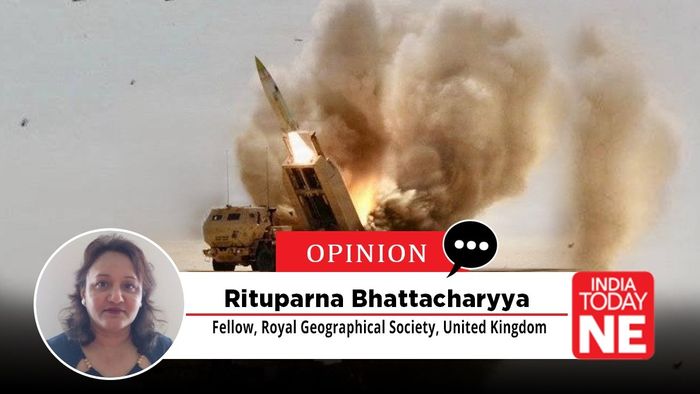
The uneasy pause that followed last month's memorandum of understanding between Washington and Tehran has collapsed into open threat and counter-threat. On Friday night, that is, 10th July 2026, US President Donald Trump warned that 1,000 American missiles stood 'locked and loaded and aimed at the Islamic Republic of Iran', with thousands more to follow if Tehran acted on what he described as a plot to assassinate him — a threat he said was voiced openly at the funeral of the slain Supreme Leader, Ayatollah Ali Khamenei, and separately conveyed to him by Israeli intelligence. He has since said that orders have been given to 'decimate and destroy all areas of Iran' should any attempt on his life succeed.
The rhetoric has been as scorching as the ordnance. Asked at the NATO summit in Ankara why he had soured so rapidly on Iran's rulers — men he had, barely a month earlier, called 'smart' and 'very rational' — Trump dismissed them as 'scum', 'cuckoo' and 'sick people', adding that they were 'sort of crazy… a little bit out of control', even as he insisted Tehran 'wants to make a deal so badly'. Declaring the 17 June memorandum 'over', he mused aloud: 'We can play games, but I'm not sure I want to make a deal. Let's just finish the job.'
Tehran, for its part, has refused to talk. Iran on Saturday rejected the American contention that negotiations could simply continue without a ceasefire, insisting that Washington must first meet its conditions on transit through the Strait of Hormuz and the normalisation of its oil exports. Chief negotiator Mohammad Bagher Ghalibaf was blunter still, saying he had told the US Vice President to his face: 'We have no trust in you.' Iran, he warned, is prepared for 'all-out defence'.
Overshadowing the diplomacy is the question of succession and revenge. In his first message since burying his father in Mashhad, the new Supreme Leader, Mojtaba Khamenei, pledged to avenge his 'innocent blood', declaring that 'revenge is the will of our nation'. Ayatollah Ali Khamenei was killed on the opening day of the US–Israeli war on Iran; his funeral procession wound through Tehran on Monday past hundreds of thousands of mourners. That the son has not appeared in public since assuming office has only deepened speculation about the stability of the Islamic Republic's leadership at its most perilous hour since 1979.
The immediate trigger for this week's escalation was maritime. Early in the week, Iranian forces attacked three commercial tankers in and near the Strait of Hormuz — strikes American officials attribute to an 'errant part' of Iran's system bent on wrecking the memorandum. Washington's response was ferocious: successive waves of air and naval strikes on roughly ninety Iranian military targets, from air-defence systems and coastal radars to missile depots and small-boat fleets, alongside fresh sanctions and the revocation of the oil-sales waiver that had underpinned the truce. Iran's Revolutionary Guard retaliated with missile and drone attacks on US bases in Kuwait and Bahrain; Tehran says at least fourteen people were killed in the American bombardment.
The arithmetic of the Strait tells its own story. On Wednesday (8th July), twenty-one tankers transited the waterway through which roughly a quarter of the world's seaborne oil must pass; by Thursday, the figure had collapsed to six. Washington is now demanding that Iran publicly declare the Strait open to all shipping — 'if it's not their position, it's not going to be a great day for them', one senior US official warned — and has made plain that nuclear negotiations, including its insistence on securing Iran's enriched uranium ('if we don't get the dust, we do not have a deal'), will go nowhere until the waterway question is settled. Oman is once again the frantic intermediary: Foreign Minister Abbas Araghchi travelled to Muscat on Saturday to meet his counterpart, Badr al-Busaidi.
For India, this is no distant quarrel. The International Energy Agency has already called the war's disruption the largest in the history of the global oil market, with Brent crude breaching $120 a barrel at the height of the March closure of the Strait. New Delhi, which draws the bulk of its crude and much of its LPG from the Gulf, has announced an expansion of its strategic petroleum reserves in direct response to the price shock. Every week of renewed disruption feeds through to freight rates, fertiliser costs, aviation fuel and household inflation — pressures that land hardest on peripheral economies such as the North East, where transport costs already inflate the price of essentials from Guwahati to Aizawl.
There is a sharper irritant still: American strikes this week hit the port city of Chabahar on Iran's south-eastern coast, damaging its maritime control tower. Chabahar is the anchor of India's most ambitious westward connectivity project — the Shahid Beheshti terminal operated by an Indian company, and the gateway to the International North–South Transport Corridor that was designed to bypass Pakistan. Washington had already stripped the port of its sanctions protection last year; bombing it places New Delhi's investment, and its careful balancing act between Washington and Tehran, under visible strain.
The North East has its own ledger of exposure. Iran has long been among the most important buyers of Assam's orthodox tea, and every previous sanctions cycle has snarled payments and squeezed the state's gardens; a full-blown war promises worse for an industry already under stress. Gulf remittances sustain thousands of households across the region, and any widening of the conflict to Kuwait, Bahrain and beyond puts that workforce in harm's way. And with airspace across West Asia repeatedly closed, the region's long-promised connectivity to the wider world grows costlier by the week.
Mediators in Muscat and Doha are racing to restore a diplomatic track that both principals profess to want intermittently. But with a grieving new Supreme Leader vowing that vengeance is 'inevitable', and an American president counting his missiles aloud, the space between war and peace in the Gulf has rarely looked narrower — or the stakes for India's eastern periphery higher.