Manipur University Prioritize Advanced Research Methodology Through Two-Day National Workshops
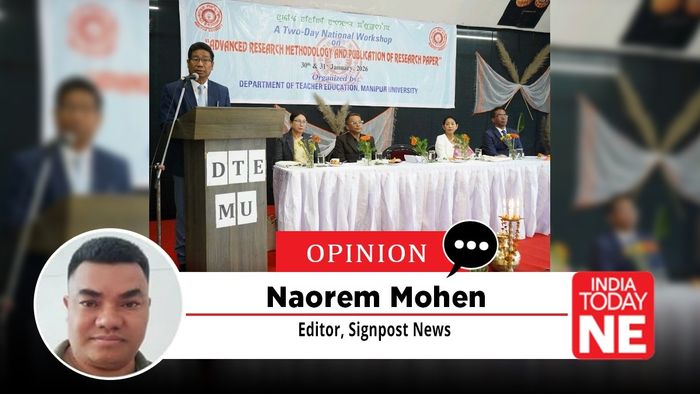
The Department of Teacher Education, Manipur University, recently concluded a successful Two-Day National Workshop on Advanced Research Methodology and Publication of Research Papers (30–31 January 2026) at the department’s Auditorium Hall.
- Jan 31, 2026,
- Updated Jan 31, 2026, 6:28 PM IST
The Department of Teacher Education, Manipur University, recently concluded a successful Two-Day National Workshop on Advanced Research Methodology and Publication of Research Papers (30–31 January 2026) at the department’s Auditorium Hall.
Attracting 160 participants—faculty, research scholars, postgraduate students, and invitees—the event combined conceptual depth with practical training in research methodology and scholarly publishing.
This National workshop directly tackled several persistent gaps that hold back research progress at institutions like Manipur University. By building deeper methodological competence, it empowered participants to move beyond superficial or descriptive work and instead produce robust, well-designed, solution-driven studies that genuinely align with the vision of NEP 2020, the priorities of the National Research Foundation, and the urgent demands of the 17 Sustainable Development Goals.
At the same time, the targeted training helped overcome long-standing publication hurdles—those familiar frustrations of rejection, mismatched journals, or weak manuscripts—equipping researchers with the practical skills to craft stronger papers and secure spots in high-impact, reputable journals.
In a region like Northeast India, where routine access to national-level experts, advanced resources, or frequent workshops remains limited, the event also played a vital role in fostering genuine collaboration, sparking fresh innovation, and nurturing a more vibrant, supportive research culture that motivates both faculty and young scholars. Ultimately, these efforts position Manipur University to step forward and contribute meaningfully at the national level, ensuring its research gains wider visibility, relevance, and influence rather than staying confined to regional conversations.
In his inspiring address as Chief Guest, Vice-Chancellor of Manipur University, Prof. N. Lokendra Singh painted a compelling picture of the intertwined power of teaching and research as the true engines of knowledge expansion and societal progress. He placed particular emphasis on the transformative frameworks provided by the National Education Policy (NEP) 2020 and the newly envisioned National Research Foundation (NRF), both of which he described as vital catalysts for fostering multidisciplinary learning and cutting-edge, boundary-crossing research.
Turning specifically to social science research—a domain especially relevant in Manipur and the Northeast—he stressed that it can no longer afford to remain confined to surface-level exploration and mere interpretation of phenomena.
Instead, he called for a bolder, more purposeful approach that generates actionable insights and real solutions. Prof. N Lokendra Singh went on to highlight the pressing imperative for academia to engage meaningfully and deeply with the 17 Sustainable Development Goals (SDGs), arguing that education and research must actively contribute to producing high-quality, tangible outcomes while supporting the restructuring and revitalization of systems within the state.
Throughout his remarks, he returned again and again to the central role of young minds—students, scholars, and early-career researchers—positioning them as the driving force capable of leading this much-needed change and ensuring that Manipur University’s contributions have lasting, positive impact on both regional and national development.
As Guest of Honour, Prof. Memcha Loitongbam, Dean of the School of Social Sciences at Manipur University, spoke with conviction about the necessity of a thorough, in-depth grasp of research methodology. She argued that only such understanding can lead to genuinely constructive and valuable research outcomes, and she urged participants to prioritize meaningful interaction, genuine collaboration, systematic and rigorous analysis, and the pursuit of high-quality, impactful research paper publications that truly advance knowledge.
Meanwhile, Prof. Ch. Ibohal Meitei, Director of the Research and Development Cell at Manipur University, turned the spotlight on the younger generation of researchers. He highlighted their vital role in driving progress and encouraged them to embrace innovative thinking—channeling creativity not as freewheeling experimentation, but in a disciplined, systematic, and well-organized way that leads to real breakthroughs.
Prof. Krishna Prasad Gogoi of the Department of Education at Dibrugarh University brought fresh external perspectives. He shared insightful reflections on the essential inputs and approaches that shape strong research, neatly connecting them to the three timeless fundamental questions every researcher must confront: What exactly is being studied, How should it be investigated, and—most critically—Why does it matter?In her presidential address,
Prof. Premlata Maisnam, Head of the Department of Teacher Education and Dean of the School of Education at Manipur University, delivered a heartfelt and forthright message. She described research as the true backbone of all academic development and growth, expressing deep concern about the persistent difficulties many face in getting their work published in reputed, high-quality journals.
At the same time, she warmly appreciated the workshop as an important sensitization programme, one that would help nurture and empower young minds. She strongly advocated for research and publication practices that are both innovative in spirit and uncompromisingly ethical in execution.
Finally, the keynote address by the workshop Convenor, Dr. Koijam Sobita Devi, brought clarity and focus to the entire event. She clearly articulated the programme’s primary objective: to significantly enhance the research competencies of faculty members, research scholars, and postgraduate students alike, equipping them with the advanced skills and confidence needed to produce work of lasting value.
The technical sessions, guided in part by external experts, provided a comprehensive and practical dive into the core elements that separate good research from truly impactful scholarship. They began with research topic selection and research design, guiding participants on how to identify feasible, original, and significant topics that fill genuine gaps in the literature while aligning with both national priorities like NEP 2020 and regional needs in Manipur and the Northeast.
From there, the focus shifted to crafting robust study designs—whether experimental, correlational, quasi-experimental, or mixed-methods—ensuring strong validity, reliability, and effective control of bias so that findings could stand up to scrutiny.Sessions on quantitative and qualitative data analysis offered balanced, hands-on insights into handling different kinds of evidence.
For numerical data, participants explored descriptive statistics, inferential tests, regression models, and more advanced techniques to reveal patterns and relationships with precision.
On the qualitative side, interpretive approaches such as thematic analysis, narrative inquiry, and grounded theory were unpacked, along with the value of triangulation to blend methods for richer, more trustworthy insights. Practical exposure to tools like SPSS for quantitative work and NVivo for qualitative coding made these concepts immediately applicable.
A particularly valuable segment addressed research tool development and standardization, which is especially relevant for education and social science researchers.
Experts walked through the step-by-step process of building valid and reliable instruments—questionnaires, rating scales, interview protocols, or observation checklists—starting with clear construct definition and literature-informed item generation, followed by pilot testing, item analysis (including factor analysis), reliability estimation using measures like Cronbach’s alpha, and norming to suit diverse populations.
In a context like Manipur, where tools often need cultural and contextual sensitivity, this training ensures measurements are credible and comparable.Academic writing received focused attention, with guidance on structuring manuscripts in the classic IMRaD format (Introduction, Methods, Results, and Discussion), writing concise yet compelling abstracts and introductions that hook readers and highlight significance, and maintaining logical flow, clarity, and an audience-appropriate tone throughout.
Ethics formed a foundational thread running through the sessions. Discussions emphasized obtaining informed consent, protecting participant confidentiality, minimizing any potential harm, securing institutional review board approvals where required, and practicing reflexivity—constantly reflecting on one’s own positionality and biases as a researcher.
Plagiarism prevention was treated with the seriousness it deserves, covering the spectrum of issues from direct copying and mosaic plagiarism to self-plagiarism, and offering clear strategies for proper citation, effective paraphrasing, and responsible use of detection tools like Turnitin to safeguard integrity.
Finally, journal selection and publication strategies tied everything together into actionable advice: how to critically evaluate journals based on scope, impact factor, indexing status, open-access models, and publication fees; how to steer clear of predatory outlets; how to write persuasive cover letters that emphasize novelty and fit; how to respond constructively to reviewer comments (even in the face of rejection); and how to revise diligently and persist through multiple rounds until success.
Across all these sessions, one message rang clear. Methodological rigor, unwavering ethical integrity, and skillful, strategic dissemination are not separate silos—they are deeply interdependent. Mastering them together is what transforms research into work that is credible, visible in high-quality venues, and genuinely relevant to society.
For researchers at Manipur University and similar institutions, these sessions delivered not just knowledge, but the practical toolkit needed to produce scholarship that matters.
Further gains in NIRF’s research-heavy parameters (publications, citations, professional practice) depend on sustained capacity-building.The workshop addressed key gaps like building deeper methodological competence to produce robust, solution-driven studies aligned with NEP 2020, NRF, and SDGs.
The valedictory included Prof. Ganga Prasad Prasain (Former VC, Tripura University) as Chief Guest, alongside Guests of Honour Prof. S. Jibonkumar Singh, Prof. Subhash Sarkar, and Prof. Pavan Kumar Yadavalli, with Prof. Premlata Maisnam presiding.
The strong turnout of participants reflects genuine demand. Regular advanced workshops—ideally expanding to multidisciplinary themes, grant writing, and collaborations—will accelerate progress, enhance rankings, attract funding, and enable Manipur University to produce transformative, ethical, high-visibility research that benefits the Northeast and India.
In today’s competitive academic atmosphere, prioritizing such training is imperative for excellence, relevance, and long-term impact. For a central university like Manipur University—located in Northeast India and facing geographical isolation, infrastructural constraints, and occasional disruptions—such workshops are essential, not optional.