Mission Clouded Leopard Must Become More Than a Conservation Promise
Every species on Earth bears a ‘secret gift’, a divine fragment of the infinite. Through these gifts, we glimpse not merely the struggle for survival, but the artistry of the Creator itself. In their movements, their voices and their hidden abilities, nature reveals a pattern that continually surpasses human imagination.
- Aug 08, 2026,
- Updated Aug 08, 2026, 5:49 PM IST
Every species on Earth bears a ‘secret gift’, a divine fragment of the infinite. Through these gifts, we glimpse not merely the struggle for survival, but the artistry of the Creator itself. In their movements, their voices and their hidden abilities, nature reveals a pattern that continually surpasses human imagination.
Among the cat family, few species capture the paradox of grace and power as vividly as the clouded leopard. Unlike lions and tigers, which roar, or smaller domestic cats that purr, the clouded leopard does neither. Its semi-ossified throat and neck bones place it in a distinct evolutionary niche, marking it as one of nature’s most remarkable creations.
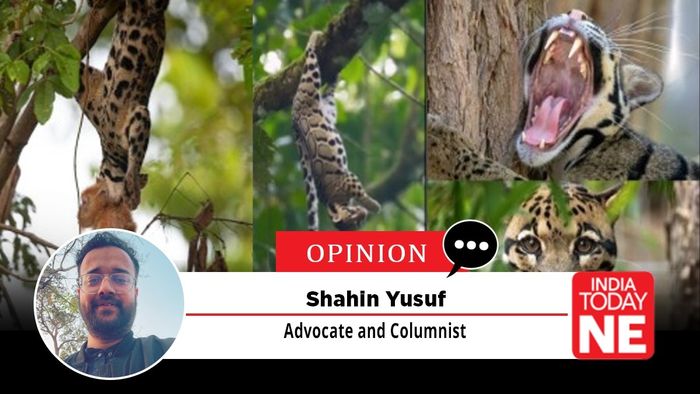
The clouded leopard is perhaps nature’s most extraordinary design. A silent hunter of deer, primates, birds and even porcupines which requires strong body armaments and claws, it reigns over the forest canopy with astonishing agility. It can descend trees head-first, hang effortlessly from branches and move through the treetops with a confidence unmatched by almost any other wild cat. Possessing the longest canine teeth relative to its skull of any living cat and exceptionally powerful limbs and claws, it is exquisitely adapted to life between earth and sky. Yet these remarkable adaptations endure only where forests remain vast, connected and undisturbed.
The clouded leopard carries both ecological and legal significance. The clouded leopard (Neofelis nebulosa) is listed as Vulnerable on the IUCN Red List and enjoys the highest statutory protection under Schedule I of the Wild Life (Protection) Act, 1972. Meghalaya’s initiative therefore rests not merely on ecological aspiration but also on constitutional and legal obligations.
The State is not judged by the number of policies it announces, but by whether those policies translate into measurable outcomes and deliverables. Environmental governance is no exception, though animals have no right to vote, citizens do judge
them especially in forested State like Meghalaya based on their conservation record. Article 48A directs the State to protect forests and wildlife, while the Supreme Court has repeatedly interpreted environmental protection as an integral component of the right to life under Article 21. Article 51A (g) similarly imposes a duty upon citizens to safeguard the natural environment. Against this constitutional backdrop, Meghalaya Government deserves appreciation for launching Mission Clouded Leopard on International Clouded Leopard Day. Known locally as Maccha Pheng in Garo and Lakrong in Khasi, this elusive wild cat has long been woven into the cultural and ecological heritage of the State. The Mission has rightly identified habitat restoration, scientific research, community participation and landscape connectivity as its principal pillars. Yet conservation history repeatedly demonstrates that vision documents often falter during implementation. The Action Plans must move beyond broad objectives and clear define responsibilities, timelines and statutory authority before implementation begins.
The greatest challenge to Mission Clouded Leopard is governance, not science. Forest conservation in Meghalaya covers 76% of the state but operates within a complex framework where most forests are owned by communities, clans, or individuals, with legislative authority resting in Autonomous District Councils under the Sixth Schedule. Rising market pressures and aspirations have commodified forests, driving deforestation, Meghalaya lost 84.07 sq km between 2021–23. Litigation over the NGT’s 2014 ban on rat-hole mining shows how ownership and customary rights complicate conservation. Any High Ecological Value Zones must involve tribal institutions, not unilateral administration. Urbanisation adds stress through hill cutting and timber demand, worsened by the absence of land-zoning laws and informal timber trade. Shifting cultivation, once sustainable, now threatens biodiversity as shortened cycles prevent regeneration.
Successful conservation requires recognising local communities as partners, not obstacles. Meghalaya already has statutory tools to reward stewardship: Biodiversity Management Committees under the Biological Diversity Act, 2002 and Community Forest Resource rights under the Forest Rights Act, 2006. These provide a legal base for conservation agreements and Payment for Ecosystem Services, which must be clearly built into the Action Plan rather than vague references to participation. Compensation and livelihood programmes should be legally enforceable, not discretionary. Forest protection succeeds only when communities living near wildlife gain tangible benefits. The Meghalaya Basin Development Authority, working through the World Bank-supported Community-Led Landscape Management System, is best placed to coordinate this effort, given its reach, manpower, and resources in rural areas. The State PWD, National Highways Authority of India, and other construction agencies must acknowledge the presence of this species within forest habitats, refrain from disruptive construction, and adopt long-term mitigation measures.
Scientific conservation requires measurable baselines and independent reviews. The survey identifying 21 clouded leopards in Balpakram provides a starting point. Habitat corridors linking Nokrek, Balpakram, Baghmara, Narpuh, and Nongkhyllem should be mapped using telemetry, camera traps, and genetic studies, with periodic reviews against clear indicators. Poaching remains a major threat, driven by illegal trade in body parts. An inter-departmental task force—integrating Forest, Police, Revenue, Tourism, and community institutions—must be constituted with a mandate of zero poaching mortality, achieved through targeted crackdowns, lawful arrests, proper charge-sheets, intelligence gathering, and community cooperation.
Technology, too, must reflect ecological realities. Meghalaya’s prolonged monsoon requires year-round monitoring systems rather than seasonal enforcement. Conservation cannot stop at political borders. The clouded leopard’s habitat extends into Bangladesh, but international cooperation lies within the Union Government’s domain. Meghalaya’s role should focus on technical coordination, scientific data-sharing, and collaboration through bilateral and CITES mechanisms under the Ministry of Environment, Forest and Climate Change, rather than pursuing independent cross-border arrangements.
The clouded leopard is more than an endangered species; it is an umbrella species reflecting the health of Meghalaya’s forests and biodiversity. Mission Clouded Leopard will be judged not by its announcement but by its implementation. An Action Plan must clearly define legal authority, institutional responsibility, financing, scientific benchmarks, and community participation to endure political change and judicial scrutiny. Without these foundations, the Mission risks fading into rhetoric; with them, Meghalaya can set a model for forest governance beyond a single species.