Moromor Deuta: Reintroducing a Literary Giant to Contemporary Audiences
The story of modern Assamese literature, theatre, and cinema cannot be told without acknowledging the immense contribution of Dr. Bhabendra Nath Saikia.His contributions as a storyteller, novelist, playwright, filmmaker, editor, and educator were extraordinary.
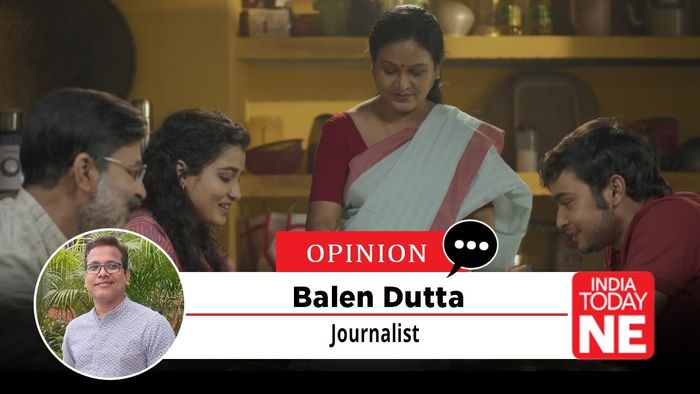
- Jun 15, 2026,
- Updated Jun 15, 2026, 2:12 PM IST
“MoromorDeuta has awakened Dr. Saikia after 23 years of silence.” – Preeti Saikia
The story of modern Assamese literature, theatre, and cinema cannot be told without acknowledging the immense contribution of Dr. Bhabendra Nath Saikia.His contributions as a storyteller, novelist, playwright, filmmaker, editor, and educator were extraordinary. Whatever field he engaged with, he enriched with remarkable creativity and excellence. More than a writer, dramatist, editor, or director, he was, in many ways, a complete cultural institution who helped shape Assam's intellectual and artistic consciousness.
Yet, as time passed, the works of Dr Saikia - like those of many great literary figures - gradually receded from the regular conversations of younger generations. Every year, Aarohan (The initiative by Dr Saikia under Bhabendra Nath Saikia Children Welfare Trust) and a handful of devoted admirers have continued to commemorate his birth anniversary and remember his legacy. However, there has been comparatively little effort to revisit his vast body of work through fresh creative interpretations, critical engagement, or contemporary artistic mediums. When literature remains confined to remembrance alone, its living connection with society slowly fades away.
It is within this context that the recently released film MoromorDeuta, directed by Himjyoti Talukdar, assumes particular significance.
This is Talukdar's third Assamese feature film. His earlier works, Calendar (2018) and Taarikh (2025), received widespread appreciation from audiences and critics alike. Both films demonstrated his ability to explore social realities, human psychology, and the subtle shifts of changing times through a sensitive cinematic language. Following the success of Taarikh, he came to be regarded as one of Assam's promising filmmakers.
Seen from that perspective, MoromorDeuta is much more than just another film in his career. It represents the formidable challenge of reinterpreting a treasured literary creation of one of Assam's greatest literary icons through the language of contemporary cinema.
Audiences have embraced the film wholeheartedly. At a time when it is often claimed that Assamese viewers do not watch Assamese cinema, a film based on Dr. Saikia's novel has successfully completed four weeks in theatres. That, in itself, is an encouraging development.More importantly, just as Dr. Saikia's stories resonate deeply with ordinary readers - perhaps even more than with critics - MoromorDeuta has managed to touch the hearts of everyday audiences. This may well be the defining strength of Dr. Saikia's writing, the rare ability to preserve literary depth while remaining emotionally accessible to common people.The film also reminds us of an important truth: Assamese literature possesses an abundance of stories worthy of cinema. What is needed is the willingness and vision to discover them. MoromorDeuta stands as one such example.
At the same time, the film has not been without criticism. Some viewers have pointed out that several elements differ from the original novel - character names have been altered, certain aspects of the social context have been modified, and there are ambiguities regarding the period setting. However, Literature and cinema are fundamentally different forms of expression. What can be described through words in a novel often requires reinterpretation through images, movement, sound, silence, and dramatic rhythm in a film. Adaptation, in cinematic theory, is rarely understood as a literal, word-for-word translation. Rather, it is viewed as an act of reinterpretation -a fresh artistic response designed for a different medium, a different era, and a different audience. This is why even masters of cinema exercised creative freedom while adapting literary works. Satyajit Ray introduced changes in Pather Panchali, despite its roots in Bibhutibhushan Bandyopadhyay's novel. Ritwik Ghatak reshaped literary narratives according to his own cinematic vision. Across world cinema, significant literary adaptations often bear the personal imprint of their directors.
Today's audiences perceive stories differently from audiences of three or four decades ago. Their visual literacy, social experiences, and expectations of storytelling have evolved considerably. Had Moromor Deuta been recreated exactly as the novel existed within its original context, it might not have connected with younger viewers with the same emotional force. Talukdar appears to have recognised this reality. The altered names, newly introduced social nuances, and blended temporal sensibilities can all be seen as part of a filmmaker's creative freedom. One may agree or disagree with these choices, but they emerge from an artistic rationale.
Perhaps the film's greatest achievement lies elsewhere. Moromor Deuta has brought Dr. Bhabendra Nath Saikia back into public conversation. Many young viewers are discovering him for the first time through this film. They are becoming curious about his writings and eager to explore his literary world. That is no small accomplishment. In this regard, the remarks of Preeti Saikia, Dr. Saikia's wife, carry profound significance. Responding to a question, she observed:
"It felt as though Dr. Saikia had been asleep for twenty-three years, and Moromor Deuta awakened him once again."
That statement perhaps offers the most meaningful assessment of the film. Beyond being his life partner, Preeti Saikia was also a close collaborator and producer of Dr. Saikia's films, making her one of the people most deeply connected to both his personal life and artistic legacy.If this cinematic endeavour could bring her a sense of joy and fulfilment, then her perspective merits thoughtful consideration.
It is also worth remembering that after Dr. Saikia's passing, veteran filmmakers the late Munin Barua and Prabin Hazarika adapted his works into films such as Dinabandhu (based on the short story Joutuk) and Shrinkhal (based on the short story of the same title) . However, until now, no younger filmmaker had ventured into bringing Dr. Saikia's stories to the screen. Through Moromor Deuta, Himjyoti Talukdar has opened that path.
Preeti Saikia also noted another encouraging development - after watching the film, members of the younger generation of filmmakers have expressed interest in adapting more of Dr. Saikia's stories for cinema. This suggests that Moromor Deuta has rekindled a meaningful dialogue between Assamese literature and filmmaking.
It also raises an important cultural question. In West Bengal, figures such as Satyajit Ray continue to occupy a vibrant place in public imagination through constant engagement and celebration. Why have we, in Assam, not sustained a similar relationship with a personality as significant as Dr. Bhabendra Nath Saikia? Literature cannot remain confined to textbooks and memorial gatherings alone. It must continually find new languages, new mediums, and new audiences. At the very least, Moromor Deuta has attempted exactly that.
Debates over whether the film is flawless will undoubtedly continue. Differences of opinion are natural and necessary in any artistic discourse. But one fact is difficult to deny: after many years, a young filmmaker has had the courage to bring Dr. Bhabendra Nath Saikia's literary legacy back into the cultural consciousness of the people in the very critical phase of Assamese cinema.That courage, that sense of responsibility, and that commitment to cultural continuity deserve recognition.
Ultimately, Moromor Deuta may be remembered as more than just a film. It may stand as a conversation between generations - a bridge connecting the cultural inheritance of the past with the sensibilities of the present.
Twenty-three years after Dr. Bhabendra Nath Saikia's passing, a young filmmaker has stepped forward to introduce him once again to a new generation.
And that, surely, is a hopeful cultural story for all of us.