Morvi 1979: The Flood That Gave Me a Second Life
The 1979 Morvi dam disaster devastated the town with massive floods and loss of life. Survivors and the community rebuilt Morvi into a symbol of resilience and industrial revival.
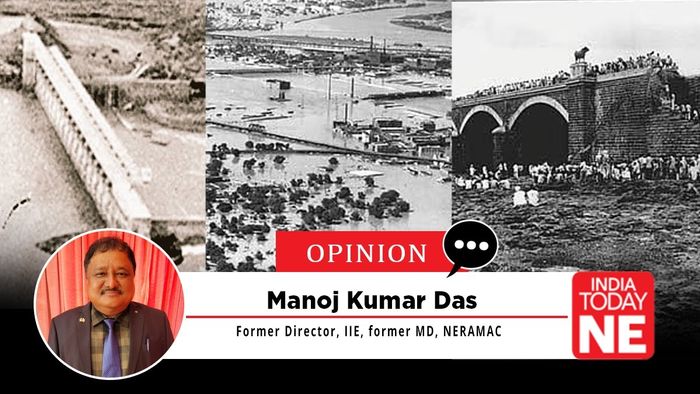
- Aug 04, 2026,
- Updated Aug 04, 2026, 2:23 PM IST
A Survivor's Memoir of India's Deadliest Dam Disaster
Part I: When the Waters Came
Some memories fade with time. Others remain frozen forever.
For me, 11 August 1979 is one such day. Nearly five decades have passed, yet every monsoon, every image of swollen rivers, and every report of devastating floods transport me back to the historic town of Morvi in Gujarat. I can still hear the deafening roar of the floodwaters, see a railway coach carrying desperate men, women, and even stray dogs disappear into a raging torrent, and relive the desperate struggle for survival on the rooftop of Hill Hostel. Those memories remain as vivid today as they were on that unforgettable afternoon. On that day, I came face to face with death. By the grace of God, I survived. More importantly, those three harrowing days transformed my understanding of life, leadership, engineering, and public service in ways no classroom ever could. Barely fifteen days earlier, I had left my village of Bordoloni in Assam's Dhemaji district to pursue a degree in Production Engineering at Lukhdhirji Engineering College, Morvi. For a seventeen-year-old boy, it was the journey of a lifetime—more than 2,500 kilometres across India into a land that was culturally, linguistically, and geographically unfamiliar. I arrived alone with a steel trunk, a holdall, and dreams larger than my luggage. No one in my family had ever travelled to Gujarat, and I was probably the only student from Assam in the college. Like countless young Indians leaving home for higher education, I carried little more than a bedding roll, a few engineering books, my prized mini-drafter, and the hope of building a meaningful career. I believed I was travelling to Morvi to study engineering. I did not realise that destiny had brought me there to witness one of history's greatest engineering disasters—and to learn lessons about resilience, responsibility, and the value of human life that would shape the rest of my journey.
A Town Built on Vision
Morvi was unlike any town I had ever seen. Nestled on the banks of the Machhu River, about 240 kilometres from the Rann of Kutch where the river meets the Arabian Sea, it was once celebrated as the "Paris of India." Its broad avenues, elegant public buildings, graceful suspension bridges, royal palaces, and meticulously planned civic infrastructure reflected the vision of Maharaja Sir Lakhdhirji Waghji Jadeja, the enlightened ruler of the erstwhile princely State of Morvi. The Lukhdhirji Engineering College campus was itself a part of that rich legacy, much of it having once belonged to the royal capital complex. Our residence, Hill Hostel, named after Sir Claude Hill, a former Governor of Saurashtra, was an imposing structure built of massive stone masonry with remarkable craftsmanship—a lasting testament to the engineering excellence of an earlier age. The Maharaja's foresight extended beyond architecture. He established Gujarat's first polytechnic and promoted technical education in pioneering disciplines such as Horology and Ceramic Technology, initiatives that later gave birth to renowned industries like Scientific Clock Industries and Parshuram Potteries, laying the foundations of Morvi's industrial transformation. As newly admitted engineering students, we admired the town's heritage and vibrant atmosphere, never imagining that within a matter of days this thriving industrial and educational centre would become synonymous with one of independent India's greatest man-made disasters.
An Ordinary Rainy Afternoon
he morning of 11 August 1979 dawned with relentless rain. For several days, Gujarat had been lashed by unusually heavy monsoon showers, but as first-year engineering students, weather reports were the last thing on our minds. We were far more occupied with settling into hostel life, attending classes, making new friends, and adjusting to a life far away from home. Among my closest companions were students from Manipur and Odisha. Although we hailed from different parts of India and spoke different languages, hostel life quickly dissolved those differences. We studied together, shared meals, laughed about our struggles with Gujarati food, and dreamed of the future. That afternoon, the incessant rain made it impossible to walk to our favourite student haunt, the Nataraj Hotel, for lunch. After eating whatever little food we had in the hostel, we returned to our rooms for an afternoon rest. It seemed like just another rainy day until, at around 3:00 p.m., I was jolted awake by loud shouts and frantic commotion. At first, I could not understand what had happened. Curious, I walked to the window—and froze. The floodwater had already risen to the level of the windowsill.
The Railway Coach
Looking towards the nearby narrow-gauge railway workshop, I witnessed a scene that seemed almost unreal. Three narrow-gauge railway coaches were being swept away by the raging floodwaters. On the roof of one coach stood a handful of terrified people, while a few stray dogs had instinctively climbed aboard in search of higher ground. For a brief moment, it appeared that the coach might carry them to safety. Then an immense wall of muddy water slammed into it with terrifying force. The coaches twisted violently, rolled over, and vanished beneath the torrent. In an instant, the people were gone. The dogs were gone. Everything disappeared. Nearly five decades later, that haunting image remains etched in my memory. Whenever I see news of devastating floods anywhere in India, it is that railway coach—its desperate passengers and their final moments—that returns to me first.
Instinct
I have often wondered what made me react so quickly that afternoon. The answer, I believe, lies not in Morvi but in my childhood beside the flood-prone Jiadhal River in Bordoloni, Dhemaji, Assam. Every monsoon, we watched rivers swell, embankments weaken, villages prepare for inundation, and families move to safer ground. Floods were not strangers to us; they were an accepted part of life. We had learnt not only to live with them but also to benefit from them. The annual floods replenished our fields with fertile silt, brought driftwood for fuel, and filled the rivers with fish. Without consciously realizing it, those childhood experiences had trained my mind to recognize danger long before others sensed it. The moment I saw the railway coach disappear beneath the raging waters, instinct told me this was no ordinary flood. There was no time to hesitate, no time to analyse, and no time to gather all our belongings. I shouted for my friends to wake up and, within seconds, grabbed whatever I could—some clothes, my engineering books, my prized mini-drafter, the cash I had, medicines, shoes, and a few personal belongings. Then we ran.
Racing the Water
The staircase became our lifeline. As we rushed upward, something terrifying happened—the floodwater seemed to chase us, rising with astonishing speed. It felt as though a giant column of water was pursuing us up the building, much like water racing through a capillary tube. By the time we reached the first floor, the water had already caught up. We knew that stopping, even for a moment, meant certain death. Without exchanging a word, we continued climbing until we reached the terrace. Every room was locked, leaving us with no choice but to force open the pumpman's room. That tiny space became our refuge for the next three days. We possessed almost nothing that could sustain us: a bunch of bananas, a few medicines, and drinking water from the overhead tank. As darkness fell and rain continued to lash the rooftop, we realized we needed a source of light. Necessity demanded improvisation. Drawing upon the ingenuity I had learnt growing up in a village without electricity, I fashioned a small oil lamp from an empty ink bottle, the steel valve of a discarded bicycle tube, a strip of cloth for a wick, and a little kerosene the pumpman had left behind. The tiny flame barely illuminated the room, yet it transformed our spirits. In that moment, I learnt that hope does not always arrive as a blazing torch; sometimes it survives as the faintest flicker of a small lamp refusing to be extinguished.
A Sea Where a Town Once Stood
From the rooftop, we watched helplessly as Morvi disappeared beneath a vast, raging sea of muddy water. Entire thatched houses floated past like matchboxes, uprooted trees slammed into buildings, and furniture, livestock, vehicles, and household belongings swirled endlessly in the violent current. Most heartbreaking of all was the sight of human and animal bodies being carried away by the flood. No engineering textbook, no classroom lecture, and no youthful imagination could have prepared us for such unimaginable devastation. Barely fifteen days earlier, I had left my home believing that engineering was about machines, factories, and production systems. Standing on that rooftop, surrounded by destruction on a scale I had never imagined, I realised that engineering is, above all else, about safeguarding human life. A failed structure can destroy an entire city; a well-designed and well-built one can save countless lives. That profound lesson, learnt amid the tragedy of Morvi, has remained with me throughout my life and career.Far away in Assam, my family had no idea what I was going through.
There were no phones. Mobile phones, internet were not invented then. Television had experimentally reached India. Ironically, my family was initially reassured because they knew I was staying in a place called "Hill Hostel." They imagined that it must be located safely on elevated ground.
Much later, I learnt that my grandmother had repeatedly dreamt of me trapped in floodwaters. At the time, no one could understand the source of her anxiety. In Morvi, meanwhile, we remained completely cut off from the outside world, with no way of knowing whether help would ever reach us. The relentless rain continued without pause, and the floodwaters showed no sign of receding. As darkness gave way to another uncertain night, we could do little except wait, pray, and hope that we would survive to see another sunrise. Those long hours of helplessness taught us that when human strength reaches its limits, hope and faith become the only anchors that keep despair at bay.
The first night on the rooftop seemed endless.
The first night on the rooftop seemed endless. The relentless rain, the darkness, and the deafening roar of the floodwaters below made sleep impossible. Huddled together inside the tiny pumpman's room, we did not know whether the building beneath us would withstand the fury of the Machhu River. Our provisions were painfully meagre—a bunch of bananas, a few medicines, drinking water from the overhead tank, and the small improvised lamp whose flickering flame gave us more hope than light. Unsure how long we would remain stranded, we rationed the bananas with great care, cutting each one into six small pieces. Hunger gnawed at our stomachs, but fear was stronger than hunger. Every crashing sound from below made us wonder whether another building had collapsed or whether the waters were rising once again. When dawn finally broke on 12 August, we stepped onto the rooftop and looked around. What met our eyes was beyond imagination. The Morvi we had known had simply ceased to exist. Our hostel stood like a lonely island in an endless expanse of muddy water. The once-bustling neighbourhood had been transformed into an unrecognisable wasteland. Houses had vanished, roads had disappeared, and uprooted trees lay scattered across the landscape. Everywhere we looked, the flood had left behind a trail of destruction—debris, furniture, livestock, household belongings, and the lifeless bodies of both people and animals. An eerie silence had replaced the sounds of a vibrant town, broken only by the distant, relentless roar of the floodwaters, a grim reminder that the catastrophe was far from over.
Walking Through a Dead City
As the floodwaters slowly receded, curiosity and concern drew us out of the hostel to see what had become of the town. Barefoot, we walked cautiously towards the spot where our favourite student haunt, the Nataraj Hotel, had once stood. Every step was painful. Thick layers of slush concealed sharp babool thorns, broken glass, twisted metal, and shattered masonry that pierced our feet as we struggled forward. The familiar landmarks of Morvi had vanished. The Nataraj Hotel had been washed away without a trace, and the cycle shop across the road had suffered the same fate. Bicycle frames, wheels, chains, and mangled metal lay scattered over a wide area, mute testimony to the unimaginable force of the flood. Then we encountered a sight that continues to haunt me even after nearly five decades. Human bodies hung suspended from electric and telephone wires, left there as the floodwaters receded. No words can adequately describe the horror of that moment. Death had become so widespread that it seemed almost unreal. As we stood in stunned silence, a man carrying the few belongings he had managed to salvage walked past us and quietly said, "The whole city is finished." His words carried neither anguish nor drama—only the weary acceptance of an unbearable truth. Only years later did I fully appreciate the science behind the devastation we had witnessed. A single cubic metre of water weighs about one tonne; when millions of tonnes of water surge forward at tremendous speed, they become an unstoppable force capable of uprooting bridges, collapsing buildings, and sweeping away entire neighbourhoods. That tragic afternoon taught me never to underestimate the power of nature—a lesson that has become even more relevant today as India faces increasingly frequent floods and other extreme weather events.
Waiting for Rescue
Rescue operations were severely hampered because the relentless rain prevented helicopters from flying. For nearly three days, we remained stranded and largely cut off from the outside world, uncertain whether help would ever arrive. When the weather finally improved, helicopters began circling over Morvi, dropping food packets onto rooftops. A few landed on our hostel terrace. The food was cold, rain-soaked, and difficult to eat, but to us it was more than a meal—it was the first tangible sign that we had not been forgotten. Soon afterwards, we were instructed to make our way to Parshuram Potteries, where one of the largest relief camps had been established. The walk of barely three kilometres felt like a journey through a city transformed beyond recognition. An industrial unit known until then for manufacturing ceramic products had become a centre of compassion and hope. Volunteers worked tirelessly, huge cauldrons of food simmered continuously, doctors attended to the injured, and anxious families searched for missing loved ones. For the first time since the disaster, we were served a bowl of hot khichdi. Standing in a relief queue for that simple meal became one of the defining moments of my life. Until then, I had never imagined that I would one day depend on humanitarian aid for survival. Yet that humble bowl of khichdi tasted better than any feast I had ever eaten. It taught me humility, gratitude, and the true value of food. Even today, I cannot bear to waste a single grain of rice, for every grain reminds me of Morvi and of the countless lives forever changed by that tragic flood.
News Reaches Home
Communication in 1979 was painfully slow, making the uncertainty almost as agonising as the disaster itself. Ironically, one of the earliest visual images of the Morvi tragedy reportedly came not from India but from an American satellite, and the news reached television audiences overseas before many people within the country fully understood its magnitude. It is said that a young woman from Morvi, living in the United States, alerted the Prime Minister's Office, helping convey the scale of the catastrophe to the Indian authorities. Meanwhile, thousands of kilometres away in Assam, my family waited anxiously for news. They knew only that I was studying in Morvi and had no means of finding out whether I was alive. My grandmother, meanwhile, remained deeply troubled by recurring dreams in which she saw me trapped in floodwaters. Only when communication was finally restored did my family learn that I had survived. The relief they felt was beyond words. For them, as for me, the journey from fear and uncertainty to hope had lasted an eternity.
Beginning Again
After the immediate relief operations stabilised the situation, the engineering students of Lukhdhirji Engineering College were shifted to Lalbhai Dalpatbhai (LD) College of Engineering in Ahmedabad so that our education could continue. Gradually, life began to regain a semblance of normalcy, but none of us who had lived through the Morvi disaster were ever the same again. Months later, when conditions improved, we returned to Morvi to resume our studies. Recognising the extraordinary circumstances, the authorities offered all affected students mass promotion to the next academic year. Many accepted the concession, understandably so. I, however, made a different choice. I requested permission to appear for the examinations because I believed that a marksheet earned through one's own effort carried a value that no concession could replace. Looking back, I realise that this decision was yet another lesson born out of adversity: difficult circumstances may justify compassion, but they should never become an excuse to compromise one's standards or diminish the satisfaction of honest achievement.
The Engineering of Survival
Years later, I often found myself reflecting on why Hill Hostel had survived when many newer buildings had failed so catastrophically. Built with massive stone masonry and exceptional craftsmanship, the hostel stood firm against the fury of the flood. In contrast, the nearby hostel blocks—Machhu-I, Machhu-II, and Machhu-III—had suffered devastating damage. When we later visited them, only reinforced concrete columns and floor slabs remained; most of the walls had been swept away by the torrent. For a young engineering student, the contrast was both striking and unforgettable. It taught me that engineering is not merely about constructing impressive structures or achieving technical excellence—it is a sacred responsibility entrusted with the protection of human life. Every calculation, every design decision, and every choice of material has consequences measured not only in cost or efficiency but in lives saved or lost. The failure of a single dam devastated an entire town, while the strength of one well-built hostel preserved the lives of dozens of young students. No classroom lecture or engineering textbook could have imparted that lesson more powerfully than the tragedy of Morvi itself.
Morvi's Remarkable Rebirth
History, however, did not end with the flood. Against seemingly insurmountable odds, Morvi rose from the ruins and rebuilt itself with extraordinary determination. Volunteers from numerous organisations, government agencies, local communities, and countless ordinary citizens worked tirelessly to recover bodies, clear mountains of debris, restore essential services, and rebuild shattered homes and lives. The contribution of RSS volunteers in cleaning the devastated town and assisting survivors was widely acknowledged, while Gujaratis across India and around the world extended generous support for relief and reconstruction. In the end, the resilience of the people proved stronger than the fury of the flood. Building upon the industrial foundations laid decades earlier by Maharaja Sir Lakhdhirji Waghji Jadeja, Morvi gradually reinvented itself. Scientific Clock Industries continued to uphold the town's horological legacy, and Parshuram Potteries remained an enduring symbol of its industrial heritage. Most remarkably, Morvi transformed itself into India's ceramic and vitrified tile capital. Today, more than a thousand ceramic and tile manufacturing units produce world-class products exported across the globe. Morvi's remarkable journey—from unimaginable devastation to global industrial prominence—stands as one of India's most inspiring stories of resilience, reconstruction, and the indomitable spirit of its people.
The Flood That Never Left Me
Looking back after nearly half a century, I realise that Morvi did far more than spare my life—it shaped the person I became. The flood taught me to remain calm in moments of crisis because panic never solves a problem. It taught me to make decisions swiftly because hesitation can cost lives. It impressed upon me that preparedness is always more valuable than reaction, that hunger strips away every illusion of privilege, and that survival itself is a blessing to be cherished with gratitude. Throughout my later career in public institutions, entrepreneurship development, and the revival of struggling organisations, I repeatedly drew upon the lessons first learnt on the rooftop of Hill Hostel. Whether rebuilding institutions in distress or confronting seemingly insurmountable challenges, I carried with me an unshakable conviction that no destruction is so complete that it cannot be overcome through courage, compassion, sound leadership, and collective determination. Even today, whenever devastating floods strike Assam, Bihar, Uttarakhand, Kerala, Gujarat, or any other part of India, I do not merely watch the news—I relive my own memories. I remember the railway coach carrying frightened people and stray dogs before disappearing forever beneath the raging waters. I remember the tiny homemade lamp whose faint flame kept hope alive in our darkest hours. I remember the humble bowl of hot khichdi that restored not only my strength but also my faith in humanity. I remember a city buried beneath mud that refused to surrender. Above all, I remember that I had travelled more than 2,500 kilometres from Assam to Morvi believing I was going there to study engineering. Instead, Morvi taught me the engineering of life—lessons in resilience, responsibility, humility, and hope that no university curriculum could ever have offered. The waters of the Machhu River receded long ago, but the lessons they left behind continue to shape every chapter of my life.