No NRC, No Census: Can Manipur Afford to Skip the Count?
Manipur's ethnic conflict intensifies as Meiteis demand NRC before Census 2027, while Kukis oppose this order. The region faces governance challenges that require simultaneous NRC and census implementation for better policy outcomes. Provide the answer in Indian English
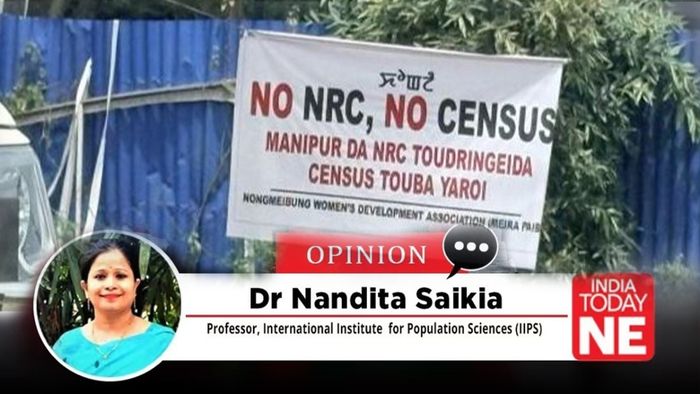
Dr Nandita Saikia
- Sep 14, 2026,
- Updated Sep 14, 2026, 9:11 AM IST
This week, after an official visit to Meitei-dominated districts of Manipur, a striking reality emerged. Though I wished to travel into Kuki-inhabited areas, no Meitei car from Imphal would risk the journey amid the ongoing ethnic conflict. Across urban and rural Manipur plain, one slogan dominated every surface—buses, shops, temples, cars, and even trees: “No NRC, No Census.” While the rest of India prepares for Census 2027 after a 16-year gap, Manipuri’s are demanding the National Register of Citizens first and resisting the census.
What drives this unusual stance?
Manipur: A Unique Indian State Bound to Sanatan Civilisation
Few outside the Northeast realise that Manipur has been a co-creator of Sanatan civilisation since the Mahabharata era. The Adi Parva of the Mahabharata (Gita Press, Gorakhpur edition) describes Manipura as a “city of jewels,” ruled by King Chitravahana. His daughter, Princess Chitrangada, lived as a prince until she met Arjuna during his exile. The third Pandava Arjuna fell in love with her; they married in Manipura and had a son, Babruvahana, who stayed behind at the king’s request to continue the royal line.
At first glance, Manipur’s people present an Oriental appearance—women in two-piece traditional attire riding scooters, or the famous all-women markets that dominate every district centre. Yet this diversity only underscores India’s genius for absorbing many races: a Tamil face differs from a Punjabi’s, just as a Jharkhandi look differs from a Kashmiri’s.
The Meiteis remain the largest community in Manipur’s valley and form the cultural core of the state. A closer look at Meitei culture reveals deep cultural oneness with Sanatan traditions. The women’s two-piece dress echoes Assam’s mekhela-sador, Kerala’s mundum-neriyathum, and the Gopi attire of Braj. Manipuri classical dance, one of India’s most celebrated forms, vividly portrays the Raas Leela of Sri Krishna and the Gopis.
Most Meiteis follow Gaudiya Vaishnavism; many practise it alongside the indigenous Sanamahi faith. Sanamahism itself shares striking parallels: its five classical elements—fire, water, air, earth and ether—mirror the Panchabhuta concept. The supreme creator Atingkok Maru Sidaba has a consort, Leimarel Sidabi, the great mother-earth goddess who may appear as Imoinu, a counterpart of Devi Lakshmi who brings wealth and peace. In Meitei courtyards one commonly finds a carefully tended Tulsi plant, before which water and flowers are offered to the deity—exactly as in Sanatan households. Men and women wear Tulsi malas with vertical chandan tilak, clear markers of Vishnu worship. Ancestor worship and reverence for forest deities are everyday practices, just as in many North Indian villages. Young Meitei boys still wear earrings and anklets, another shared Indian custom. Every Meitei child has Janam Kundli, used in marriage matching. Manipur maintains a stronger presence in Vrindavan than any other Northeastern community. And who doesnot know Manipur’s distinctive contribution to the Indian National Army during the freedom struggle? Whether through Gaudiya Vaishnavism or Sanamahi, Manipura’s cultural continuum with the rest of India stretches back to time immemorial. Yet, Manipur is under crisis today!
Frontier Neglect: Manipur’s Enduring Crisis of Illegal Migration
As one of India’s frontier states, Manipur has long faced challenges that successive policymakers and researchers largely overlooked. Historically, the state endured a massive Burmese invasion between 1819 and 1826. In the decades that followed, it has grappled with insurgency, drug trafficking, and continuous illegal immigration from Myanmar (formerly Burma). Despite a strong work ethic, the central role of women in family and society, and fertile land, industrial development has remained stagnant. In recent years, the state has drawn national attention due to the intense conflict between Meiteis and Kukis. Kukis, originally from the Burma region, first entered Manipur in significant numbers during the colonial period as militias, labour corps, and settlers. Further migration occurred during World War II.
The porous and poorly guarded border has allowed continued influx, especially during political upheavals such as military rule in Myanmar or periods of insurgency in India’s Northeast. Today, Meiteis — among the oldest communities of the state — find their movement largely confined to the valley, with restricted access to the hill areas. Meitei leaders emphasise they have no grievance against Kukis who settled before Independence. Their concern centres on post-Independence illegal entrants who, they argue, are reducing available space and resources for the indigenous population and are now demanding a separate administrative zone or Union Territory status.
The core problem remains the absence of any reliable system in Manipur — or across India — to distinguish genuine citizens from those who entered after Independence. This uncertainty explains the strong Meitei demand for an updated National Register of Citizens (NRC). Contrary to this, Kuki organisations are demanding census implementation and approval of UT status before implementation of NRC.
Yet the critical questions persist: Is an NRC in Manipur feasible? And what lessons can the state draw from Assam’s experience?
Learning from Assam’s NRC Experience
Even a decade after it was launched, Assam’s National Register of Citizens remains uncertain and incomplete. The exercise suffered from deep structural flaws. Although Assam possessed 1951 NRC data, the cut-off year for detecting illegal immigrants was fixed at 1971. Paradoxically, the areas that witnessed the highest levels of illegal immigration recorded the lowest rates of exclusion — largely because documentation was often supplied by the descendants of those very immigrants. Widespread corruption, later flagged by the CAG, and the easy availability of fake documents further undermined the process. As a result, the Assam NRC has still not been declared final. Senior advocate Upamanyu Hazarika has meticulously documented these structural and implementation failures in his book NRC: How Indigenous Hope Turned into Despair. Even if the government agrees to conduct an NRC in Manipur, preparing a robust protocol, implementing it rigorously, carrying out thorough re-verification, and publishing an accurate final list will require considerable time. While an updated NRC is clearly needed for Manipur — and potentially for other states — Assam’s experience shows that a credible and complete exercise demands long-term vision, administrative integrity, and strong management. Without these, the process risks becoming another prolonged and ultimately futile effort trapped in bureaucratic and political complications.
What Manipur Stands to Lose by Skipping Census 2027?
India already has clear precedents of the dangers of avoiding a census. Assam skipped the 1981 Census and Jammu & Kashmir skipped the 1991 exercise. In both cases, the decision failed to resolve underlying problems; instead, it created a long data vacuum that made governance harder and tensions deeper.
A census is not a citizenship exercise. It simply counts everyone present — citizens and non-citizens alike. Yet this headcount, combined with other large surveys, provides the only reliable way to identify villages and blocks where population is growing at an unnatural rate. Without fresh numbers, policymakers are left flying blind.
Census data forms the backbone of district-level welfare schemes, central fund allocation, and infrastructure planning. A prolonged gap of 16 years already strains administration; another delay will create serious bottlenecks in implementing programmes. When schemes run without updated evidence, the ultimate losers are ordinary citizens who depend on those services. In the absence of Census 2027, critical follow-up studies such as the National Family Health Survey (NFHS), Longitudinal Ageing Study in India (LASI), and Global Adult Tobacco Survey (GATS) will also lose their scientific sampling frame in Manipur. Accurate data on health, nutrition, ageing, and well-being will become far harder to generate.
Delimitation of assembly and parliamentary seats, as well as the fair distribution of central resources, will likewise suffer from outdated population figures.
In short, while a carefully designed and time-bound NRC remains essential for Manipur, conducting Census 2027 is equally urgent. Instead of avoiding, both Census and NRC can go hand in hand. Skipping it will only deprive the state of the evidence base needed for sound governance and effective public policy.
Author details: Dr Nandita Saikia, Professor at International Institute for Population Sciences, Mumbai; Contact: nanditasts@gmail.com
More details: www.nanditasaikia.com
MORE NEWS
Read more!