Not validation, but truth: Reassessing the Auniati Satra Satradhikar's UK visit
The recent UK visit of the Satradhikar of Auniati Satra deserves to be remembered with dignity. But dignity does not come from exaggeration. It comes from accuracy.
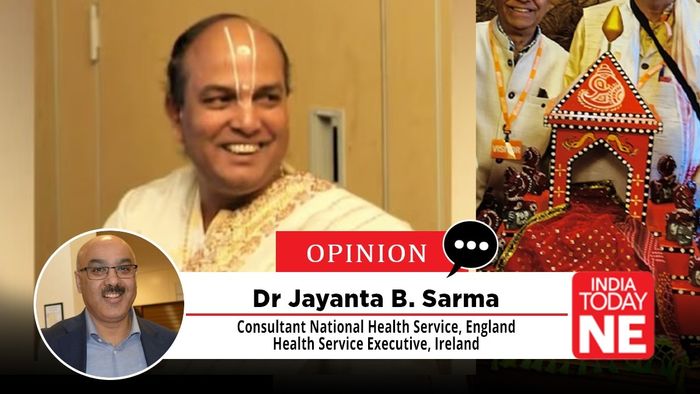
- Jun 23, 2026,
- Updated Jun 23, 2026, 12:58 PM IST
The dignity of Assam’s traditions is not preserved by inflated claims, but by historical literacy, journalistic care, and a critical mind.
There are moments when a community must pause, not to accuse, not to diminish, but to restore proportion. When a tradition is ancient, rich and civilisational in its reach, the responsibility of speaking about it becomes even greater. One must resist the temptation to decorate it with borrowed grandeur. One must also resist the opposite temptation of cynicism. The obligation is simpler and more sacred: to hold the truth carefully.
The recent UK visit of the Satradhikar of Auniati Satra deserves to be remembered with dignity. But dignity does not come from exaggeration. It comes from accuracy.
Auniati Satra does not require Westminster to validate it. Its significance rests on its own long history: centuries of religious reform, devotional discipline, manuscript culture, music, theatre, pedagogy, community organisation, artistic imagination and moral authority. To preserve such a tradition, we must preserve proportion. To preserve proportion, we must preserve facts.
Yet, in the public telling of this visit, proportion appears to have been lost.
A small meeting was arranged within the parliamentary estate in London. It was initially publicised in some quarters as a major “British Parliament” event, and sections of Assam-facing media and social media amplified it as though the Satradhikar had been invited to address the British Parliament itself. Such language naturally created the impression of formal institutional recognition by the British Parliament.
The facts, however, appear to be more modest.
The event had originally been publicised as taking place in Committee Room 15 of the House of Commons. In the end, it was reportedly shifted to Committee Room 11 because Room 15 was unavailable due to an ongoing meeting. MP Bob Blackman, whose support had been cited in relation to the event and whose name appeared prominently in the invitation, did not attend in person and sent an apology. There are indications that another MP, possibly of Indian origin, may have attended on his behalf, though this has not been independently confirmed.
Taken together, these details place the event in its proper procedural context. It was not a formal sitting of Parliament. It was not a parliamentary hearing. It was not, on the available facts, an address to the British Parliament as an institution. It appears to have been a private, invitation-only cultural meeting held inside the parliamentary estate, facilitated through parliamentary access arrangements.
There is nothing wrong with such a meeting. A small cultural gathering inside Parliament can be courteous, useful and symbolically pleasant. It may open doors, create goodwill, and allow Assamese Vaishnavite culture to be introduced to guests who may otherwise know little about it. But “at Parliament” is not the same as “by Parliament”. A committee-room meeting is not the same as addressing Parliament as a legislative body. A room inside the Palace of Westminster does not automatically convert a private event into an institutional act of the British Parliament.
This distinction matters because the Satra tradition does not need inflation. To exaggerate a small parliamentary meeting into something larger may seem harmless in the moment, but over time it risks doing an injustice to the very tradition it seeks to honour.
This is also where the failure of journalism must be named.
The inflation did not remain confined to private enthusiasm or WhatsApp circulation. It entered the public record through established media outlets.
India Today NE carried the formulation that the Satradhikar had been “invited to address British Parliament” and described it as a “historic first”. The report also placed the event in Committee Room 15 and framed it as a major cultural moment, with participation expected from around 65 parliamentarians.
The Times of India similarly reported that Auniati Satra’s spiritual head would “address UK Parliament”. Its report stated that the event would be held in Committee Room 15 and that around 65 parliamentarians were expected. Importantly, it also quoted the Satradhikar as saying that they had been given the opportunity to speak about Assam’s Vaishnav culture “at the British Parliament”.
The Assam Tribune used the framing that Assam’s Vaishnavite heritage would “take centre stage at British Parliament”, again referring to a special meeting in Committee Room 15 where the Satradhikar would deliver a keynote address.
Guwahati Plus went further in the headline itself, stating that Auniati Satra’s Satradhikar had been invited to “address the Parliament of the United Kingdom in London”.
Other digital outlets and social media channels repeated similar formulations. A private, MP-facilitated room-booking reality thereby acquired the aura of a national parliamentary honour.
This was not merely a matter of one careless headline. It suggests a wider media ecosystem accepting a prestige claim without sufficient procedural scrutiny. A journalist did not need specialist knowledge of Westminster to ask basic questions. Was this a formal sitting of Parliament? Was it a committee hearing? Was it an event organised by Parliament? Was it an All-Party Parliamentary Group event? Was it merely a meeting in a committee room booked through an MP? Were 65 parliamentarians confirmed, merely invited, or only anticipated? Was Bob Blackman’s office asked to confirm the nature of the event? Was there an official parliamentary listing?
These questions were central to the story. Without them, the reporting converted “inside the parliamentary estate” into “addressing Parliament”. That is not a minor semantic lapse. It changes the perceived status of the event.
The journalistic failure, therefore, was twofold. First, the outlets failed to verify adequately the institutional nature of the event. Second, they failed to educate readers on the distinction between a venue, a sponsor, a facilitator and an official parliamentary act.
This must be said with restraint, but it must be said. The purpose is not to embarrass any outlet. The purpose is to insist that traditions of such depth deserve better journalism.
The deeper irony is that the most profound moments of the Satradhikar’s UK visit may have taken place elsewhere, away from the glare of ceremonial language.
The visit to the British Library to view Assam Bilasini was, in my view, of immense historical significance. Here was the living head of Auniati Satra encountering one of the scattered archival traces of Assam’s own intellectual and print heritage. Assam Bilasini, published under the aegis of Auniati Satra after the appearance of Arunodoi, represents an indigenous Assamese effort at public communication, literary production and intellectual self-expression. Yet it remains far less known in public memory than it deserves to be.
Likewise, the engagement with the British Museum and the wider legacy of Assamese Vaishnavite art and material culture was not merely a museum visit. It was a moment of civilisational encounter: a living institution of Assam meeting the dispersed evidence of its own historical creativity. In such encounters, the past is not dead. It speaks quietly. It asks whether we are prepared to recognise our own inheritance without needing external validation.
That is where the true grandeur of the visit lay.
A Satradhikar walking into the British Library to see Assam Bilasini is not a small matter. A Satradhikar being guided through the historical memory of Assamese Vaishnavite material culture is not a routine courtesy. These moments connect living tradition with archival survival. They remind us that the Satras were not merely ritual centres. They were producers and preservers of knowledge, literature, performance, aesthetics, discipline and community life.
Yet the public imagination often rushes elsewhere. We are easily dazzled by power, buildings, titles and foreign institutional settings. A committee room in Parliament becomes more shareable than a rare Assamese periodical preserved in the British Library. A possible photograph with an MP becomes more attractive than the recovery of a neglected intellectual inheritance. That misplaced attraction is a weakness. It is understandable, but untenable.
For a community with a long history, prestige cannot be allowed to depend on proximity to power. If we continue to measure ourselves by whether Westminster, Washington, Delhi or some other centre notices us, we will fail to notice the treasures already in our own custody. The Satra legacy is not made great because it enters a committee room. It is already great because it shaped minds, communities, art forms and moral worlds across centuries.
For posterity, the better and more truthful account would be this:
The Satradhikar of Auniati Satra visited important British cultural and archival institutions connected to Assam’s historical memory, including the British Library and the British Museum, and also attended a small MP-facilitated private cultural meeting within the parliamentary estate.
That account is not diminished. It is stronger. It is dignified because it is true.
As an informed observer, one’s responsibility is not to mock enthusiasm or belittle sincere efforts. Many people may have acted with devotion, pride and goodwill. But goodwill does not remove the need for accuracy. In fact, the greater the devotion, the greater the obligation to be truthful.
Sacred traditions are not protected by exaggeration. They are protected by clarity.
To preserve the dignity of our traditions, we must preserve proportion. To preserve proportion, we must preserve facts. And to preserve facts, we must cultivate a critical mind — not a cynical mind, but a careful one.
That, to me, is the humble obligation of anyone who has witnessed these events closely. It is not an obligation born of dispute. It is born of reverence. Because if we truly honour the Satra legacy, we must not wrap it in inflated claims. We must allow it to stand in its own light.
References:
1. India Today NE — “From Assam to London: In a historic first, Auniati Satra’s Satradhikar invited to address British Parliament”
URL: https://www.indiatodayne.in/assam/story/from-assam-to-london-in-a-historic-first-auniati-satras-satradhikar-invited-to-address-british-parliament-1380824-2026-04-24�
2. The Times of India — “Auniati Satra’s spiritual head to address UK Parliament”
URL: https://timesofindia.indiatimes.com/city/guwahati/auniati-satras-spritual-head-to-address-uk-parliament/articleshow/131595425.cms
3. The Assam Tribune — “Assam’s Vaishnavite heritage to take centre stage at British Parliament on June 17”
URL: https://assamtribune.com/assam/assams-vaishnavite-heritage-to-take-centre-stage-at-british-parliament-on-june-17-1612652
4. Guwahati Plus — “Auniati Satra’s Satradhikar from Assam invited to address British Parliament in London”
URL: https://www.guwahatiplus.com/auniati-satras-satradhikar-from-assam-invited-to-address-british-parliament-in-london
5. The Guwahati — “Auniati Satra Satradhikar to Address British Parliament on June 17”
URL: https://theguwahati.com/auniati-satra-satradhikar-to-address-british-parliament-on-june-17/
6. Hindusthan Samachar English — “Auniati Satra Satradhikar to Leave for London, Address British Parliament on Sattriya Culture”
URL: https://english.hindusthansamachar.in/Encyc/2026/6/9/Auniati-Satra-Satradhikar-to-L.php
7. The CSR Journal — “Assam’s Vaishnavite Heritage To Be Showcased At British Parliament on June 17”
URL: https://thecsrjournal.in/assams-vaishnavite-heritage-to-be-showcased-at-british-parliament-on-june-17/
8. MyGov Assamese on X — post saying the Satradhikar would address the British Parliament
URL: https://x.com/MyGovAssamese/status/2066889126675382396/photo/1
9. Chief Minister’s Office, Assam on X — post sharing the “Vaishnavite heritage to take centre stage at British Parliament” framing
URL: https://x.com/CMOfficeAssam/status/2065623013199073755
10. Northeast Live on Facebook — “Assam’s Vaishnavite Culture Showcased at Historic Event in British Parliament, London”
URL: https://www.facebook.com/northeastlivetv/videos/assams-vaishnavite-culture-showcased-at-historic-event-in-british-parliament-lon/2250278895745140/
(Author’s Note: Dr Jayanta Biswa Sarma writes on politics, institutions, and society through the lenses of history, philosophy, and systems thinking, drawing on both Indian and Western intellectual traditions. Artificial intelligence tools may be used in preparing this article as research and editorial aids. All arguments, interpretations, and final editorial judgement remain the author’s responsibility)