Post-Disaster Reconstruction—A Question of Assamese Pride and Identity
The call is for Assam's post-disaster rebuilding to draw on Morbi's 1979 recovery model. The argument links reconstruction with safeguarding Assamese identity, livelihoods and riverine heritage.
- Aug 04, 2026,
- Updated Aug 04, 2026, 6:19 PM IST
This time, the devastating disaster in the undivided Sivasagar district has done more than just break bridges, wash away homes, or erase geographical boundaries—it has severed a crucial umbilical cord of societal memory, ancestral heritage, and cultural identity. The true depth of this crisis is not limited merely to financial and human losses; its core blow has struck the foundation of the Assamese people’s unique, centuries-old syncretic cultural identity, riverine resilience, and collective pride.
To rebuild Assam after such a catastrophic disaster requires a transformative vision that goes beyond temporary relief packages and makeshift shelter camps.
A major calamity presents state leaders with a profound moral choice. It can either be viewed as an administrative nuisance to be dealt with through minimal relief checks, or it can be embraced as a historic responsibility to rebuild society anew. True governance during a crisis is not judged merely by how quickly emergency tents are pitched, but by whether the society rebuilt after the waters recede stands stronger, prouder, and more united than before. By applying the core principles used to overcome the 1979 Gujarat disaster to our contemporary context, the Assam government can seize an unprecedented opportunity. Through moral fortitude and the execution of a sustainable transformation blueprint, it can rebuild places like Sivasagar or Charaideo into model regions that will serve as an inspiration for generations to come.
A powerful historical lesson can be drawn from the historic Machchhu dam tragedy that occurred in Morbi, Gujarat, on August 11, 1979. Although the context and geographical conditions are different, the extraordinary active participation of ordinary citizens, the rapid industrial and infrastructural revival, and the moral leadership demonstrated by the state during Morbi's aftermath present an enduring model.
When the Machchhu-II dam collapsed in 1979 and flooded the town of Morbi, Gujarat faced an unprecedented administrative and humanitarian trial. The subsequent reconstruction succeeded because it transcended one-sided bureaucratic policies and relied on four fundamental pillars:
Mobilization of Social Capital: Voluntary organizations, religious institutions, and local community groups were integrated into the core administration of relief and reconstruction processes.
Long-Term Ecosystems: Housing and civic infrastructure were not merely erected as temporary emergency arrangements; instead, they were rebuilt as long-term, safe urban and rural ecosystems.
Economic Self-Reliance: The state prioritized the rapid revival of local industries and livelihoods, enabling affected families to become economically self-reliant in a short span rather than remaining dependent on aid.
Transparent and Grounded Leadership: Top-level leadership personally engaged on the ground and operated with transparent policies, creating deep trust between citizens and the administration.
Applying these lessons to contemporary Assam requires not just rebuilding destroyed physical infrastructure, but also restoring the unique, holistic social values and pride of Upper Assam’s heritage. This must be accomplished through a multi-phased plan combining climate-resilient engineering with socio-cultural revival.
Modern engineering must respect traditional wisdom. Standard concrete models fail both ecologically and culturally in the flood-prone regions of Assam.
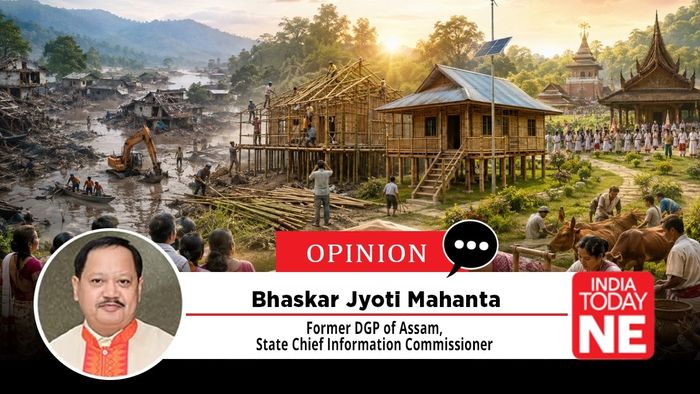
Houses constructed for rehabilitation should follow the traditional Assamese 'Chang-Ghar' (stilt house) model—utilizing local bamboo technology alongside materials like steel-reinforced concrete pillars.
In rebuilt settlements, high-resolution GIS mapping should be utilized to protect natural floodplains. High-ground public shelters equipped with solar microgrids, clean drinking water, and emergency medical supplies must be established.
Cultural and Economic Revival
Restoring cultural foundations will preserve the core essence of Assam. The Assamese identity thrives in community spaces. The destruction of physical structures often creates a spiritual and social void that fosters despair. Therefore, along with residential homes, Namghars (prayer houses), historical Satras (monasteries), and village community grounds must be rebuilt with equal priority.
Similarly, priority support must be extended to rebuild the foundations of animal husbandry, cattle rearing, and dairy distribution—not only in Nepalese Khuti area but across all affected regions. The weavers who sustain Assam's Pat and Muga silk handicrafts must immediately be provided with looms, raw materials, and market access. Reviving a weaver's loom means reviving their very existence and identity. Urgent and similar measures must also be implemented for small and large tea growers alike.
To execute these measures effectively, the administration must employ modern tools and a robust governance framework to replicate the 1979 Gujarat model.
For the Government of Assam, adopting the spirit of the 1979 Morbi disaster management means securing a lasting place in the public memory through three specific actions:
Establishing a Dedicated High-Level Reconstruction Authority that transparently displays every rupee spent and every home rebuilt via a real-time public dashboard.
Building a Central Memorial and Living Cultural Museum in the most severely affected district—not just to pay tribute to those lost, but to showcase the history, folklore, and resilience of Assam’s riverine communities.
Executing Land Reforms During Reconstruction to grant legal land titles (Patta) to affected riverine families, ensuring that no distressed family remains landless or socio-economically marginalized.
The 1979 Morbi disaster proved that while nature can destroy physical structures within minutes, an organized human resolve and visionary governance can build something far more enduring from the ruins.
Assam’s current trial is not merely about surviving another calamity; it is a journey to re-assert the core essence of Assamese identity. By integrating the sensitive and decisive spirit of Gujarat's historic recovery model with modern technology, climate-conscious planning, and people-centric governance, the present leadership can transform grief into future strength. In doing so, the government will not only revive homes—it will safeguard the immortal soul of the 'Assamese' existence for generations to come.