Power and Dependence: Why are regional parties declining in India?
Political parties have multiplied in absolute numbers since 1989, yet their legislative strength is shrinking, with political space now getting increasingly occupied by the electoral footprint of the BJP and its allies.
- Jun 26, 2026,
- Updated Jun 26, 2026, 12:25 PM IST
Democracy in India presents a paradox of increased electoral enthusiasm at a moment when personalisation and centralisation of political parties have become the norm. Parties are organised yet not institutionalised. Electoral enthusiasm is evident from increased voter turnout in successive elections, the emergence of new parties, the resilience of States as the site of intense electoral competition, and the consolidation of stable and strong governments at the Union and the States. Political parties have multiplied in absolute numbers since 1989, yet their legislative strength is shrinking, with political space now getting increasingly occupied by the electoral footprint of the BJP and its allies. Regional parties still command vote share but not seat share in adequate numbers. They are in alliances in several States, yet they can influence and not decide, as they have lost the decisive edge. Regional parties, which mostly balanced rival alliances between 1989 and 2014, appear to be more comfortable with the bandwagon now. The structure of electoral competition has changed gradually in a fundamental sense. The gradual emergence and consolidation of a neat bipolar alliance structure, specifically since the 2014 Lok Sabha elections, has brought in a centrality of political ideologies and offered regional parties a space that is less open-ended, thereby contributing to the dependence of regional parties on alliance architectures led by the Congress and the BJP, respectively.
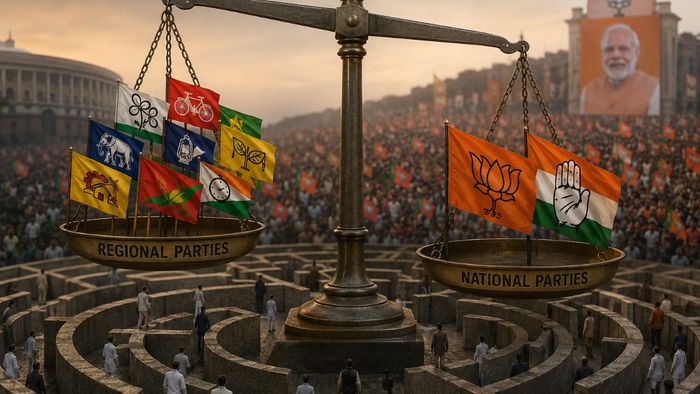
At present, there are different shades of regional parties. Some have declined; some have become dependent, while a few have remained resilient. Also, rumours regarding splits in leading regional parties like the SP and the NCP (SP) are doing the rounds. However, the broader picture of the dependence of regional parties on a dominant alliance architecture led by the BJP overshadows the picture of a more autonomous electoral space of regionalist parties that existed prior to 2014. Predominantly, regional parties are either declining or becoming dependent on a dominant alliance architecture.
Declining, Depending and Resilient
Parties like the AIUDF, BSP, SAD, AIADMK, RJD and JDS have considerably diminished from their previously held positions in their respective States. AAP in Delhi, ZPM in Mizoram and TVK have risen to power in recent times, while SKM, DMK, SP, JKNC, JMM and TDP have remained resilient. Alliances are inevitable, yet while some regional parties (AGP, BPF, Shiv Sena, JDU, JDS and TDP) appear to have become more dependent and conformist, others like the TMC and SS (UBT) have witnessed rebellion and the subsequent merger of their respective rebel MPs and MLAs into other regional parties. Ironically, the rebel MPs/MLAs did not merge with the BJP; rather, they merged with other regional parties. They preferred an alliance over a party that leads the alliance. A dominant alliance led by the dominant party has a considerable electoral interest in keeping the regional parties alive yet dependent for three interdependent reasons. First, alliances with prominent regional parties help in building cultural and social endorsement for the BJP, whose electoral footprint expanded geographically in an exponential way during the last decade. Such social and cultural endorsement is integral to the civilisational narrative, which is the constitutive basis of the BJP's ideological plank at the moment. Second, as evident from the recent Assembly elections in Assam, the dominant alliance keeps the Congress in check, as the latter fails to stitch together an alliance with parties having significant electoral presence in a State. Thirdly, such an alliance is a prerequisite for floor coordination to ensure the smooth passage of legislation requiring a special majority, such as the Delimitation Bill.
Balancing to Bandwagon
Regional parties in India are facing challenges that may broadly be classified as internal and external. Internal challenges primarily relate to the inner functioning of parties and have attributes like leadership, ideology, finance, and organisational structure. The external challenges relate to the changing structure of political competition both at the Union as well as the State level. It owes to the systemic consolidation of the dominance of the BJP and its allies at the Union as well as across 20 States and two Union Territories, concomitant with the numerical marginalisation of the Congress.
On the surface, the systemic nature of the dominance that the NDA enjoys seems to be a fallout of the successive mandates that the alliance secured at the Union and the way it formed governments in States, unsettling the Congress and several leading regional parties. However, the depth and width of this dominance are structural in nature as well, and are embedded in the constitutional structures of the parliamentary system, the unique nature of Union-State relations, and the electoral system enshrined in the Constitution. Thus, the dominance of the Congress till 1989 also owed to the organisational structure of the party since Independence, the fragmentation of the opposition space and the centralisation inherent in Union-State relations.
The unique blend of parliamentary/legislative majority and leader-centrism, and its intersection with federal politics, contributed to the rise of several regional leaders and regional parties having a base within the bounds of States. These parties faced horizontal and vertical challenges. Horizontally, they were mostly sub-regional parties within a State and had a distinctively identified social base. The vertical challenge was really to maintain their presence at the national level in the Lok Sabha and the Rajya Sabha. Alliances at the national level since 1989 resolved this challenge to an extent but also sowed the seeds of dependence among regional parties on two rival national partie, the BJP and the Congress. The numerical marginalisation of the Congress, coupled with the irreversible loss of its power in several States of India, contributed to the structural shift in the balance in favour of the NDA. Consequently, politics in India became unipolar on the basis of the legislative influence exercised by parties. But in terms of electoral competition and voting behaviour, politics is still bipolar, divided along ideological lines. It conveniently explains how, despite leading a minority coalition government since 2024, Modi could maintain as overwhelming a majority as in any majority coalition government (2019–2024).
The internal challenges of leadership transition and the quest for ideological middle ground, coupled with the politicisation of micro-social identities, constitute the primary hurdles for regional parties. These challenges, in conjunction with an external environment of unipolar politics, are restricting the space for the autonomous expansion of regional parties. Unable to resolve leadership issues, which are primarily linked to the question of dynastic succession, regional parties today face an existential challenge. Ironically, internal setbacks are reinforcing the external challenges, which make regional parties more dependent at a moment when unipolarity has gained definite ground in Indian politics.
The BJP's dominant position at the Union has given it considerable leeway in maintaining dominance through defections, splits and mergers. For instance, the rebels from the TMC and the SS (UBT) consider the BJP to be their political protectorate, sensing the huge gap between the government and the opposition at both levels of government. Further, the BJP's ability to heighten the salience of national issues over which States have limited power and competence, such as citizenship, SIR, delimitation, synchronisation of elections, and the identification of social groups as SCs and STs, has added strength to its agenda-setting and narrative-building capabilities. Regional parties are divided on these issues and also find it difficult to position their views on them. The SIR and citizenship issues yielded definite dividends to the NDA, while the opposition lagged behind in Bihar, Assam and West Bengal. In a way, a new form of constitutional asymmetry informing informal political processes has emerged, disadvantaging regional parties