Rivers Beyond Borders: Why the Siang Is More Than Water
The Siang River links diverse ecosystems and cultures across borders, playing a crucial role in ecology and livelihood. Balancing modern science with traditional knowledge is key to sustaining this vital waterway.
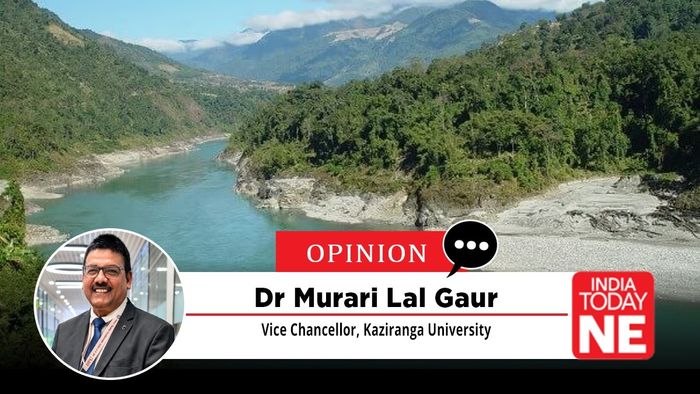
Dr Murari Lal Gaur
- May 14, 2026,
- Updated May 14, 2026, 5:57 PM IST
Standing beside the Siang River recently in Arunachal Pradesh, watching the enormous Himalayan waters
descending through deep valleys and ancient forests, one thought repeatedly came to my mind:
• Rivers are not merely flowing water.
• They are living civilizations.
• They carry the memory of mountains, the chemistry of landscapes, the songs of forests, the
struggles of communities, and the destiny of nations.
Long before political boundaries appeared on maps, rivers were already flowing across valleys,
civilizations, cultures, and continents - silently connecting humanity.
• Political boundaries may divide maps, but rivers refuse to recognize them.
• They rise in one nation, gather strength in another, nourish millions across landscapes, and finally
merge into seas beyond human boundaries.
• Rivers are among the few living systems on Earth that simultaneously connect geography,
ecology, climate, culture, economy, spirituality, and civilization.
• Long before humanity learned diplomacy, rivers had already mastered the art of connection.
The story of humanity is essentially the story of rivers.
A few days ago, while recording a short video clip during discussions surrounding the proposed Upper Siang Multipurpose Project in Arunachal Pradesh, I stood silently near the mighty Siang River, watching the enormous force of water descending from the Himalayas. The sound of the river was powerful yet peaceful. The water was carrying not merely sediments and discharge, but centuries of geological history, ecological memory, and civilizational continuity.
At that moment, one thought repeatedly came to my mind:
• “A river is never merely water flowing in a channel. A river is geography in motion, ecology in
action, and civilization in liquid form.”
• During the last four decades, I have had the privilege of working closely with many rivers across
India - through hydrology, watershed management, river-bank erosion control, ravine restoration, irrigation engineering, groundwater recharge, stream hydraulics, grassland hydrology, forest-water interaction, and landscape ecology.
From the ravines of the Chambal River to the shifting meanders of the Yamuna River, from drought-prone
watersheds to flood-sensitive Himalayan valleys, I have seen rivers behaving like living entities. Some rivers are calm and disciplined. Some are energetic and unpredictable. Some quietly nurture civilizations, while others constantly challenge human understanding through floods, erosion, sedimentation, and channel migration.
But among all river systems, international rivers are perhaps the most complex and sensitive. These rivers do not recognize political borders. They begin in one nation, flow through another, influence several others, and finally merge into seas or oceans. Such rivers carry not only water but also diplomacy, ecology, culture, energy, economy, biodiversity, and geopolitics. The Siang River is one such extraordinary river.
Originating in Tibet as the Yarlung Tsangpo, the river enters Arunachal Pradesh as the Siang before transforming into the mighty Brahmaputra in Assam and eventually flowing into Bangladesh toward the Bay of Bengal. In this long and majestic journey, the river connects glaciers, mountains, forests, tribal societies, agricultural plains, wetlands, fisheries, biodiversity hotspots, and millions of people.
The Siang therefore is not merely a river of Arunachal Pradesh.
• It is a transboundary ecological corridor.
• It is a geopolitical waterway.
• It is a climatic regulator.
• It is a cultural messenger from the Himalayas.
And perhaps above all, it is a living artery of South Asia.
The future geopolitics of the world may increasingly depend not only upon oil and minerals but also upon freshwater systems and river diplomacy. Interestingly, rivers are among the few natural systems where physics, chemistry, biology, geology, ecology, sociology, economics, culture, spirituality, and politics all interact simultaneously.
Very few natural systems are so multidimensional.
The physics of rivers is itself fascinating. Rivers continuously adjust their slope, velocity, depth, width,
sediment load, and channel shape. A river is not a static pipeline carrying water. It is a dynamic self-adjusting system. One little-known scientific reality is that rivers actually transport mountains.
Yes, rivers carry mountains in dissolved and sediment form → The Brahmaputra, for example, is
among the highest sediment-carrying rivers in the world. Scientific studies suggest that this river system
may transport nearly 700–800 million tonnes of sediments annually from the fragile Himalayas toward
downstream plains and the Bay of Bengal.
This sediment is both a blessing and a challenge → It creates fertile agricultural plains but also intensifies channel instability, bank erosion, flood vulnerability, and embankment pressure. Thousands of hectares of valuable land are lost annually in Assam due to river-bank erosion. Villages shift. Agricultural fields disappear.
Human settlements migrate. Yet the same river also nourishes soils, wetlands, fisheries, groundwater recharge systems, and biodiversity.
This duality is the true philosophy of rivers → A river gives life and simultaneously tests human wisdom.
The chemistry of rivers is equally remarkable. Rivers are not chemically uniform systems. They carry
dissolved oxygen, nutrients, carbon compounds, minerals, organic matter, nitrogen, phosphorus, and
biological elements. The chemistry of a river continuously changes from glacier zones to forests, from
agricultural lands to urban settlements.
In many ways, a river records the chemical signature of the landscapes through which it flows. Another hidden scientific truth is that rivers and groundwater continuously interact beneath the Earth’s surface. During floods, rivers recharge underground aquifers. During dry seasons, groundwater sustains river flow. This invisible dialogue between rivers and aquifers maintains ecological continuity across landscapes. Freshwater ecosystems occupy less than one percent of Earth’s surface, yet they support nearly ten percent of all known species. Healthy rivers sustain fish, amphibians, birds, aquatic insects, wetlands, floodplain vegetation, microbial ecosystems, and ecological food chains.
• A healthy river is therefore not merely flowing water.
• It is a moving biodiversity corridor.
The Brahmaputra basin itself supports rich aquatic biodiversity, river dolphins, migratory birds, wetlands,
fisheries, and unique floodplain ecosystems. Almost every major civilization of the world evolved around rivers; the Nile civilization, the Indus civilization, the Yellow River civilization, and the Tigris-Euphrates civilization.
Human civilization itself is fundamentally a river-bank phenomenon.
Even today, rivers shape livelihoods, transportation, agriculture, culture, spirituality, and regional identities. In Northeast India especially, rivers are deeply connected with indigenous and tribal life systems. For many local communities, rivers are not merely “water resources.” Rivers are sacred companions. They are songs, rituals, memories, fisheries, transport systems, agricultural lifelines, and ecological ancestors.
Traditional communities often understood river behaviour more wisely than modern planners.
• They knew where floods naturally spread.
• They knew where erosion intensifies.
• They knew how ecological coexistence could be maintained.
Modern science must now learn to respect this traditional wisdom.
The Himalayan region adds another level of complexity to rivers like the Siang and Brahmaputra. The Himalayas are geologically young, tectonically active, fragile, and highly erosion-prone mountains. This is why Himalayan rivers behave differently from many stable peninsular rivers.
Heavy rainfall, cloudbursts, landslides, seismic activity, glacial melt, and steep slopes make these rivers
highly dynamic.
The Northeast region of India is among the wettest regions on Earth. Many areas receive annual rainfall exceeding 2000–4000 mm. When such intense rainfall interacts with fragile mountain systems, rivers become highly energetic and sediment-rich.
The river of tomorrow may not behave like the river of yesterday.
• One emerging scientific concern is the increasing frequency of glacial lake outburst floods, which
may significantly affect downstream river systems in future decades.
• One of the greatest lessons rivers taught me during four decades of field experience is this:
• “Successful river management must always begin from upstream and gradually move
downstream.”
Nature itself follows this principle.
• The upstream zones regulate forests, springs, infiltration, sediment generation, and hydrological stability. Disturbances in upper catchments eventually travel downstream in the form of floods, erosion, instability, sedimentation, and ecological stress.
• If forests disappear upstream, flood intensity increases downstream. If slope instability increases
upstream, disasters intensify downstream. If soil erosion accelerates upstream, sedimentation
expands downstream.
Nature always works in continuity → Therefore, river restoration and watershed treatment should ideally proceed from upper catchments toward middle and lower reaches. Attempting to repair only downstream areas while neglecting upstream degradation often becomes expensive, unstable, and ecologically ineffective. This is one of the most neglected truths in river management globally.
The future of river science is changing rapidly → Tomorrow’s rivers may increasingly be monitored through satellite hydrology, artificial intelligence, drone mapping, LiDAR surveys, digital twins, IoT river sensors, real-time flood forecasting systems, and advanced sediment monitoring technologies.
The 21st century may become the century of smart rivers.
• Yet even the most advanced technologies cannot replace human wisdom.
• A river cannot be fully understood only through computer models and satellite imagery. Rivers
must also be walked, observed, heard, respected, and emotionally understood.
Another little-known scientific reality is that forests and rivers maintain deep ecological partnerships.
Healthy forests stabilize slopes, regulate infiltration, reduce sediment loss, improve water quality, sustain springs, and moderate flood peaks. Destroy forests, and rivers gradually change their character.
In many ways, rivers are climate regulators themselves
About the Author:
Dr. M. L. Gaur is a hydrologist, watershed scientist, academic leader, and river observer with more than four decades of field experience across India in river hydrology, watershed management, groundwater systems, erosion control, irrigation engineering, forest-water interactions, nature based solutions to deal rivers (Yamuna, Chambal, Mahi) for their ravines & gullied lands under National Bamboo Missions using bamboo based engineering interventions, climate-resilient landscapes, and ecological restoration. He has worked extensively on river systems, ravines, floodplains, watersheds, and Himalayan hydrology across multiple regions of India.
MORE NEWS
Read more!