Rot at the Core: How the Sinai Camp Raid Exposed Manipur’s Broken Kuki SoO Militancy
The highly sensationalised and dramatic Sinai Camp raid has rather exposed the deep-rooted rot within Manipur’s deeply corrupt Kuki SoO militancy system. Like a Pandora’s box, it has opened up more questions than answers, exposing deep cracks in Manipur’s governance, the structural failures and inherent dangers of the Kuki SoO arrangement, the politics of Kuki appeasement, fundamental questions about the state’s authority over armed militancy, and the urgent need to bring the Kuki SoO arrangement to an end.
- Nov 01, 2026,
- Updated Nov 01, 2026, 6:17 PM IST
The highly sensationalised and dramatic Sinai Camp raid has rather exposed the deep-rooted rot within Manipur’s deeply corrupt Kuki SoO militancy system. Like a Pandora’s box, it has opened up more questions than answers, exposing deep cracks in Manipur’s governance, the structural failures and inherent dangers of the Kuki SoO arrangement, the politics of Kuki appeasement, fundamental questions about the state’s authority over armed militancy, and the urgent need to bring the Kuki SoO arrangement to an end.
The 20 October 2026 operation at Sinai Camp and its subsequent takeover by government security forces exposed serious weaknesses in Manipur’s tripartite Suspension of Operations (SoO) arrangement. Established in August 2008 between the Union Government of India, the Government of Manipur, and Kuki armed militant groups under the United People’s Front (UPF) and the Kuki National Organisation (KNO), the arrangement is now facing mounting scrutiny over the government’s failure to ensure effective oversight, enforce ground rules, and hold armed groups accountable. The Sinai Camp episode has brought these systemic failures into sharp focus, raising fundamental questions about the credibility and viability of the entire framework.
This article examines exclusively the Kuki armed militant groups operating under the KNO and UPF, along with their proxies. It does not cover the separate Zomi and Hmar militant groups, which also fall under the broader SoO framework.
The immediate trigger was the killing of three Meitei civilians in Sunurok Hills (within Kangpokpi district) on 19 October 2026 by active cadres of the Kuki National Front–Nehlun (KNF-N), described as a proxy of the Kuki SoO group KNF(P). Public fury reached a dramatic peak when two victims’ bodies were brought to the gate of Chief Minister Yumnam Khemchand Singh’s official residence, forcing the government to confront mounting public anger. The subsequent Sinai Camp operation, however, has exposed far more than an isolated security failure. It has brought the credibility of the entire SoO monitoring system into question, particularly over cadre verification, weapons control, camp supervision, and the accountability of armed groups operating under the arrangement.
The central question is no longer simply whether the government can conduct a security operation. It is whether the state exercises meaningful authority over armed groups operating under its own arrangement—or whether the SoO framework has evolved into a system in which oversight is ineffective, accountability is elusive, and the government’s authority is increasingly in doubt.
Sinai Camp’s Alarming Discrepancies: Unaccounted Cadres, Questionable Weapons Control and a Breakdown of SoO Oversight
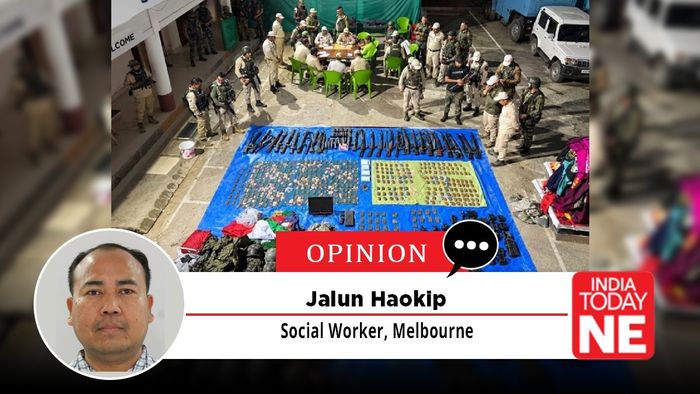
Security forces raided Sinai Camp in Kangpokpi district on 20 October 2026. The camp was associated with the Kuki National Army (KNA) and the Kuki Liberation Army (KLA), both operating under the Kuki National Organisation (KNO). It was designated to accommodate 159 cadres—93 from the KNA and 66 from the KLA—yet only 18 individuals, only one of whom was registered cadre, were found during the raid.
Security forces seized 24 firearms, 38 magazines, ammunition, explosives, wireless communication equipment and other combat gear. On 23 October, Home Minister Govindas Konthoujam stated in a media interview that only one of the 18 individuals found at the camp had been identified as covered by the SoO arrangement, while the identities and affiliations of the other 17—who may have been new recruits or unregistered members of the groups—remained under investigation.
These findings demand urgent answers. Who were the 17 individuals, and how did they come to be at the camp? Where are the missing registered cadres and their weapons? Did camp functionaries or senior commanders know about these discrepancies?
Reports that arrested cadres claimed the missing personnel had gone to fight and participate in violence along IT Road in Kangpokpi district and in Ukhrul and Kamjong districts raise further alarm. Where are these missing cadres now, what are they doing, and where are their guns? Who owns the weapons in the possession of SoO groups, and who is accountable for them? If authorities cannot account for personnel and weapons at a single designated camp, the effectiveness of oversight across the wider Kuki SoO network must also be called into question.
The infamous beheading of Ajinpou Ringkangmai, a 52-year-old Naga Liangmai man from Makui village, by Kuki armed militants—one of whom has been identified as Mangminhao Kipgen of J. Songtun village, a cadre of the Kuki National Front (KNF), a Kuki SoO militant group—and the perpetrators’ act of filming their own brutality and publicising the footage on social media bear the hallmarks of ISIS-style brutality and terrorism, potentially influenced by jihadist ideology. The incident raises grave concerns about the consequences of years of Kuki radicalisation, indoctrination and extremism at the socio-political and cult-religious levels, as well as the potential influence of jihadist ideology.
The conditions in the Sinai camp have undeniably exposed breaches of the SoO ground rules on several counts. Weapons kept in double-locked storage supposedly under the supervision of the state home department have disappeared, along with 158 cadres of the KNA and KLA. Cadres who are supposed to remain in the camp and not commit crimes have absconded and reportedly taken part in violence. How long has this situation persisted? No one knows; it may have been going on for years.
The government must clarify how many weapons have gone missing and publicly provide details of the missing weapons and the personal details of the missing cadres. It cannot boast about the exercise and then simply wash its hands of the matter by claiming that the SoO ground rules no longer apply following the expiry of the agreement.
Breaching the SoO ground rules is one matter; committing crimes under Indian law is far more serious. Regardless of whether the SoO arrangement remains in force, no one is above the law. The law must apply equally to SoO cadres and their leaders, just as it does to other armed militants. As law and order is a State subject, Chief Minister Yumnam Khemchand Singh must be held accountable for the state government’s response.
Given that SoO cadres receive regular stipends, logistical assistance and other support from the Indian government under an official arrangement, that SoO operations are funded by public money, and that the state government is responsible for their management and enforcement of ground rules, the unauthorised possession or removal of service weapons, as well as the abscondment of cadres from designated camps, must be treated with the same seriousness as cases involving regular government security personnel who abscond with their service weapons. Public funding must come with accountability, and SoO cadres and their leaders must not be allowed to operate above the law.
Political Spectacle vs. Ground Reality
Chief Minister Yumnam Khemchand Singh’s subsequent visit to Sinai Camp on 25 October via helicopter—publicized as the first visit by a sitting Chief Minister to an active SoO camp—served as little more than high-visibility political theater. After infamously claiming the SoO agreement with Kuki armed groups was not a state subject, he suddenly took a keen interest in the matter, flying to the Sinai camp to make a political statement and pose for photos.
Staging a photo opportunity at an empty camp where 158 cadres and their arms are unaccounted for does not restore state authority; it highlights its absence.
Relocating Sinai Camp to Sijang under Saikul subdivision, or shifting cadres among the 13 remaining designated camps, addresses none of the core dangers. Merely shifting geographic coordinates while keeping armed structures, illicit arsenals, and command networks intact guarantees continued instability.
The Historic Rally & Public Mandate to End Kuki SoO Militancy
The massive cross-community rallies sweeping across Imphal and the hill districts on October 31, 2026, delivered an unequivocal ultimatum to New Delhi and state leadership: abrogate the Suspension of Operations (SoO) agreement immediately.
Spearheaded by COCOMI and Naga CSOs—and backed by the United Naga Council (UNC) and Thadou Inpi Manipur—this historic mobilization united diverse indigenous communities around four non-negotiable imperatives:
Immediate Abrogation of the SoO Pact
An End to Armed Aggression & Proxy Warfare
Withdrawal of the Assam Rifles
Time-Bound Resettlement of Displaced Families
This mass movement proves that terminating the SoO arrangement is no longer up for debate—it is an absolute prerequisite for restoring the rule of law and safeguarding Manipur’s integrity.
The political precedent is clear. Under former Chief Minister N. Biren Singh—a staunch leader and champion of Manipur’s integrity and indigenous peoples—the State Cabinet withdrew from the SoO pact on March 10, 2023. On February 29, 2024, the Manipur Legislative Assembly passed a unanimous resolution calling for the complete termination of the agreement across all 25 underground factions under UPF and KNO.
When the state government has previously acted, the State Assembly has passed a unanimous resolution, and the public has spoken loudly, clearly, and unitedly, what is stopping the present state government under Chief Minister Yumnam Khemchand Singh and the Central government from taking decisive action?
Is appeasing armed Kuki militants for political vote banks more vital than honoring a democratic mandate? The citizens of Manipur must hold accountable any leadership that sacrifices public security for political expediency.
SoO Expired, but Militancy Unchecked: The Government’s Accountability Test
On 23 October, Home Minister Govindas Konthoujam stated in a media interview that the SoO arrangement covering groups under the Kuki National Organisation (KNO) and the United People’s Front (UPF) had expired on 4 September 2026 and had not been renewed. He stated, “The violation of SoO ground rules does not arise” and that “there is no SoO agreement [that] exists in the state.”
The government must clarify the legal and operational consequences of the arrangement’s expiry and ensure that it is not revived or extended without accountability and effective disarmament. The priority must be to account for all registered cadres and weapons, investigate suspected violations, and dismantle unlawful armed networks.
With the SoO arrangement expired, why has the government not launched comparable operations against KNO and UPF camps, cadres and leaders? Enforcement must also extend to their proxies, including KNA-Burma, KNF (Nehlun) and armed Village Volunteers (VVs), wherever evidence establishes unlawful activity.
Jangboi Kipgen, identified as the de facto chief of KNF-N, Home Secretary of KNF(P) and Chairman of the Unified Command of Kuki militant groups, including both SoO and non-SoO groups, raises further questions about the relationships between these armed networks. The government must investigate these links and establish whether coordination, protection or other forms of support have enabled armed groups to operate beyond effective oversight and accountability.
Arresting a few Kuki armed cadres occasionally is not enough. The problem will persist if those detained are simply replaced by existing cadres or new recruits. The government must pursue the chain of command, investigate senior militant leaders, including group chiefs, and hold them accountable under the law. The objective must be to dismantle the networks enabling unlawful armed activity, not merely arrest individuals while leaving the wider system intact. The government must get to the bottom of this, ensure that no armed group, cadre or leader operates above the law or terrorises the public, and take appropriate legal action to proscribe organisations that meet the criteria for designation as terrorist organisations.
Security forces and the Indian Army have conducted combing operations against the United Kuki National Army (UKNA), Naga and Meitei militant groups across remote hill districts and the valley, even deploying Army helicopters in operations against the UKNA. Why, then, do KNO and UPF cadres and leaders continue to openly operate freely within civilian communities?
All designated Kuki SoO camps are accessible by road, making geographical inaccessibility an unconvincing explanation for the absence of comparable operations. The government must explain why similar scrutiny has not been applied to these camps and their cadres. Continued inaction raises serious questions about its willingness to hold Kuki SoO groups accountable and whether political considerations are sustaining a mutually convenient status quo.
The SoO ground rules prohibited recruiting new cadres. Those who were 18 when the arrangement was formalised in 2008 would now be 36, while those who were 28 would now be 46. The apparent presence of younger cadres warrants scrutiny. Authorities must audit registration dates, service records and identities to determine whether recruitment restrictions were breached. The findings must be made public.
The Sinai operation must not remain an isolated exercise. All designated camps and relevant armed networks must be subjected to consistent and lawful scrutiny, without selective enforcement or political protection.
Political Patronage and Armed Militancy: The Nexus Manipur Must Confront
The open or obvious relationship between electoral politics and Kuki armed organisations is another issue that cannot be ignored. Deputy Chief Minister Nemcha Kipgen is the wife of Thangboi Kipgen, president of the Kuki National Front (KNF-P), a SoO group under the UPF. Kimneo Haokip Hangshing, the Saikul MLA, is the wife of the chairman of the Kuki Revolutionary Army (KRA), a SoO armed group under the KNO.
Other MLAs—including Saikot MLA Paolienlal Haokip and Henglep MLA Letzamang Haokip associated with the KNO/KNA, KNF-MC,KNF(S), KNF (Z), KLA etc; Saitu MLA Haokholet Kipgen, with the UPF/KNF; and Tengnoupal MLA Letpao Haokip, with the KNO/KNA and UPF/UKLF—all have close family ties and vested interests linked to leaders of Kuki SoO militant groups operating in their respective areas. Kuki SoO militant groups sponsored candidates in areas where they operate, while political leaders support these groups, creating a reciprocal political relationship.
These MLAs represent or serve the interests of Kuki SoO groups rather than those of their respective constituencies, raising concerns that a government propped up by them effectively becomes a government of, by and for militant groups rather than the people. These relationships warrant independent scrutiny and appropriate legal action, given concerns about armed groups’ political influence and the enforcement of SoO ground rules.
Before the 2022 Manipur Assembly election, the Kuki National Organisation (KNO) and the United People’s Front (UPF) publicly endorsed BJP candidates and openly canvassed for votes in their respective areas of influence. Since the SoO arrangement began in 2008, Kuki SoO groups have faced accusations of electoral interference, including vote-stealing and election rigging, while serving as an influential, convenient and powerful vote bank for successive ruling parties, including the Congress and the BJP.
The apparent nexus between political parties, government officials, elected representatives and other individuals in positions of power, security forces, and Kuki armed militant groups raises serious questions about the influence of armed organisations on governance, electoral competition and law enforcement. Concerns also extend to Kuki civil society organisations, including the Kuki Inpi, Kuki Students’ Organisation, Kuki Zo Council, CoTU and ITLF, among others, which are acting as proxies for Kuki SoO groups.
The involvement of Kuki SoO groups and their proxies in extortion, illegal taxation, intimidation, restrictions on movement, and interference in elections and civilian affairs is incompatible with constitutional governance. When armed organisations and their proxies exercise such coercive powers, they undermine public safety, erode the rule of law, and function as parallel authorities beyond effective government control.
The acquisition of new weapons, recruitment of new cadres, intimidation, extortion, killings, and the operation of armed militants as a parallel authority over civilian communities constitute not only breaches of the SoO ground rules but also violations of Indian law.
Thadou Community Under Siege: Persecution, Suppression and the Cost of Kuki Militancy
Thadou organisations, including Thadou Inpi Manipur (TIM) and Thadou Community International (TCI), have repeatedly raised concerns about Kuki radicalism and the dominance and supremacist ambitions of Kuki armed groups and their proxy organisations within Kuki civil society. They allege that these organisations operate in collusion with government authorities and security forces.
Clearly, these Kuki armed groups, operating freely under the SoO arrangement, are exercising parallel authority, intimidating civilians, and interfering in political processes, particularly by targeting, persecuting, and suppressing the indigenous Thadou community and other indigenous peoples of Manipur. Operating predominantly in Thadou-inhabited areas, these groups have contributed to prolonged and severe suffering within the Thadou community. The scale and duration of this suffering underscore the devastating impact of Kuki chauvinism on the Thadou community.
On 31 August 2025, TIM submitted a 35-page memorandum to the Central and state governments demanding the complete abrogation of the SoO arrangement, documenting evidence of ground-rule violations and setting out the reasons for its termination. What has happened at the Sinai Camp further underscores the urgency of ending the arrangement without further review or extension.
Sinai Camp: The Final Test of Government Authority and Accountability
The government can no longer evade the fundamental questions exposed by Sinai Camp. It must establish the whereabouts of the missing cadres and weapons, conduct a comprehensive audit of every designated camp, investigate the killings of the three civilians, and hold all responsible individuals—from perpetrators to commanders and facilitators implicated by the evidence—accountable under the law. Helicopter visits, photographs and public statements cannot substitute for concrete action. The government’s credibility will ultimately be judged by whether it delivers justice, restores the rule of law and dismantles unlawful armed networks.
The people of Manipur must not be forced to endure another massacre, another public outcry or another cycle of violence before the government acts. Organisations, citizens from both the valley and the hills, and political parties have repeatedly demanded the abrogation of the SoO arrangement with Kuki armed militant groups under the KNO) and UPF. The revelations from Sinai Camp reinforce the urgency of addressing these demands. No arrangement can justify unaccountable armed networks, the intimidation of civilians or violations of Indian law.
The message is clear: the SoO arrangement must not be renewed or extended. Its expiry must mark a definitive break from a failed system that has failed to deliver lasting peace and security and has produced outcomes contrary to its stated objectives. The government must pursue robust but lawful disarmament, comprehensive investigations, full accountability and the dismantling of unlawful armed networks—without political compromise or selective enforcement.
Manipur cannot achieve lasting peace and democracy while armed groups operate as parallel authorities, function like mafias, and serve as vote banks for political parties, vested-interest groups and politicians. The rule of law and democracy must prevail over the rule of the gun, and no militant organisation, political leader or public authority can stand above them. Manipur needs justice, security and constitutional governance—not another extension of a failed arrangement.
The writer, Jalun Haokip (MSW), is a Melbourne-based native of Manipur with professional experience in social work across mainstream and Indigenous Australian communities. He currently works as a family violence practitioner within the Victorian Government in Melbourne.