Should Guwahati be a Purple City?
The proposal deserves to be viewed sympathetically because behind even a seemingly simple idea lies an important instinct: the desire to imagine Guwahati not merely as a congested administrative town that grew by accident, but as a city with a coherent identity and emotional presence.
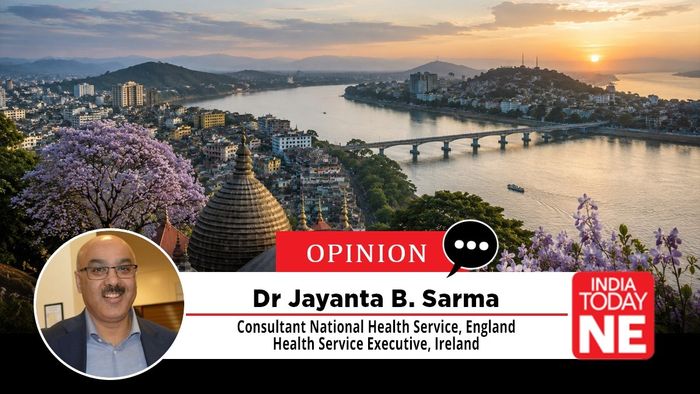
- Jun 02, 2026,
- Updated Jun 02, 2026, 11:31 AM IST
When the Guwahati Municipal Corporation recently floated the idea of branding Guwahati as a “Purple City,” the proposal immediately generated curiosity, amusement, approval and scepticism in equal measure. Some dismissed it as cosmetic politics. Others welcomed it as a refreshing attempt to give the city a recognisable identity. As often happens in Assam, the debate quickly moved beyond paint and colour into deeper questions of authenticity, governance and aspiration.
Yet perhaps the more useful response is neither ridicule nor uncritical enthusiasm. The proposal deserves to be viewed sympathetically because behind even a seemingly simple idea lies an important instinct: the desire to imagine Guwahati not merely as a congested administrative town that grew by accident, but as a city with a coherent identity and emotional presence.
That instinct itself should not be mocked.
Modern cities increasingly compete not only through infrastructure, but through narrative. Cities seek recognisable personalities. Jaipur became the Pink City. Jodhpur became the Blue City. Singapore cultivated the image of a clean garden metropolis. Bengaluru evolved from “Garden City” into India’s technological capital. These identities are not merely tourism slogans. They shape civic pride, investor perception, public imagination and even policy direction.
In that sense, Guwahati’s attempt to discover a visual identity is understandable and perhaps overdue.
The choice of purple is also not arbitrary. It draws from the Kopou Phool, Assam’s beloved foxtail orchid deeply associated with Bohag Bihu and Assamese cultural memory. Unlike many branding exercises imported from marketing templates, this one at least attempts to emerge from a genuinely local symbol. That gives the idea a degree of cultural legitimacy and emotional resonance.
But this is precisely where the real challenge begins.
A city is not a logo. It is a living organism.
Branding a city successfully requires a sophistication far beyond selecting a colour palette or repainting public walls. In fact, the simpler the idea sounds, the more complex the execution often becomes. Urban identity is one of those phenomena in which aesthetics, sociology, ecology, governance, economics, and psychology quietly intersect.
A successful city brand usually works because it captures an underlying truth already present within the city itself.
Jaipur is not globally recognised simply because its buildings are pink. The colour became meaningful because it sat atop an already coherent historical urban form. Venice is not famous merely for canals. Kyoto is not defined only by temples. The visible symbol succeeds because it reflects something deeper and organically rooted.
This is where Guwahati faces a more difficult task.
Can a rapidly expanding, flood-prone, traffic-congested and ecologically stressed city meaningfully acquire a coherent visual identity through colour alone? Or must identity emerge from a broader urban philosophy?
One suspects the latter.
If the “Purple City” idea is to evolve beyond decorative urbanism, it would require an extraordinary level of planning and due diligence. Urban planners, ecologists, transport experts, architects, landscape designers, tourism specialists and citizens would all need to contribute. Questions would arise immediately. Which areas become purple-themed? How are heritage and local architectural diversity preserved? What materials are used in a high-rainfall city? How is visual consistency maintained without becoming artificial or visually exhausting? How are wetlands, hillsides and riverfronts integrated into the aesthetic vocabulary? How are private commercial spaces incentivised rather than coerced? What is the budgetary sustainability?
Even the psychology of colour in tropical urban environments matters.
Without such sophistication, there is always the danger that branding becomes what urban theorists sometimes call “façade urbanism”, the treatment of surfaces while deeper structural problems remain unresolved.
And Guwahati’s structural challenges are substantial.
Citizens instinctively associate the future of the city less with colour and more with drainage, wetlands, mobility, public transport, greenery, footpaths, riverfronts and air quality. The emotional pain many residents express is not that Guwahati lacks a brand, but that it appears to be losing its natural character. The memory of a greener, slower and more breathable Guwahati still lingers in public consciousness.
Perhaps that itself points towards more organic alternatives for the city’s long-term identity.
Guwahati may not need to imitate colour-branded cities at all. It already possesses unusually powerful natural and civilisational anchors. It is the gateway to the Northeast. It sits beside one of the world’s great rivers. It is surrounded by hills. It contains wetlands of ecological significance. It is a Shakti Peeth. It lies at the intersection of South Asia and Southeast Asia’s cultural worlds. It is simultaneously ancient and rapidly transitional.
These are not manufactured assets. They already exist.
One could imagine Guwahati being more naturally branded as a river city, a hill-and-wetland city, a green gateway metropolis, or even the cultural capital of the Brahmaputra valley. Such identities would emerge less from applied aesthetics and more from ecological restoration and urban renewal itself.
Imagine if Guwahati became known nationally for restoring its wetlands instead of filling them. Imagine tree-lined mobility corridors, integrated riverfronts, protected hillsides, walkable public spaces and orchid landscaping naturally woven into the city fabric. In such a scenario, purple would not merely be painted onto the city; it would bloom from within it.
Perhaps that is the deeper opportunity hidden inside this conversation.
The “Purple City” proposal may ultimately matter less for whether Guwahati literally becomes purple, and more because it has forced the city to ask an important civilisational question:
What kind of city does Guwahati wish to become?
(Author’s Note: Dr Jayanta Biswa Sarma writes on politics, institutions, and society through the lenses of history, philosophy, and systems thinking, drawing on both Indian and Western intellectual traditions. Artificial intelligence tools may be used in preparing this article as research and editorial aids. All arguments, interpretations, and final editorial judgement remain the author’s responsibility)