The forgotten art of the hunger strike
Why Gandhi saw fasting not as a political weapon but as a discipline of self-purification—and what Sonam Wangchuk’s protest reveals about the moral condition of contemporary democracy.
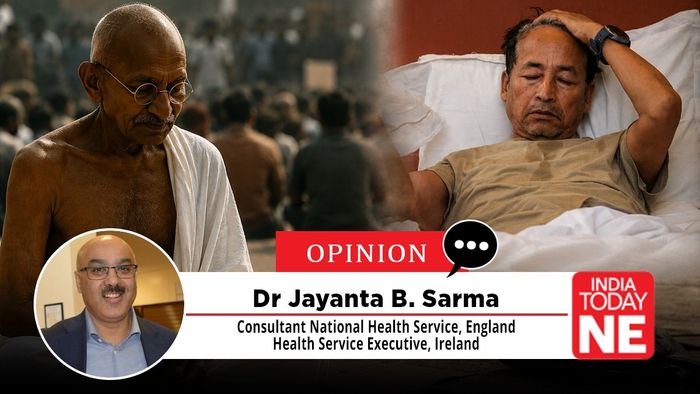
- Jul 16, 2026,
- Updated Jul 16, 2026, 6:39 PM IST
As Sonam Wangchuk entered the third week of his indefinite hunger strike, concern over his health began to dominate the headlines. Political leaders appealed to him to stop. Public figures expressed solidarity. Social media filled with messages of admiration.
Yet an uncomfortable question lingered.
If the cause truly moves us, why does the sacrifice remain his alone?
Why do we watch from a distance rather than carry even a symbolic share of the burden?
To answer that question, we must return to the man who transformed fasting from a personal act of renunciation into one of history's most remarkable instruments of public life.
Mohandas Karamchand Gandhi.
Most people know that Gandhi fasted. Far fewer know how carefully he reflected on fasting itself. He did not regard it as a political trick or a weapon to force an opponent's hand. He regarded it as an art, perhaps one of the most demanding arts of public life.
His first lesson is the one we have almost entirely forgotten.
“Fasting is a process of self-purification.” (Young India, 24 November 1927).
This simple sentence overturns the modern understanding of political protest. Today, we instinctively think of a hunger strike as something directed against the government or an institution. Gandhi insisted that it begins elsewhere—with oneself.
Before one asks society to examine its conscience, one must first examine one's own. Before demanding sacrifice from others, one must embrace sacrifice personally. Fasting was therefore not primarily an instrument for changing the opponent. It was a discipline for changing the self.
Only then could it become an appeal to another's conscience.
Gandhi's second lesson is equally striking.
“Fasting... is a powerful thing but a dangerous thing, if handled amateurishly.” (Harijan, 27 October 1946).
Why dangerous?
Because moral witness can easily become moral coercion.
Gandhi warned:
“Fasts can be really coercive... A fast undertaken to attain a selfish object... would amount to the exercise of coercion or undue influence.” (Harijan, 9 September 1933).
These words sound surprisingly contemporary.Gandhi understood that voluntary suffering possesses immense emotional force. Used carelessly, it can become moral blackmail rather than moral persuasion.
That is why motive mattered more than publicity.
Then comes perhaps his most profound insight.
“Fasting can only be resorted to against a lover, not to extort rights but to reform him.” (Selected Letters of Mahatma Gandhi, “Fasting in Satyagraha”).
By “lover,” Gandhi did not mean romantic affection. He meant a relationship founded upon mutual moral recognition.
A hunger strike is not an act of violence. It is an appeal to conscience. Such an appeal only works where conscience still exists as a shared language.
That observation forces us to confront an uncomfortable reality.
Do we still inhabit the moral world in which Gandhi's fasting made sense?
Today's politics is shaped by speed, spectacle and permanent attention. Every movement seeks visibility. Every protest competes with countless others. Every public act is instantly analysed for hidden motives.
The public wonders whether the activist is performing.
The activist wonders whether the public truly cares.
The government wonders whether the protest is political theatre.
Mutual scepticism has become the default condition of democratic life.
Perhaps that is why contemporary hunger strikes often appear strangely lonely.
If a hunger strike truly awakens society's conscience, one might expect people to shoulder at least a symbolic portion of the burden. Thousands might observe a one-day fast, organise community discussions, or voluntarily accept some measure of personal discomfort in solidarity with the cause.
Instead, solidarity increasingly consists of posts, hashtags and expressions of concern.
We admire sacrifice without participating in it.
This is not merely a criticism of the public. It also invites reflection on the hunger strike itself.
When every political disagreement is accompanied by an indefinite fast, the extraordinary gradually becomes ordinary. Like every profound moral act, fasting is vulnerable to inflation. Repeated too frequently as a tactic for immediate demands, it risks losing both its political potency and its deeper purpose of self-purification.
Gandhi never imagined fasting as a substitute for patient political work. His fasts drew their authority from a life already devoted to truth, service, discipline and constructive action. They were not isolated performances but moments within a lifelong moral practice. They were expressions of a much larger moral journey.
Perhaps that is the distinction we have forgotten.
We have come to judge a hunger strike by a single question: Did it make the government concede?
Gandhi might have begun elsewhere.
Did it purify the person who fasted?
Did it deepen the conscience of those who witnessed it?
Did it strengthen the moral fabric of the community?
Political victories can be immediate or delayed. Moral transformation is almost always slow. It unfolds over years through example, trust and shared sacrifice rather than dramatic moments alone.
Perhaps, then, the hunger strike is not meant to be understood as a political weapon at all.
It is a political art.
Like every great art, it does not seek merely to produce an immediate effect. It seeks to cultivate a different kind of human being and, through such individuals, a different kind of society.
The real question before us today is therefore larger than the fate of Sonam Wangchuk's fast or any future hunger strike.
It is whether we still possess the moral culture that once gave such acts their extraordinary power.
(Author’s Note: Dr Jayanta Biswa Sarma writes on politics, institutions, and society through the lenses of history, philosophy, and systems thinking, drawing on both Indian and Western intellectual traditions. Artificial intelligence tools may be used in preparing this article as research and editorial aids. All arguments, interpretations, and final editorial judgement remain the author’s responsibility)