The Machine That Heats the World It Promises to Save
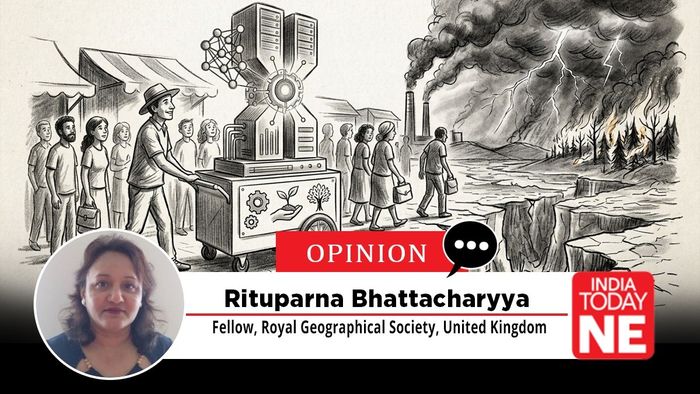
Artificial intelligence is being sold to us as the answer to the climate emergency. From Sivasagar to Langtang, from Andalusia to Antalya, the ledger looks rather different — and the argument about who gets to switch it off has only just begun.
- Oct 05, 2026,
- Updated Oct 05, 2026, 2:34 PM IST
Waist-deep in Station Chariali
On 22 July 2026, the Desang embankment gave way, and Sivasagar town became a river. Water ran through the streets of the old Ahom capital at the height of a person’s chest. In Ward No. 11, families climbed onto beds, then onto roofs, then waded to the nearest temple. In the Station Chariali market, more than a hundred shopkeepers watched two to five feet of silted water dissolve their stock. Not a single ward was left dry; two were described, generously, as “somewhat safe”.
It had begun three days earlier, with incessant rain across the Naga hills and eastern Assam. The Dikhow, the Disang, the Jhanji and the Dhansiri came down together while a swollen Brahmaputra refused to take their water. By the time the monsoon relented, official counts recorded 62 dead; when Al Jazeera returned to the districts in August, the toll had passed a hundred, with some 700,000 people displaced, 1.2 million affected and 2,700 villages gutted. A vlogger from the area, Kukil Das, described trees thirty and forty metres tall coming down off the hills: “It was a tsunami.” Asor Ali, seventy-five years old, said that even the generations before him had not seen such a flood.
The researcher Mirza Zulfiqur Rahman put it more bluntly still: “The flood was purely human-made, caused by the fracturing of the landscape.” Nagaland lost 794.88 sq km of forest cover between 2013 and 2023, by the Forest Survey of India’s reckoning, and 14 per cent of its tree cover between 2002 and 2025. Stone and sand mining have hollowed out the Dikhow’s bed. Coal has been cut from the hills above. The rain was extraordinary; the catastrophe was assembled.
I begin here deliberately. The global conversation about artificial intelligence and climate change is conducted almost entirely in aggregates: terawatt-hours, gigatonnes, compute scaling, and almost never in the language of a market in Sivasagar under five feet of water. If AI is to be judged on its climate performance, the judgement has to be made where the climate actually lands.
An emergency, formally acknowledged
The physical case is no longer in serious dispute. The World Meteorological Organization’s (WMO) Global Annual to Decadal Climate Update for 2026–2035 predicts that annual global mean temperatures for 2026–2030 will fall between 1.3°C and 1.9°C above the 1850–1900 baseline. There is a 91 per cent chance of “very likely”, in the WMO’s careful register, that at least one year in that window temporarily breaches 1.5°C, and an 86 per cent chance that one of them overtakes 2024 as the warmest year in the instrumental record.
The 1.5°C figure is not a scientific cliff edge; it is a political and moral one. It entered the Paris Agreement in 2015 because small island states and climate-vulnerable nations fought for it, on the evidence that every increment between 1.5°C and 2°C means materially more coral death, more crop failure, more coastlines lost and more people displaced. The Conference of the Parties (COP) has organised its rationale around that threshold ever since: hold the line and adaptation remains conceivable; cross it durably and whole categories of loss become permanent.
At COP30 in Belém (Brazil), the parties conceded, for the first time in a negotiated text, that an overshoot of 1.5°C is now likely, with language urging that its extent and duration be limited. What followed that admission was thinner. The “global mutirão” package launched a voluntary “global implementation accelerator” and a “Belém mission to 1.5C”, but contained no fossil-fuel roadmap despite 82 countries pressing for one; the European Union called it a missed opportunity. The call to triple adaptation finance was pushed back to 2035 and its baseline year quietly deleted. Developed-country adaptation finance currently runs at around $26 billion a year against an estimated need of $310 billion. Even with more than a hundred new national climate plans submitted, the world remains on course for 2.3°C to 2.5°C of warming by 2100.
COP31 convenes at the Antalya Expo Centre from 9 to 20 November 2026, with Türkiye’s Murat Kurum as President and Australia’s Chris Bowen as President of Negotiations, an awkward diarchy produced by a hosting dispute that itself consumed negotiating time at Belém. It will meet in a year that has already furnished more evidence than any delegate can comfortably read.
What 2026 has looked like
On 26 August, a slab of ice and rock roughly 0.2 sq km in extent detached from near Langtang Lirung at an altitude of 5.2 km and fell about 1.2 km into the valley beneath. The United States Geological Survey’s analysis of long-period seismic waves established that this was a glacier collapse, not an earthquake. The flood that followed tore through Rasuwa, Nuwakot, Dhading, Gorkha and Chitwan in Nepal and Gyirong county in Tibet. As of mid-September, the confirmed dead number more than 1,429-1,386 in Nepal, 43 in China, with over 5,649 missing, among them 587 foreign nationals from 39 countries. Nepal has put direct damage at above Rs 400 billion (about US$2.64 billion) and reconstruction at Rs 723.32 billion (US$4.73 billion). Scientists speaking to the BBC, CNN and NPR judged that climate change probably increased the likelihood of the event; others cautioned that more proximate causes were at work. Both things are true, and the second does not exonerate the first: warming does not cause each collapse; it loads the dice.
Europe, meanwhile, burned. Between 18 June and 2 September, fires consumed roughly 540,000 hectares across the European Union, an area more than twice the size of Luxembourg. The summer did not set an overall record, but it broke a great many individual ones: four of the EU’s fifteen largest fires of the past decade occurred within it, and the single week of 16 to 22 July burned nearly 190,000 hectares, the most for any such week since records began in 2006. One fire in Ávila destroyed more than 42,000 hectares; another in Huelva nearly 44,000. France broke its annual burned-area record before July was out, with a single Gironde fire taking 37,000 hectares. Belgium suffered its worst wildfire in more than a century. Spain’s cumulative total by early August stood at 185,948 hectares, more than double its fourteen-year average; France’s at 99,092, more than triple; the United Kingdom’s at 22,206, its worst in fifteen years; the Netherlands burned at nearly five times its long-run average.
Heat came in waves, the fourth since May, and the records fell in places that do not think of themselves as hot: 41.7°C in Germany, 41.1°C in the Czech Republic, 40.5°C in Poland. More than 30,000 excess deaths across the continent have been attributed to the summer’s successive heatwaves, over 10,000 of them in June alone. Hundreds of thousands of people were evacuated from their homes.
Sivasagar (Assam), Langtang (Nepal), Andalusia (Spain). Three geographies, one signature. This is what a climate emergency looks like when it stops being a forecast.
The meters are running
It is into precisely this moment that artificial intelligence has arrived, carrying two contradictory promises: that it will help us model, predict and decarbonise our way out of the emergency, and that it requires an unprecedented expansion of energy-hungry infrastructure to do so.
A useful place to watch the second promise being kept is TheAIMeters, a public dashboard that runs live counters for the AI industry’s physical footprint: prompts and tokens processed, Graphics Processing Units (GPU)-hours consumed, electricity drawn, carbon dioxide emitted, water evaporated. Its method is transparent and deliberately conservative, electricity estimated as (IT load × utilisation × hours) × power usage effectiveness; carbon derived from electricity multiplied by grid emission factors weighted across regions; water combining on-site cooling with the water embedded in generating the power in the first place. The site is candid that these are “indicative estimates rather than exact measurements”, public proxies rather than audited totals. That candour is the point.
There is no regulator publishing the real numbers, so a civic dashboard is what we have.
The same is true of the small industry of AI carbon footprint calculators now available to anyone curious about the cost of their own habits. Their published ranges are instructive: roughly 0.1 to 0.5 watt-hours per query for small models, 2 to 5 Wh for frontier models, and 10 to 80 Wh for the “reasoning” models that think at length before answering — a spread of nearly three orders of magnitude, driven by how hard we ask the machine to work. Image generation runs at 2 to 5 Wh apiece. A single working session of twenty to fifty questions can, on these estimates, account for around half a litre of water.
Set against this, Google’s disclosure of August 2025, the first from a major laboratory , reported that a median Gemini text prompt used 0.24 Wh of energy, 0.26 ml of water and emitted 0.03 grams of CO₂ equivalent. Reassuringly tiny. But the boundary drawn around that figure excluded model training, data storage, network energy, end-user devices and the indirect water consumed in generating the electricity, and used market-based rather than location-based carbon accounting, which is to say, it credited purchased renewable certificates rather than measuring the grid the machines actually run on. Shaolei Ren of the University of California, Riverside, was scathing: “They’re just hiding the critical information... This really spreads the wrong message to the world.”
The honest aggregate is more sobering. Data centres consumed just over 1 per cent of global electricity in 2024 and produced about 0.5 per cent of global CO₂ emissions, growing at roughly 12 per cent a year since 2017. The International Energy Agency’s central scenario has their demand more than doubling to 945 TWh by 2030, which is approximately the entire current electricity consumption of Japan. AI’s share of data-centre power, between 5 and 15 per cent in recent years, is projected to reach 35 to 50 per cent by 2030. And the electricity is not clean: fossil fuels supply nearly 60 per cent of data-centre power today, coal foremost among them, with gas generation built expressly for data centres set to more than double to 293 TWh by 2035. In Ireland, data centres already take 21 per cent of national electricity, rising towards 32 per cent; in Dublin, 79 per cent of local consumption; in Virginia, 26 per cent of the state’s power.
The footprint arrives in South Asia
This is no longer somebody else’s argument. India’s data-centre capacity has nearly tripled from 520 MW in 2020 to about 1.5 GW today and is projected to reach 6.5 GW by 2030 on the back of roughly $200 billion of anticipated investment. Electricity demand from the sector is expected to rise from around 13 TWh in 2024 to some 57 TWh by 2030, with AI alone accounting for an estimated 26.3 GW of new demand by 2031–32. On a grid still substantially coal-fired, those terawatt-hours have a colour.
The water figures deserve equal attention and receive almost none. A 100 MW facility consumes roughly two million litres a day, the daily draw of about 6,500 households. Indian data centres used approximately 150 billion litres in 2024–25; by 2030 that is projected to exceed 358 billion litres. The industry clusters in Mumbai, Hyderabad, Bengaluru and the National Capital Region. Hyderabad’s surface water supply fell 20 per cent in the summer of 2024. Rajasthan extracts 147.11 per cent of its annual groundwater recharge. We are proposing to site an evaporative industry in an aquifer-stressed country and calling it infrastructure modernisation.
For North East India, the calculus is different again but not more comfortable. The region is not yet a data-centre hub; it is, however, a hydropower frontier, and the electricity that Delhi’s and Hyderabad’s server halls will need is precisely the argument that will be made for the next tranche of large dams on the Siang, the Subansiri and the Dibang. The pattern is old, and the region knows it well: the periphery supplies the energy and absorbs the ecological cost; the value is realised elsewhere. An ecofeminist reading, what I have elsewhere called Nature’s #MeToo (published in the journal Space and Culture, India on 26-09-2026), would name this what it is: an extractive relation, dressed in the vocabulary of progress, in which the violated party is never consulted about consent.
The other side of the ledger
None of this makes the case against AI in climate work, and it would be dishonest to pretend otherwise. Machine-learning weather models have genuinely transformed forecasting. Google DeepMind’s GraphCast produces a ten-day global forecast in under a minute on a single TPU machine, whereas conventional numerical weather prediction demands hundreds of machines in a supercomputer, and it outperformed the European Centre’s operational HRES model on more than 90 per cent of 1,380 test variables: 99.7 per cent of them in the troposphere, where forecasting matters most. Models of this family are now moving into operational service at national weather agencies. For a state like Assam, where the difference between a 24-hour and a 72-hour warning of a Dikhow surge is the difference between moving livestock and losing it, that is not a marginal gain. AI is also doing serious work in grid balancing, materials discovery for batteries and catalysts, methane-plume detection from satellite imagery, and the monitoring of deforestation of exactly the kind that fractured the Naga hills.
But 2026 has illustrated the limits sharply. The Langtang collapse was, as one broadcaster put it, almost impossible to predict: no forecasting system, however fast, anticipates the detachment of a particular ice mass at a particular hour. Warning systems also fail at the last mile far more often than at the modelling stage: the message that never reaches the village, the household with nowhere to go even when warned. And the efficiency gains, real as they are, are not of the same order of magnitude as the emissions growth from the wider industry. A model that saves a megawatt-hour by optimising a grid does not offset a sector adding hundreds of terawatt-hours of demand. Both facts belong in the same sentence, and they rarely appear there.
VII. “A SICK conspiracy”
Which brings us to the politics, which turned unusually explicit in the second week of September 2026.
On 12 September, Dario Amodei, chief executive of Anthropic, published an essay arguing that “we must slow the pace at which we improve the capabilities of AI models.” He proposed three mechanisms: embedded third-party evaluators such as METR to verify safety commitments and incident reporting, which Anthropic committed to unilaterally and called on governments to require of others; coordination among leading laboratories in democracies on common safety standards and limits on the rate of unchecked progress, with the US government mediating antitrust concerns; and international coordination extending to authoritarian states on prohibitions such as bioweapon assistance. Sam Altman of OpenAI agreed to the embedded-evaluator proposal. Elon Musk posted, simply, “Dario is right.”
The President of the United States took a different view. Across 13 and 14 September, Donald Trump attacked the slowdown campaign repeatedly, writing on Truth Social: “There is a SICK conspiracy going on against AI and data centers, and the only one that is happy about it is China.” He added that “the only control or ‘guardrails’ that AI needs is a STRONG AND SMART (High IQ!) PRESIDENT.”
Note what is bundled together in that sentence. It is not only AI development that the President defends against the imagined conspiracy; it is data centres. The physical estate — the land, the power purchase agreements, the water abstraction licences, the gas turbines built to serve a single campus — is folded into a question of national security, and objection to it reframed as service to Beijing. That is a rhetorical move of considerable efficiency: it converts a planning dispute in Virginia, or a water dispute in Hyderabad, into treason. It renders the climate objection unspeakable by making it geopolitical.
Then, on 14 September, Jack Clark, one of Anthropic’s seven co-founders, told the BBC something that ought to have been heard in climate circles as well as technology ones. Most laboratories, including his own, already possess the means to shut their systems down. The question, he argued, is whether that should be left to them: “Should you mandate that companies definitely have a kill switch? Is that kill switch verifiable by a third party? I think that’s the kind of thing society is going to want to know and might want to eventually pass rules around.” A totally unregulated industry, he warned, is dangerous. “We are rolling dice with immense risks. And the point is, we have to change the course of this industry.”
What a kill switch has to do with a flood
The kill-switch debate is conducted in the idiom of existential risk, rogue systems, loss of control, the machine that will not stop. Read it, though, for its underlying principle rather than its imagery, and it turns out to be a climate argument in disguise.
Anthropic co‑founder JackClark’s decisive phrase is not “kill switch”. It is verifiable by a third party. What he is describing is a governance architecture in which a private firm’s claims about its own systems are independently auditable, and in which society retains a lever it can actually pull. Strip away the science fiction, and that is precisely, exactly, what is missing from the environmental side of the ledger. We have a self-reported figure of 0.24 watt-hours from Google, with the awkward components excluded. We have a public dashboard run by volunteers doing arithmetic on public proxies because nobody is compelled to publish the real thing. We have calculators offering three-orders-of-magnitude ranges because the underlying numbers are not disclosed. Every single one of these is an accountability failure of the same species that Clark is asking lawmakers to fix.
So, the obvious proposition is this: if we are prepared to legislate a verifiable off-switch for capability risk, we can legislate verifiable metering for environmental risk. Mandatory, audited, facility-level disclosure of electricity consumption, fuel mix on a location-based rather than market-based accounting, water withdrawal and consumption, and the emission of training runs as well as inference. Published to a common standard. Checked by someone who does not work for the company. No new technology is required; the meters already exist, and the firms already read them. What is absent is the obligation to show us.
Both debates turn on the same three questions: who holds the lever, who verifies the claim, and who bears the cost of being wrong. On capability risk, the world is at least arguing about the answers in public, with the industry’s own founders pressing for constraint. On environmental risk, the argument has barely started, and the most powerful office on earth has just declared that raising it is a conspiracy that serves China.
From the periphery
There is an asymmetry running through all of this that ought to be stated plainly. The electricity is drawn in Virginia and Dublin and, increasingly, Hyderabad. The water is drawn from aquifers that are already overdrawn. The productivity gains accrue to firms headquartered on two coasts of one country. And the losses arrive in Rasuwa and Nuwakot, in Sivasagar’s Ward No. 11, in the Andalusian hills, among people who have never issued a prompt and would struggle to explain what a GPU-hour is.
This is not an argument for refusing the technology. AI will help us forecast the Brahmaputra’s crests, map the deforestation above the Dikhow and cut the emissions of the grids that power it; it would be perverse to reject those gains. It is an argument for holding the industry to the standard it is now, remarkably, proposing for itself. When the co-founder of a frontier laboratory says publicly that his industry is rolling dice with immense risks and must change course, the appropriate response of a citizen in Guwahati or Kathmandu or Seville is neither deference nor panic, but a demand that the meters be made public and the audits made real.
COP31 opens in Antalya on 9 November with an overshoot already conceded, adaptation finance an order of magnitude short of need, and a warming trajectory of 2.3°C to 2.5°C. Somewhere in those two weeks, delegates will be told that artificial intelligence is part of the solution. It may be. But a technology whose physical demand is projected to double the electricity consumption of an entire industrial sector within five years, on a grid that is still 60 per cent fossil-fuelled, does not get to claim that status by assertion. It has to prove it, in audited numbers, at facility level, on the record.
Until then, the most useful thing any of us can do is keep watching the meters. They are running whether we look at them or not.
Dr Rituparna Bhattacharyya (FRGS, SFHEA) is a human geographer, Founding Editor-in-Chief of Space and Culture, India, and Series Editor for Gender and Violence at Routledge.