The Money Arrives. The Voice Does Not: India’s Ageing Challenge and the Human Side of Viksit Bharat 2047
A widely shared story about a delivery worker and an elderly woman has sharpened attention on ageing and loneliness in India. It underlines that remittances and development alone cannot replace dignity, connection and everyday care.
- Sep 13, 2026,
- Updated Sep 13, 2026, 12:00 PM IST
A developed India cannot be measured only by GDP, digital payments, infrastructure and global influence. It must also be measured by how it cares for those who built it.
A son working In Toronto , London , Melbourne or the Gulf region is often a symbol of family success. A daughter building a professional career in Bengaluru, Mumbai or Delhi reflects India’s progress. Remittances have become an important part of household security.
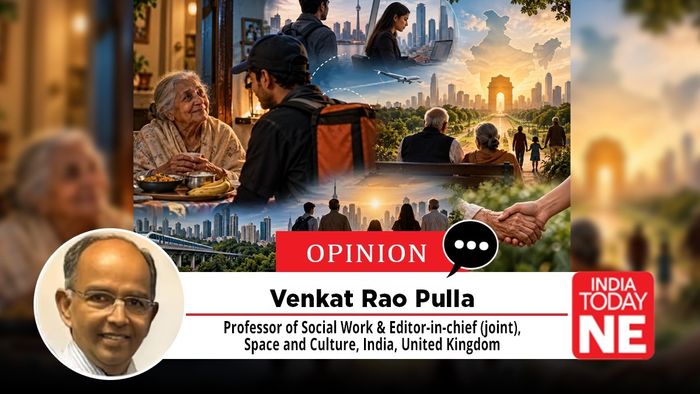
A small story circulating widely on social media has touched millions of hearts. A delivery worker receives a late-night food order. It is a simple meal of khichdi, curd and bananas. The address takes him to an old building where an elderly woman opens the door with trembling hands. She asks him not merely to leave the food, but to sit for a few minutes because “eating alone does not feel good.”
The woman’s son lives abroad and sends money regularly. Her daughter lives in another city and has built her own life. There is no anger, no accusation, no complaint. There is only a quiet emptiness. Her words stay with the young delivery worker. “Parents don’t count money, son. They count voices.”
Whether this story is a real-life account or a symbolic social media narrative, its emotional truth reflects a growing reality across the world: ageing is no longer only a medical or economic issue. It is a deeply human question about belonging, dignity and connection. I don’t know who t authored that widely circulated narrative. But its message resonates as it describes the transformation that is occurring, and presents itself as an agenda to the social work professionals must carefully address alongside other professionals.
According to the United Nations Population Fund (UNFPA) India Ageing Report 2023, India has more than 149 million people aged 60 years and above, representing more than 10 percent of the population. This number is expected to rise dramatically in the coming decades. By 2050, India is projected to have around 347 million elderly citizens, making older persons nearly one-fifth of the population.
This is one of the most significant social transformations India will experience.
Ageing is often discussed through statistics: pension systems, healthcare costs, insurance, retirement planning and dependency ratios.
But behind every number is a pe
For decades, India was known as a young nation. The demographic dividend powered aspirations, entrepreneurship and economic growth. But success brought in healthcare, better nutrition and improved standard of living which is letting many of us to see through our eighties and beyond.
The question before India is not whether people will age.
The question is: Will India age with dignity?.
Behind every number is a person. A retired teacher, a retired officer or a parent , clearly a now adhhar card holder citizen whose contribution helped build the India we see today.
The challenge in our society is not to keeping elderly and the frail aged people alive. The challenge is ensuring they continue to feel alive. The Indian family has always been one of the country’s strongest social institutions. Yet migration, urbanisation and changing lifestyles have steeply reshaped the family relationships.
Millions of Indians now live away from their parents because of education, employment and global opportunities. Surely this is progress and aspiration. But remittances alone cannot replace emotional presence. Remittances can pay medical bills., buy medicines and improve living conditions. But money cannot replace a conversation, a visit, a hand held during illness, or the simple question: “ Amma Did you eat today?”
We are good at digital payments and remittance systems, but then, it is time that we also focus on a relationship economy , where human wellbeing is measured alongside financial wellbeing.
Truly, India under Viksit Bharat 2047 must include elderly citizens as valued members of society.
Development today needs compassion. Time to begin active ageing communities, intergenerational programmes, age-friendly cities and more human behaviors technology that strengthens relationships.
Conversations about ageing should not incite blame or guilt. Young Indians face their own pressures and challenges. The answer does not lie in criticsing the collapsing family structure but the answer is in harnessing shared responsibility.
The first shift occurs when the elderly are not viewed as dependents., but are respected as reservoirs of knowledge, culture, history and wisdom.
The delivery worker in the story thought he was delivering food. But he discovered that sometimes people are hungry for conversation , have a story to tell or ask a few questions . Sometimes bluntly hungry to tell us that they still matter.
Clearly India’s journey towards 2047 will not be judged by economic criteria alone but by how it treats its elderly that are vulnerable.
As a nation we ought to move forward quickly with everyone along , including those who carried the whole nation first.