The Moscow Moment: Why India’s Northeast Could Be the Real Winner
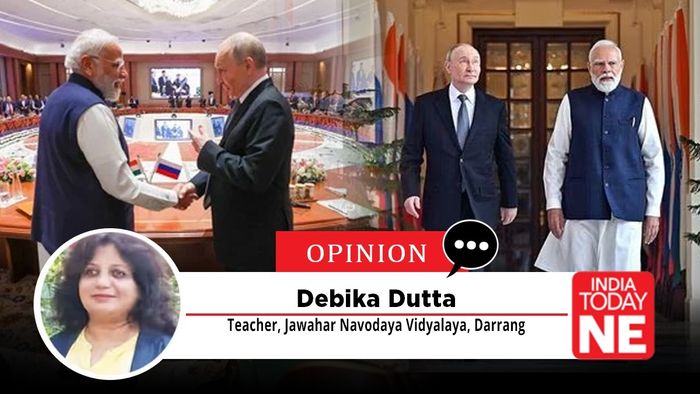
When the Russian president arrived in New Delhi this December, the headlines focused on global strategy, energy bargains, and diplomatic symbolism. Yet the most consequential outcomes may unfold far from the capital — in the Northeast, a region whose economic potential is often acknowledged but rarely positioned at the centre of national policy.
- Dec 08, 2025,
- Updated Dec 08, 2025, 2:18 PM IST
When the Russian president arrived in New Delhi this December, the headlines focused on global strategy, energy bargains, and diplomatic symbolism. Yet the most consequential outcomes may unfold far from the capital — in the Northeast, a region whose economic potential is often acknowledged but rarely positioned at the centre of national policy. The renewed India–Russia partnership, if pursued with focus and vision, could mark a turning point for this region of 45 million people, rich in resources yet historically underserved by industry and investment.
The discussions affirmed a goal that once sounded overly ambitious: expanding bilateral trade to US$ 100 billion by 2030. This is not an abstract number. In FY 2024–25, trade had already risen to about US$ 68.7 billion, up sharply due to energy imports. But the imbalance remains striking: India exported just US$ 4.88 billion worth of goods to Russia while importing nearly US$ 63.8 billion, primarily crude oil, fertilizers and coal. For long-term sustainability, India must widen its export basket and build new production ecosystems. That places the Northeast — strategically located, resource-rich and demographically young — directly in the zone of opportunity.
The region’s natural endowments are well-documented but underleveraged. Assam alone accounts for more than half of India’s onshore oil production and hosts abundant coal, limestone and clay reserves. Arunachal Pradesh has one of the country’s largest deposits of vanadium — a metal crucial for high-strength alloys and next-generation batteries. Meghalaya’s limestone reserves run into hundreds of millions of tonnes. Nagaland, Manipur and Mizoram possess significant quantities of chromite, nickel, graphite and rare earth elements. These minerals feed industries ranging from electric vehicles and steelmaking to electronics and renewable energy — all sectors where Russia is expanding production capacity and seeking secure supply chains.
This alignment of needs offers a rare chance to redesign the value chain. Instead of exporting raw minerals — a pattern that yields limited local benefit — the Northeast can become a base for processing, refining and manufacturing. With Russian investment, technology and long-term purchase agreements, the region could support metallurgical complexes, battery-component plants, alloy-making units and specialized engineering
workshops. Such industries bring not just revenue but high-quality jobs, technical training, research collaborations and spin-off enterprise growth.
Energy security discussions during the summit also carry implications that go beyond national oil reserves. India obtained assurances for uninterrupted supplies of crude, gas and coal over the next several years. Stable energy availability is not only a macroeconomic stabilizer — it is the foundation of industrial feasibility. Industries in the Northeast have long struggled with high logistics and power costs, making manufacturing comparatively less competitive. If energy-linked costs decline and infrastructure improves, long-planned sectors like food processing, cold-chain logistics, pharmaceuticals and light engineering could finally take root.
Tea — one of the Northeast’s most iconic industries — illustrates this possibility. The region contributes over 50% of India’s total tea output and nearly 90% of its high-quality orthodox tea. Russia has traditionally been one of the largest consumers of Indian tea, but exports have dipped in recent years due to logistical disruptions and market volatility. With renewed trade channels and stable payment mechanisms, the Northeast’s tea estates — especially in Assam — could regain market share. A modest 10–15% jump in tea exports to Russia would significantly benefit local economies given the sector’s labour-intensive nature.
Pharmaceuticals, another sector stressed during the dialogue, offer similar promise. India is the largest supplier of generic medicines to Russia, but most production is concentrated in western and southern states. With targeted incentives, the Northeast can host formulation units, packaging plants and logistics hubs for pharma exports to Eurasia. Skilled youth in states like Assam, Manipur and Tripura could enter a sector that promises stable employment and upward mobility.
Logistics and connectivity sit at the heart of this larger transformation. As Russia seeks more imports — from food products to electronics and chemicals — India must establish faster, cost-effective trade corridors. The Northeast is the only region that links India directly to Southeast and East Asia through land routes. With new highways, inland waterways, integrated check-posts and border-trade infrastructure, the region could become a transit and storage hub for goods moving toward Russian-linked markets via ports in Myanmar, Bangladesh and eastern India. A well-developed logistics cluster along the Brahmaputra could, for instance, cut freight time and generate thousands of jobs in warehousing, transport, packaging and value-added services.
Defence cooperation, another pillar of the talks, also holds downstream possibilities. With both countries exploring joint production and technology transfer, the demand for electronic components, precision engineering, metal alloys and specialized fabrication will rise. Few regions in India offer the combination of land availability, strategic location and youthful workforce that the Northeast does. Clusters near Guwahati, Tezpur, Jorhat or Silchar could house component-manufacturing units feeding into larger defence production chains. Such activity creates ecosystems — from machining workshops and tool-making firms to electronics testing facilities and research labs.
However, the opportunities will not automatically translate into durable gains. The Northeast has seen many promising announcements fade into inertia. For the region to truly benefit from the new India–Russia template, policy alignment is essential. Incentives for mineral-based industries must come with environmental safeguards and community participation. Transport projects must maintain pace, especially along critical corridors. Educational institutions need partnerships that prepare students for engineering, geoscience, logistics, international trade and industrial automation. And governments must ensure that local entrepreneurs are not sidelined but integrated into value chains.
This moment holds unique strategic importance. India wants to reduce its overreliance on a handful of global suppliers. Russia wants to diversify markets and secure minerals, food products and manufacturing partners. The Northeast wants meaningful industrialization, employment and recognition as a national growth engine. Few geopolitical moments offer such an alignment.
If the outcomes of the Moscow visit translate into grounded policies — creating processing plants near resource zones, building export facilities along the Brahmaputra, establishing industrial parks tailored to mineral and engineering industries, and supporting farmers and artisans with access to Eurasian markets — the Northeast could emerge as a critical contributor to India’s next economic leap.
The conversation in Delhi may have been global, but its most transformative echoes could be heard in the hills, valleys and riverbanks of the Northeast. In a geopolitically shifting world, this region stands at the threshold of relevance it has long deserved. What remains is whether policy will match potential — and whether the Northeast can seize a window of opportunity that may not come again soon.