The opponent within: How rivals shape leaders and nations
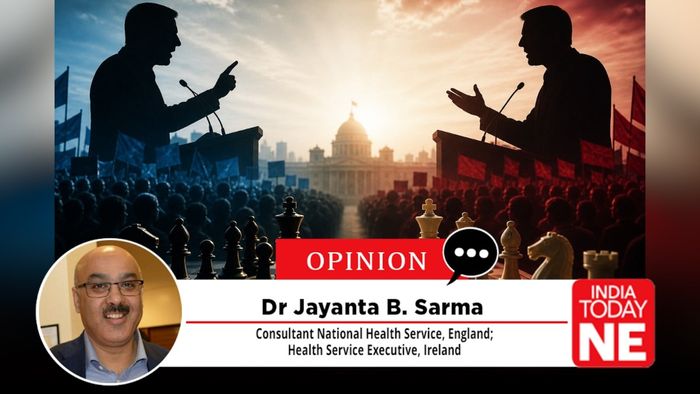
Leaders are often judged by their intrinsic values and abilities. But in politics, they are equally shaped by their opponents. Rivalry does not merely test leadership, it helps create it.
- May 01, 2026,
- Updated May 01, 2026, 8:18 PM IST
There is a comforting belief in public life: that a great leader emerges from within, shaped by conviction, character, and clarity of thought. We celebrate such figures as if they are self-forged—like steel in a furnace of personal will.
But this is only half the story.
The other half stands across the aisle.
In reality, leaders are not only defined by what they are; they are equally shaped by whom they face. Politics is not a monologue. It is a continuous strategic exchange between adversaries. Political science has long treated campaigns not as isolated performances but as interactive contests, where each move provokes a counter-move. The opponent is not a passive obstacle; he is an active force in shaping behaviour.
This is why a leader facing weak or fragmented opposition often appears calm, expansive, even statesmanlike. The same leader, confronted with a sharp and relentless rival, may become combative, defensive, and polarising. Has the leader changed? Or has the opponent revealed a different version of the same person?
The answer is: both.
At this point, a deeper question arises: does a leader lose his intrinsic values in this process?
Not in any sudden or dramatic way. Core values, ideas of justice, order, liberty, loyalty, tend to endure. They are rarely abandoned overnight. But politics does something subtler. It changes the priority of values. A leader who balances fairness and security may, under pressure, begin to privilege security. One who values openness may lean toward control.
The values remain. Their expression changes.
And over time, behaviour can move ahead of belief.
This is the quiet transformation that defines much of modern politics. Leaders adopt harsher rhetoric because the opponent is aggressive. They centralise power because the contest appears existential. Each step is justified as necessary. Yet repetition turns strategy into habit, and habit begins to reshape conviction.
Modern democracies intensify this dynamic through what scholars describe as negative partisanship, the tendency of citizens to be mobilised less by attachment to their own side than by hostility to the other. Politics becomes emotionally anchored in opposition. The rival is no longer incidental; he becomes structurally necessary.
This creates a feedback loop.
Each side amplifies the other.
Each accusation invites escalation.
Each distortion finds its mirror across the divide.
What emerges is not merely conflict, but co-evolution.
Case studies: how rivalry reshapes leaders
The theory becomes clearer when seen through real examples.
Margaret Thatcher: Adversary-driven hardening
The political trajectory of Margaret Thatcher in the United Kingdom illustrates how sustained opposition can sharpen and harden leadership style. Early in her premiership, her economic reforms were fiercely contested, by trade unions, opposition parties, and even sections within her own establishment.
Events such as the UK miners' strike 1984–85 became defining confrontations. The intensity of that conflict did not merely test her leadership, it shaped it. Her emphasis on authority, market reform, and central control became more pronounced under pressure.
Her beliefs did not originate from the conflict.
But the force and form of their expression were forged within it.
Nelson Mandela: Adversary-driven moderation
A very different trajectory is visible in South Africa during the end of apartheid.
Mandela, once a resistance leader, faced the prospect of civil conflict and entrenched opposition. In that setting, he chose reconciliation over retribution. This was not a loss of values, but a reordering of priorities—justice pursued alongside stability.
The adversary shaped not what he believed,
but how those beliefs were realised.
Viktor Orbán: Co-evolution under prolonged rivalry
The Hungarian experience shows how long-term rivalry reshapes both sides.
Over years of adversarial politics, governance under Orbán became increasingly centralised and combative. At the same time, opposition forces were compelled to become more coordinated, disciplined, and strategic.
Rivalry here did not merely produce opposition.
It produced mutual transformation.
Abraham Lincoln: Moral expansion under pressure
During the American Civil War, Abraham Lincoln’s leadership evolved in response to intense moral and political pressures.
Initially focused on preserving the Union, he gradually expanded the moral scope of the conflict, culminating in the Emancipation Proclamation.
Here, opposition and circumstance did not dilute values.
They deepened them.
Indira Gandhi: Centralisation under adversarial strain (India example)
India offers its own powerful illustration.
Indira Gandhi began with a mandate rooted in social justice and political consolidation. Yet the period of intense political contestation in the early 1970s—economic pressures, internal dissent, and opposition mobilisation, culminated in the The Emergency (India).
The Emergency marked a dramatic centralisation of power, suspension of civil liberties, and curtailment of institutional checks.
It would be simplistic to say her values disappeared.
But it is equally difficult to argue they remained unchanged in practice.
What we see instead is the core argument of this essay:
adversarial pressure can reshape how values are interpreted, prioritised, and exercised.
Reintegrating the argument
These cases reveal a consistent pattern:
- Opposition can harden leadership (Thatcher)
- It can moderate and redirect it (Mandela)
- It can drive mutual adaptation (Orbán and rivals)
- It can expand moral vision (Lincoln)
- It can also centralise and distort power under strain (Indira Gandhi)
Across all of them, one insight stands firm:
The opponent does not merely challenge the leader.
The opponent helps shape what the leader becomes.
There is, however, a subtle danger in this process.
Leaders may believe they remain true to their intrinsic values even as their actions diverge significantly from them. The shift is rarely conscious. It occurs through incremental adjustments, justified in the moment, accumulated over time.
Thus, the question is not whether values are lost.
It is whether they are preserved in belief while altered in practice.
In a deeper sense, identity itself is relational. We do not fully know who we are in isolation. We discover it in contrast, in conflict, and in engagement. Politics magnifies this truth. The leader on the public stage is not a solitary creation. He is, in part, a reflection—shaped by the opponents he faces, the pressures he absorbs, and the system within which he operates.
This leads to a more profound democratic insight.
The quality of governance depends not only on who holds power, but on the nature of opposition. A shallow opposition produces shallow politics. A reckless opposition invites recklessness in return. A thoughtful and disciplined adversary, even without winning power, can elevate the entire system.
So the real question is not only, Who leads us?
It is also, Who shapes the one who leads?
Closing Reflection
From a systems perspective, leadership is not a fixed attribute but a dynamic equilibrium, continuously adjusting to external pressures.
From a deeper philosophical lens, the boundary between self and other is less rigid than it appears. The opponent is not entirely outside; he becomes part of the field in which the self evolves.
Intrinsic values may endure at depth.
But their lived expression is shaped in relation.
In that sense, the rival is not merely across the table.
He is already within the system that makes you what you are.
(Author’s Note: Dr Jayanta Biswa Sarma writes on politics, institutions, and society through the lenses of history, philosophy, and systems thinking, drawing on both Indian and Western intellectual traditions. Artificial intelligence tools may be used in preparing this article as research and editorial aids. All arguments, interpretations, and final editorial judgement remain the author’s responsibility)