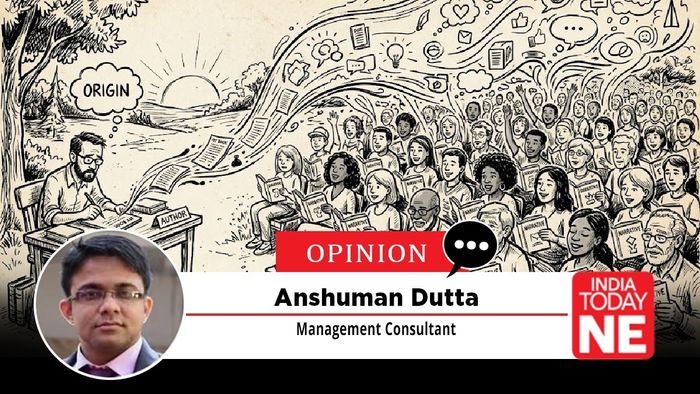
The Power of Narratives: Why Audiences Matter More Than Authors
In May, the country's top judge compared unemployed young people to cockroaches. He later said he had meant people with fake degrees. It made no difference. By then the word had left his mouth and was no longer his. Within a day a former political communications strategist had given it a home.
- Oct 18, 2026,
- Updated Oct 18, 2026, 3:43 PM IST
In May, the country's top judge compared unemployed young people to cockroaches. He later said he had meant people with fake degrees. It made no difference. By then the word had left his mouth and was no longer his. Within a day a former political communications strategist had given it a home. "What if all cockroaches come together?" he asked online. Within 48 hours the Cockroach Janta Party, a pointed play on the name of the ruling party, had an instagram page, website, a five-point manifesto, an anthem and more than four million followers on Instagram. Within a week the count was close to 15 million, ahead of the ruling party's own.
It is tempting to file this under internet curiosities. It deserves better. It is a compact lesson in a craft that governments, brands and institutions claim to practise and mostly do not, which is building a narrative, and in a second craft that gets far less attention, which is trying to counter one.
The first thing the movement understood is that a story is not delivered. It is adopted. Delivery is what institutions do: write the message, polish it, push it out and count the reach. Adoption is what audiences do, and they only do it with material that already belongs to them.
So it began with a feeling that was already there. Youth unemployment was in the air, and so was a medical entrance exam cancelled after a leak, which affected some 2.3 million students. Then it reframed a hostile event instead of inventing a friendly one. The words stayed the same and the blame moved, from lazy young people to a system that had failed them. An insult worn willingly stops being an insult.
Then it made belonging cheap. Membership asked only that you be unemployed, cynical, lazy and chronically online, which turned the entry fee into a joke at the member's own expense. People share a joke long before they join a cause.
A joke alone would have faded within weeks. What made it harder to dismiss was proof: a manifesto, a concrete demand over the exam leak, a sit-in, and by the summer the education minister's resignation. Humour earned attention. Risk earned credibility.
Going viral, though, is the easy part. An earlier protest movement filled public spaces in cities around the world and never drew up a list of demands. When its camps were cleared, little remained to hold. A Serbian resistance movement took the opposite course. It used street theatre to make a regime look absurd, aimed at a single target, and in October 2000 its campaigns, alongside those of opposition parties, helped force the ruler out. Attention is a signal. What counts is capacity: organisers, legal help, a presence in towns where nobody is watching, and a clear idea of what winning looks like.
On capacity the Cockroach Janta Party is hard to read from outside. It reports more than a million registered members and has a legal team, but how deeply it is rooted beyond the screen is not public, and is also questionable.
October set a second test, which is what a story does with its own success. The movement chose a new and larger target, the country's voter rolls. Its founder was detained as he landed in Delhi and released the next day on condition that he commit no breach of peace for a year. The joke that opened doors now has to decide whether it is still a joke. Irony travels fast and costs little. Sincerity travels slowly and carries weight. The skill lies in knowing when to turn that dial, and in turning it before events do it for you.
That brings us to the other half of the craft, the one people reach for by instinct. Those on the receiving end of this story tried the usual counters. A clarification from the speaker did not dislodge the label. When the movement's account was withheld on one platform, it returned within minutes under a new name. A rival group of satirists declared itself the formal opposition, and a lawyer filed to register the name in his own right. Each counter handed the story another chapter.
The research on countering narratives is more modest than its advocates suggest and more useful than its critics allow. The old fear that a correction makes people cling harder to a falsehood barely appeared in Thomas Wood and Ethan Porter's study "The Elusive Backfire Effect: Mass Attitudes' Steadfast Factual Adherence", published in Political Behavior, which tested 52 issues with more than 10,000 participants. Corrections generally work on facts. They work far less well on a story that meets a need the fact does not touch.
Warning people early helps, within limits. In "Psychological inoculation improves resilience against misinformation on social media", published in Science Advances in 2022, Jon Roozenbeek, Sander van der Linden and colleagues found that short videos explaining a manipulation technique helped viewers spot it across experiments with nearly 30,000 people. The gain in their YouTube field test was about five percent. A 2025 follow-up in Nature Communications by Rakoen Maertens and colleagues, across five experiments with 11,759 participants, found the protection lasted about a month for text and video, faded sooner for games, and was topped up by booster reminders.
Tone matters as much as timing. In a 2021 PNAS paper, "Empathy-based counterspeech can reduce racist hate speech in a social media field experiment", Dominik Hangartner and colleagues followed 1,350 users who had posted racist content. Only replies that appealed to empathy reduced such posts, by about a third. Humour barely moved them.
The rest is murkier. A systematic review of 19 studies, "Counter-narratives for the prevention of violent radicalisation: A systematic review of targeted interventions", led by Sarah Carthy and published in Campbell Systematic Reviews, found small, mixed effects. Suppression is the most contested option of all. Erica Chenoweth, whose book with Maria Stephan, Why Civil Resistance Works, compared 323 campaigns between 1900 and 2006 and found nonviolent ones far more successful, later reported that success rates have fallen, from about half across the last century to about a third in the most recent eight years of her data. She links the fall to digital-age repression, in which regimes use online activity to find organisers. Yet attacks that look unjust can also bring sympathy to their target.
Four lessons follow, and they are judgments drawn from the evidence, not findings. Go to the audience, not the author, because by the time a story is worth countering the author no longer holds it. Be early where you can, since warning people beats rebutting them, and patient where you cannot, since committed audiences resisted a quick reply in one experiment and responded after a gap. Choose empathy over mockery. And answer the grievance underneath, because a story built on unemployment and a leaked exam will not lose its force until those things are addressed.
None of this is a verdict on the movement's claims. Its central October demand is disputed. Critics say about 130 million names were dropped from a draft voter roll. The poll regulator says those were entries flagged during the revision, that wrongly removed voters can enrol again, and, with the ruling party, rejects the allegations of misconduct. A reader can think the movement right or wrong on that and still learn from how it built its case.
The same applies to those who would counter it. The tools are symmetrical. The method that helps a movement build a story helps its opponents build theirs, and the research does not care whose cause it serves. That is a reason to use the tools in the open and to hold every story to one test: does it survive being checked? A story that needs people not to look is spin, whoever tells it. A story that invites scrutiny and grows stronger for it is leadership.
The lasting lesson is not about one word. Once a message leaves your mouth it belongs to whoever picks it up. Build stories worth carrying. Counter the ones you dispute by being worth listening to. Build a narrative, or counter a narrative, you must first connect.
The views expressed in this article are those of the author and do not represent the positions of any organization, employer, or publication with which the author is affiliated.