The Pune-Mumbai Expressway Incident and India’s Gaps in Risk Preparedness
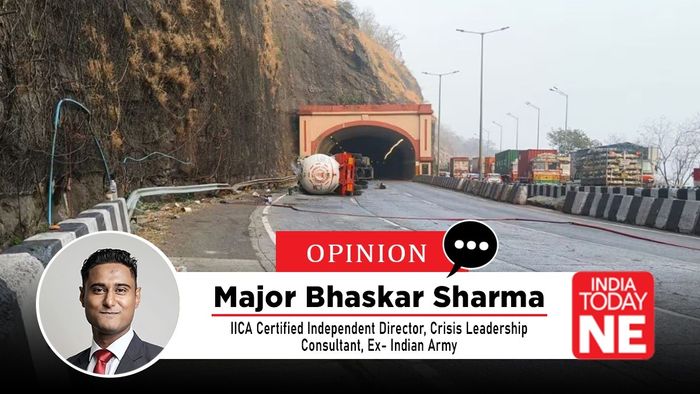
The recent incident on the Pune-Mumbai Expressway, where a tanker carrying hazardous material toppled and brought traffic to a standstill for nearly twelve hours, should be seen as more than an unfortunate accident or a case of traffic mismanagement. With close to 30,000 trucks and thousands of commuters stranded, the incident exposed deeper systemic gaps in India’s approach to risk assessment and preparedness.
- Feb 11, 2026,
- Updated Feb 11, 2026, 5:24 PM IST
The recent incident on the Pune-Mumbai Expressway, where a tanker carrying hazardous material toppled and brought traffic to a standstill for nearly twelve hours, should be seen as more than an unfortunate accident or a case of traffic mismanagement. With close to 30,000 trucks and thousands of commuters stranded, the incident exposed deeper systemic gaps in India’s approach to risk assessment and preparedness.
As India rapidly expands its infrastructure, logistics networks and industrial base, the movement of hazardous materials such as fuel, chemicals and dangerous goods has increased significantly and will continue to increase in future. Highways, ports and urban corridors now carry risks that were once limited to controlled industrial zones.
While regulatory frameworks, compliance norms and documentation processes exist, but, incidents like this raise a critical question. How much of India’s risk management is procedural and how much of it is truly effective on the ground?
It is reasonable to assume that the company involved, whether a public sector undertaking or a private operator, complied with mandated requirements like licences, permits, safety certificates, vehicle documentation and insurance as they are standard prerequisites. However, risk is not mitigated by documentation alone. Paper compliance does not automatically translate into operational readiness.
The more important questions actually relate to people and processes. Does the driver fully understand the nature and behaviour of the hazardous material being transported? Is the driver trained only to drive, or also to respond under stress in an emergency? Does the accompanying crew understand what the documents actually signify and how they must act upon them when something goes wrong? Is emergency response equipment available, and more importantly, is the crew confident in using it under pressure?
In many organisations, training becomes a one-time exercise. Certificates are issued, compliance boxes are ticked and preparedness is assumed. In reality, preparedness is not a certificate. It is a habit that must be reinforced through repeated training, drills and scenario based learning.
Another crucial dimension is, vehicle readiness and pre movement risk clearance. Before transporting hazardous material, was the tanker thoroughly inspected? Was there a structured decision making process to determine whether the vehicle should move or not?
In high risk environments such as the military, no hazardous movement begins without formal clearance. Vehicles carrying sensitive or dangerous material move only after inspections, crew briefings, route assessments and contingency planning. Schedules do not override safety considerations. Movement is authorised only when risk has been consciously evaluated and mitigated to the extent possible.
If similar checking mechanisms exist in civilian logistics, incidents like this compel us to question their robustness. If such mechanisms do not exist, then the absence itself represents a significant organisational vulnerability. Accidents involving hazardous material are rarely caused by a single failure. They are usually the result of multiple small lapses aligning at the same time. Fatigue, route design, speed management, load distribution, traffic conditions, inadequate emergency preparedness and human decision making under stress often interact in complex ways. Without a structured and dynamic risk assessment framework, organisations tend to react after an incident, rather than prevent it.
There are valuable lessons to be drawn from military risk doctrine. One fundamental principle is that hazardous material is never moved in isolation. Ammunition, explosives and substances such as white phosphorus are transported in convoys, not as lone vehicles. Such convoys include lead and rear protection vehicles, clearly visible hazard markings, prescribed distances between vehicles, and dedicated firefighting and emergency response equipment.
Personnel accompanying the load are trained specifically for the risks involved. Movements are planned, rehearsed, and protected. White phosphorus, for instance, is never mixed with other ammunition. It is transported
separately, marked distinctly and handled by trained teams aware of its properties and dangers. These practices exist not because accidents are expected, but because risk is acknowledged and respected.
This raises an important question for civilian logistics. Why are vehicles carrying hazardous materials often allowed to move alone, unsupported, and largely indistinguishable from regular traffic? Could policies be redesigned to mandate escort vehicles, convoy movement, or enhanced monitoring for certain categories of hazardous cargo?
Visibility and communication are equally critical. International norms mandate clear hazard placards for dangerous goods. These markings are not symbolic. They enable first responders, traffic police and emergency services to immediately understand the nature of the risk. Beyond markings, preparedness requires rapid information sharing and local responder training. Delays often occur not because help is unavailable, but because responders are
unsure about what they are dealing with.
When an accident involving hazardous material occurs, the first few minutes are decisive. Decisions taken during this period determine whether the situation remains contained or escalates into a larger crisis. Effective response depends on trained personnel, usable equipment, coordination with authorities and standard operating procedures that have been practiced, not merely written.
The Pune-Mumbai Expressway incident highlights a broader truth. Risk management cannot be treated as an internal side responsibility or an afterthought. It requires specialisation. India needs more professional organisations dedicated to risk assessment, advisory and preparedness training. Such entities help organisations identify vulnerabilities, design realistic response frameworks and train people to function under pressure.
The benefits are not limited to regulatory compliance. Effective preparedness prevents financial losses, protects reputation, ensures continuity, and most importantly, saves lives.
Risk is inevitable in a growing economy. Disasters are not. The difference lies in preparedness. As India aspires to become a global manufacturing and logistics hub, it must move beyond paperwork and intent. It must invest seriously in professional risk assessment and preparedness. The lesson is clear. Preparation costs far less than recovery and training costs far less than loss.