The Scientist, the Stranger and the Myth of the Lonely Hero
What the journeys of successful scientists can teach young people about achievement, cooperation and the institutions that make both possible
- Nov 18, 2026,
- Updated Nov 18, 2026, 7:05 PM IST
When a successful scientist returns to his homeland and speaks to an audience of schoolchildren, the occasion carries a responsibility beyond recounting personal achievements. The speaker is not merely telling a story. He is helping young minds imagine how the world works, what makes success possible and what kind of people they should aspire to become.
A recent public address by Assamese scientist Dr Rubul Mout in Nagaon provides an occasion to reflect on this responsibility. Speaking to students, he emphasised personal struggle and the need for Assamese people to build a worldwide network of mutual support, drawing comparisons with other ethnic communities. His remarks raise an interesting question: does such a community-centred account adequately reflect the wider institutional and international cooperation through which modern scientific careers develop?
There is nothing objectionable about encouraging Assamese people to support one another. Indeed, a community that takes an interest in the education and advancement of its younger members is doing something worthwhile. But when the journey of a successful scientist is presented substantially as a solitary struggle, in contrast to other communities supposedly sustained by their own networks, something important risks disappearing from the story.
That something is the extraordinary cooperative enterprise within which modern science operates.
A university, particularly one with a long research tradition, is among humanity's most remarkable institutions of organised cooperation. It is not merely a collection of talented individuals pursuing their separate ambitions. It is an accumulated commonwealth of knowledge, resources, experience and human generosity, built over generations for the benefit of people who may not yet have been born.
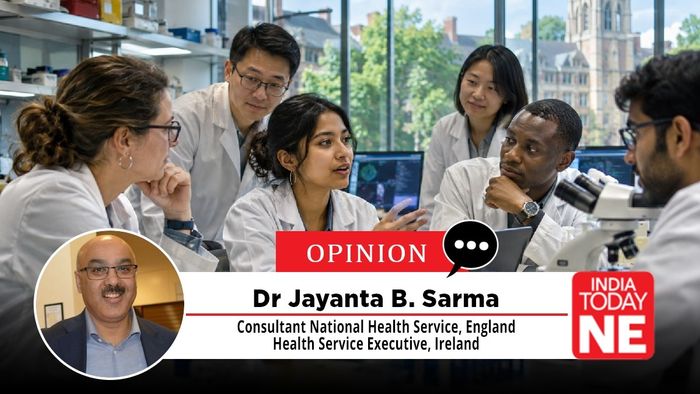
Consider what happens when a young researcher from Assam enters an American or European university. The laboratory was built before the researcher arrived. The scientific techniques were developed by others. The research questions emerged from decades of intellectual endeavour. Teachers and supervisors provide guidance, colleagues exchange ideas, reviewers scrutinise manuscripts, and institutions provide the infrastructure through which hypotheses become experiments and discoveries.
Even writing a competitive research grant application is frequently a collaborative exercise. Behind a principal investigator may stand colleagues, research administrators, finance professionals, technical specialists and institutional sponsors. The investigator's original intellectual contribution may be exceptional, but the enterprise within which it becomes productive is unmistakably collective.
The more successful a researcher becomes in securing substantial grants, developing laboratories and leading research programmes, the more deeply embedded that individual generally becomes in this elaborate system of cooperation.
A scientist may conceive an original idea alone. Bringing it into the world is another matter.
There is something particularly remarkable about the international university that we seldom celebrate adequately. A young person from a relatively obscure village in Assam can enter an institution established in another country, benefit from facilities created by generations of people with whom he shares neither ancestry nor language, and eventually become a respected contributor to that institution.
The professor who recognises his potential may be American. His collaborator may be Chinese, Nigerian, British or Indian. The administrator helping him navigate a complicated grant application may belong to yet another community. Their cooperation need not depend upon shared ethnicity, religion or nationality.
They participate in an institutional culture sustained, at its best, by intellectual curiosity, competence, professional trust and mutual obligation.
These institutions are not perfect. Prejudice, professional rivalry, discrimination and unequal opportunities exist. Nor does institutional membership guarantee good mentorship. Yet their remarkable achievement is that cooperation across national and cultural boundaries is not merely possible but routine.
Imagine telling a young Assamese student that the world contains institutions where strangers may recognise her abilities, invest in her development and welcome her contribution without asking whether she belongs to their community.
What could be more liberating?
It would be unfortunate if this extraordinary possibility disappeared behind a narrative of ethnic competition and solitary conquest.
Personal struggles, of course, are real. Poverty, unfamiliar languages, migration, cultural dislocation and separation from family can make an academic journey exceptionally difficult. A person may feel profoundly lonely while surrounded by supportive colleagues. One may lack an Assamese professional network while benefiting enormously from teachers, mentors and collaborators of other backgrounds.
But emotional loneliness and professional isolation are not the same thing. Nor is the absence of support from one's own ethnic community equivalent to the absence of support altogether.
This distinction matters, especially when personal experience is presented to young audiences as an explanation of how professional success occurs.
There is a familiar genre of inspirational storytelling in which the protagonist leaves an unpromising homeland, enters unfamiliar territory, overcomes formidable obstacles and eventually triumphs through exceptional determination. It is the story of the lonely hero conquering foreign soil.
The narrative is appealing because it has a recognisable hero, a struggle and a resolution. But its dramatic simplicity often requires the disappearance of the supporting cast. Teachers become incidental. Colleagues become invisible. Institutions become scenery. Opportunities appear as rewards for perseverance rather than products of both individual merit and an enabling environment.
We celebrate the hero and forget the commonwealth that made the achievement possible.
This is not to suggest that Dr Mout necessarily received particular forms of personal assistance that have not been documented, or that he intended to deny the contributions of colleagues. The concern is with the wider implications of a narrative that emphasises ethnic solidarity and individual struggle without giving comparable prominence to the transnational institutions within which scientific careers are made.
Professional networks certainly matter. Mentorship, introductions, recommendations and collaborative relationships can transform careers. Assamese professionals abroad have every reason to help younger people from Assam, just as members of other communities may choose to support their own.
But there is a crucial difference between encouraging community solidarity and suggesting that professional success depends primarily upon ethnic patronage.
An Assamese researcher need not find an Assamese professor to enter a world-class laboratory. Nor should the success of Bengali, Telugu, Jewish or other researchers be explained principally through the supposed advantages of their ethnic networks. Such explanations risk reducing complex institutional achievements to competition between communities.
The more productive question for young people is not how to acquire a powerful patron from their own community, but how to become capable, trustworthy and generous participants in networks that transcend community boundaries.
That requires more than ambition and perseverance.
It requires intellectual honesty, curiosity, discipline, humility, the willingness to learn from others, respect for different perspectives and the ability to collaborate. It requires the confidence to approach unfamiliar people without assuming hostility and the generosity to recognise contributions without feeling that one's own achievement is diminished.
It also requires reciprocity. The student who receives guidance today should become the colleague who offers guidance tomorrow, not necessarily to someone from the same community, but to someone whose potential deserves encouragement.
That is how institutions acquire continuity and strength.
We understandably tell our children to dream big, work hard and never give up. These are admirable exhortations, but they are incomplete. Hard work does not guarantee success. Talent does not operate independently of opportunity. Perseverance cannot substitute for access to education, laboratories, financial resources and supportive institutions.
To suggest otherwise is to place an unreasonable burden upon the individual while allowing society to escape responsibility for creating the conditions in which talent can flourish.
Our children should learn determination, certainly, but also cooperation. They should learn to seek mentors without surrendering independent judgement, to accept criticism without resentment, to share credit fairly and to help others without demanding personal loyalty.
Above all, they should understand that science is not a contest between ethnic communities for intellectual supremacy. It is a human enterprise in which people inherit knowledge from strangers and contribute knowledge for the benefit of strangers yet to be born.
There is a further lesson for Assam.
We often celebrate individuals who achieve distinction elsewhere. Their success becomes a source of collective pride. Yet we devote comparatively little attention to the institutions that enabled them to succeed.
What would it take to create more of those conditions at home?
Not simply more inspirational speeches or appeals to ethnic solidarity, but functioning laboratories, accessible libraries, research funding, reliable administration, supportive mentorship, fair recruitment and institutions capable of recognising merit without regard to personal connections.
A university is a particularly sophisticated expression of a much older human idea: that people can pool knowledge, resources and effort to create opportunities and benefits extending far beyond themselves. Such institutions are, in the deepest sense, institutions for the common good — সামূহিক কল্যাণৰ প্ৰতিষ্ঠান.
The task before Assam is not merely to produce more successful Assamese individuals abroad. It is to strengthen institutions at home through which successive generations, regardless of background, can develop their abilities.
The most valuable contribution of a successful expatriate scientist may therefore be more than the inspiration of a personal success story. It may be an understanding of how effective institutions function, how cooperation is organised, how research is supported and how opportunities can be made accessible to others.
There is no need to diminish individual achievement to recognise collective contribution. Quite the opposite. A scientist's accomplishment becomes more meaningful when we understand the human relationships and institutional arrangements through which it was realised.
When our children hear the story of someone who travelled from a village in Assam to a distinguished international research institution, they should certainly be encouraged to believe that such a journey is possible.
But they should also hear about the teachers who opened doors, the colleagues who shared ideas, the institutions that provided opportunities and the strangers whose generosity made unfamiliar places welcoming.
For the most important lesson may not be that a remarkable individual conquered the world alone.
It may be that the world, despite its divisions and imperfections, contains remarkable possibilities for people willing to learn from, cooperate with and contribute to one another.
That is a story worth bringing home.