The Song That Forgot Us: Northeast India and the Imagination of the Nation
The story argues that the Northeast’s absence from India’s national anthem is more than a historical omission—it reflects a deeper failure of recognition that has shaped how the region is seen across the country. From classrooms and newsrooms to everyday encounters on mainland streets, that silence has been repeated for generations.
- Aug 13, 2026,
- Updated Aug 13, 2026, 7:24 PM IST
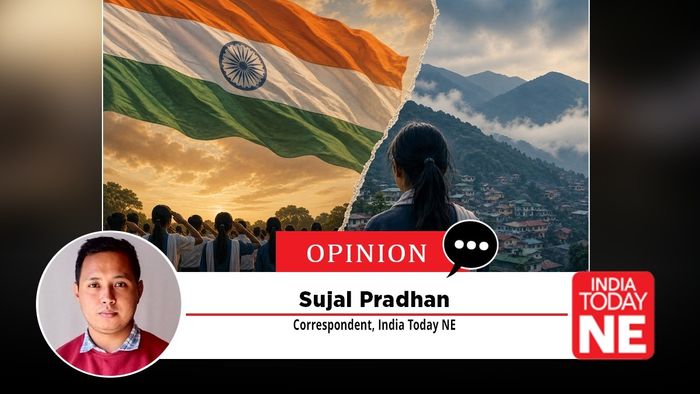
Every Indian schoolchild learns to stand up straight and sing fifty-two seconds of "Jana Gana Mana" — Punjab, Sindh, Gujarat, Maratha, Dravida, Utkala, Banga; the Himalayas, the Vindhyas, the Ganga, the Yamuna. We are taught how many states make up India. We are taught to recite this song as the sound of the nation itself. What we are not taught — what generations of schoolchildren have never been taught — is that the song does not know we exist.
Independence Day in Gangtok — in Sikkim — was never a quiet affair. Football tournaments in almost every village. Schools preparing parades, children rehearsing group dances to patriotic Bollywood songs and integration anthems. Tricolour flags on cars, bikes, streets, and windows. A different energy altogether — electric, proud, and deeply felt. That is how I grew up. That is how many like me grew up.
But something shifted over the years — not in a negative sense, but in a questioning one. I am Indian. I have always been Indian. And yet, at different levels, in different cities, in different conversations, I have had to prove it. Again and again. That discomfort — that quiet, persistent demand to justify my belonging — is the reason I am writing this piece.
I grew up in the Northeast. I learned the anthem like every other Indian child. It took me years to notice what was missing. It took me longer to understand that the missing was not accidental.
The Anthem as Phatic Ritual
Before examining what the anthem omits, it is worth understanding what it does. "Jana Gana Mana" is not primarily an information document — it does not define India's borders, list its citizens, or describe its constitution. It functions, in the language of communication theory, as phatic communication — a ritual whose purpose is not to convey content but to create and sustain collective feeling. The anthropologist Bronisław Malinowski, who coined the term, described phatic communion as speech that binds people together not through meaning but through participation. When fifty-two seconds of music play and every person in a stadium rises, the anthem is doing exactly this — not telling Indians something, but making them feel something together.
This is why the anthem's omissions matter far more than a simple geographical error would. To be excluded from a phatic ritual is not to be left off a list. It is to be excluded from the emotional bond the ritual creates. Every time Jana Gana Mana plays in a school assembly, and a child from the Northeast stands and sings provinces they have never visited — while their own home goes unmentioned — the phatic ritual of nationhood is being performed around them rather than for them. They participate in the ritual. The ritual does not acknowledge them. For over a century, the Northeast has been asked to feel Indian through a song that does not know they exist.
Phatic communication, as research has shown, is the core of any society — the invisible social glue that holds communities together, that builds trust, that signals belonging. Nations use anthems, flags, and shared rituals precisely because these phatic acts build collective identity faster and deeper than any policy or law. The tragedy of the Northeast's exclusion is not just political. It is phatic. The national bond was built, anthem by anthem, school assembly by school assembly, without including the Northeast in the ritual's text. What followed — the mainland's ignorance, the media's neglect, the discrimination on Delhi streets — was the lived consequence of that phatic exclusion, compounded over generations.
The Omission and the Asymmetry
Rabindranath Tagore composed "Bharoto Bhagyo Bidhata" in 1911, and its first verse became India's national anthem in 1950. The provinces named are those under direct British rule: Punjab, Sindh, Gujarat, Maratha, Dravida, Utkala, and Bengal. No part of Northeast India appears.
The standard defense is that Tagore named only British-administered provinces. But Assam was a British-administered province in 1911 — as real on the colonial map as Bengal or Punjab — and it still didn't make it in. Meanwhile Sindh, which became part of Pakistan after Partition, remains in the anthem to this day. A region that left India is still named. A region that has always been India was never named at all. That asymmetry cannot be explained away by administrative timing or historical convention. It is the starting point of a much longer story.
Two counterarguments come up often and deserve brief answers. First: "Sikkim and many Northeast states joined India later." True — Sikkim acceded only in 1975, and states like Nagaland, Meghalaya, and Mizoram were carved out of Assam after 1950. But Assam itself was present and fully eligible in 1911 and 1950 both, and was still left out. Second: "The Himalayas cover the Northeast." No — "Himachala" in the anthem names a mountain range as scenery, the same way "Ganga" and "Yamuna" name rivers. Punjab, Gujarat, and Maratha are named as peoples and provinces — a categorically different thing. The mountain is in the song. The people living in and around it are not.
The Legal Record: Why Courts Were Never the Answer
The anthem has never been amended. In 2005, advocate Sanjeev Bhatnagar filed a writ petition (W.P.(C) No. 16 of 2005) before the Supreme Court seeking removal of "Sindh" on grounds of sovereignty. A bench of Chief Justice R.C. Lahoti and Justice P.K. Balasubramanyan dismissed it on May 13, 2005, ruling that "a national anthem is a hymn or song expressing patriotic sentiments or feelings" — not a territorial document subject to judicial correction. In 2018, Congress MP Ripun Bora moved a private member's resolution in the Rajya Sabha to replace "Sindh" with "Northeast," citing President Rajendra Prasad's own 1950 statement that the anthem would permit "such alterations in the words as the government may authorise as occasion arises." The resolution was discussed and quietly shelved.
What's worth noting is what the 2005 ruling actually handed every institution: a permanent excuse. If the anthem carries no legal obligation to be geographically accurate, nothing has to change, because nothing is ever legally broken. That is precisely how symbolic exclusion survives — not through dramatic injustice, but through a quiet institutional agreement that the omission simply doesn't count.
Courts were never going to fix this. The real terrain is everything downstream of the anthem — school curricula, media coverage, public imagination. None of that requires a constitutional amendment. It requires political will, which every government since 1950, across parties, has consistently declined to exercise.
Slogans and Contradictions: One Nation, Act East
Two policy positions of recent years deserve to be held against this record. The current government has marketed itself on the language of uniformity — One Nation, One Election; One Nation, One Ration Card; One Nation, One Tax. The branding insists every citizen belongs to the same seamless national system. That language invites a fair test: does "oneness" extend to symbolic belonging as readily as it extends to administrative consolidation? No comparable political will has been shown toward correcting a founding national symbol that omits an entire region — even though President Rajendra Prasad himself stated in 1950 that the anthem would permit "such alterations in the words as the government may authorise as occasion arises." The occasion has arisen. Seventy-five years have passed. Nothing has changed.
The same government rebranded India's "Look East" policy as "Act East," positioning the Northeast as India's strategic gateway to Southeast Asia — a corridor to ASEAN, a bridge to Myanmar and Thailand. But being useful as a corridor is not the same as being seen as a people. Geopolitical visibility and cultural visibility are not the same achievement. A region can be strategically central to India's foreign policy ambitions and still be invisible to the rest of the country as fellow citizens. "Act East" was designed to project India outward. It was never designed to ensure the Northeast is seen inward, by the country it is part of.
The Algorithm Replaced the TRP, but the Bias Remained
India has thirty to forty national news channels in Hindi and English alone — and not one dedicated to consistently connecting the Northeast to the rest of the country. That absence is not a minor programming gap. It is the anthem's silence, reproduced in prime time, every night.
Television ran on TRP — Television Rating Points. The algorithm replaced it, but the structural logic is identical: chase the largest audience, serve the majority, ignore the margins. YouTube, Instagram, and streaming platforms amplify what already has traction. The Northeast, already outside the mainstream imagination, gets further buried — not by deliberate suppression, but by the compounding mathematics of scale.
What digital has changed — and this is worth acknowledging honestly — is that it has also created a counter-current. Northeastern creators on YouTube, Instagram, and podcasts have built real audiences entirely outside mainland media gatekeeping. That is a genuine, partial liberation. But it operates at individual scale, dependent on each creator's own labour, while the structural bias operates at institutional scale, shaping what most of the country never learns about the Northeast at all.
We are told the media is the fourth pillar of democracy. But a pillar that holds up only the majority is not a democratic institution — it is a majoritarian one. What Indian mainland media has built, slowly and without any single dramatic decision, is a form of domestic hegemony: the Northeast exists in its imagination only during insurgencies and natural disasters — crises that confirm otherness rather than dissolve it.
The Imaginative Boundary
A nation is not only its legal borders. It is also the story it tells itself about who belongs at its centre. Anthems, textbooks, news cycles, and popular culture are where that imaginative boundary gets drawn — and it can diverge sharply from the administrative one. Northeast India is fully and legally part of the Indian Union: eight states, tens of millions of citizens, decades of constitutional integration. And yet on the imaginative map most of mainland India carries — built by the anthem, the textbooks, the algorithm — the Northeast keeps falling outside the frame.
A small but telling example: most mainland Indians assume Assamese and Bengali are the same script, the same language, the same culture. They are not. They are related but distinct — Assamese has its own unique letters, its own standardised literary tradition, its own hard-won identity. That identity was fought for — through the work of 19th-century scholars pushing back against British administrators who had simply imposed Bengali as Assam's official language, assuming the difference didn't matter. It did matter. The 1960 Assamese language movement, in which people sacrificed their lives to assert that distinctness, is almost entirely unknown to mainland India.
That is not abstract. It surfaces as routine racial slurs in Delhi and Bangalore — being asked which country you're from, in your own country. It surfaced in the murder of Nido Taniam, a 20-year-old student from Arunachal Pradesh, beaten to death in Delhi's Lajpat Nagar market in January 2014 after shopkeepers mocked his East Asian features. It surfaced again in the death of Anjel Chakma, a student from Tripura, killed in Uttarakhand in 2024. It surfaced during the pandemic, when people with East Asian features were abused on Indian streets. And it surfaces in "representation" that is only ever stereotype — the tribal, the exotic, the perpetually other — never the ordinary and modern and fully Indian.
What Inclusion Actually Looks Like
The point of this article is not to demand the anthem be rewritten, or to suggest Tagore acted in malice — he was writing within the geographic imagination available to him in 1911. The point is that the omission was never corrected, never seriously reckoned with, and has been inherited by every subsequent generation through the very systems meant to build a shared sense of nationhood.
We are not asking to be pitied. We are asking to be included in the same unremarkable way that Punjabi culture, Bengali cinema, Tamil music, and Maharashtrian politics are included — as a natural part of what India is. That inclusion is not charity. It is the minimum condition of a democracy that actually functions.
If Indian schoolchildren can recite seven provinces and four geographic features by heart before they are ten years old, but cannot place Kohima, Itanagar, Aizawl, Imphal, Agartala, Shillong, Gangtok, or Dispur on a map — that is not an accident of pedagogy. It is the imaginative boundary, reproduced classroom by classroom, decade by decade, algorithm by algorithm. And it is why, when a person from the Northeast is asked in a mainland Indian city which country they are from, the question is not really about geography. It is the anthem's silence, finally spoken aloud.
Phatic communication is the soul of any nation — the ritual language through which people feel they belong to each other. India has sung its phatic ritual for over a century. It is time the ritual learned all the words.
(The views expressed in this article are those of the author and do not necessarily reflect the views of India Today NE or its affiliates)