The Text That Betrayed a City
There is a particular kind of fear that visits a father when he reads that a girl is missing. It is not abstract. It is immediate, physical, almost a tightening in the chest that belongs to something older than social media, older than smartphones, older than the city of Guwahati itself. It is the fear of every man who has a daughter, a sister, a wife who takes a cab to work every morning.
- Apr 26, 2026,
- Updated Apr 26, 2026, 2:23 PM IST
There is a particular kind of fear that visits a father when he reads that a girl is missing. It is not abstract. It is immediate, physical, almost a tightening in the chest that belongs to something older than social media, older than smartphones, older than the city of Guwahati itself. It is the fear of every man who has a daughter, a sister, a wife who takes a cab to work every morning.
Yesterday, that fear visited thousands of people across this city and beyond.
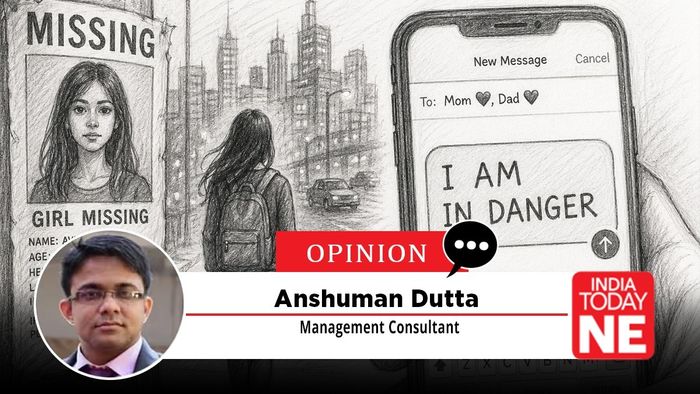
A young woman. A cab ride. A text to her mother - I am in danger. And then silence.
Within hours, the story had travelled everywhere. WhatsApp groups. Facebook pages. Neighbourhood networks. Strangers sharing the face of a woman they had never met, asking others to look, to help, to do something. The instinct behind every share was good. It was human. It was the city saying: one of us is in trouble.
By the next day, she had been found in Shillong. Safe. Police ruling out foul play. The picture quietly becoming clearer.
She had left on her own terms.
I do not write this to judge her. Whatever compelled her to leave, whatever pressure, whatever circumstance, whatever private calculus she made is hers alone to carry. People leave. People feel they cannot leave any other way. That is a conversation worth having, separately, with more patience than a news cycle allows.
But I want to speak to something else. Something that is sitting quietly in the chests of thousands of people today who shared that post, who worried through the night, who checked for updates and who now feel, not relieved exactly, but hollowed out.
They feel fooled, betrayed, played.
And among them, I want to speak specifically to the fathers.
Because the father who shared that post did not share it as a social media act. He shared it because somewhere in his body, he felt the weight of what it would mean if it were his daughter. He has felt, in small doses every single day, the low hum of fear that comes with loving someone in a world that is not always safe for women.
That fear is real. It did not deserve to be the lever that was pulled.
When a distress message is sent, whether in desperation, in strategy, or somewhere in between, it does not stay between two people. It travels. It lands in the hands of men and women who respond to it with the most genuine parts of themselves. And when it turns out to have been, at minimum, misleading, what breaks is not just trust in one person. What breaks is a small but important piece of the social fabric that makes us willing to stop, to share, to act when the next alarm comes.
That is the cost nobody is counting today. It is not people are gullible but they genuinely care or cared.
Not the police hours. Not the viral reach. But the quiet erosion of willingness, the moment of hesitation that will exist the next time, when a girl who is genuinely in danger needs a city to believe her immediately and without question.
Guwahati is a city that still knows its neighbours. That is rare and worth protecting. The speed with which this story spread was not a failure of the city. It was evidence of something good still alive here, a reflex of collective care that most metros have long since lost.
That reflex must not be trained into cynicism.
So to every father who worried through yesterday, your fear was not foolish. Your instinct to care was not wrong. What you felt was exactly what a decent person feels. Hold onto that.
But let us also ask, clearly and without anger, that those who choose dramatic exits consider the human cost of the alarm they set off on their way out. The city that worried for her was not an abstraction. It was made of real people, with real daughters, who gave something of themselves to her safety.
That deserves at least acknowledgement.