University Social Responsibility (USR): Beyond Degrees, Towards Social Change
What happens when education moves beyond classrooms and begins solving real problems in real communities? At the intersection of learning, digital literacy and civic engagement, a growing movement is redefining what it means for universities to truly serve society.
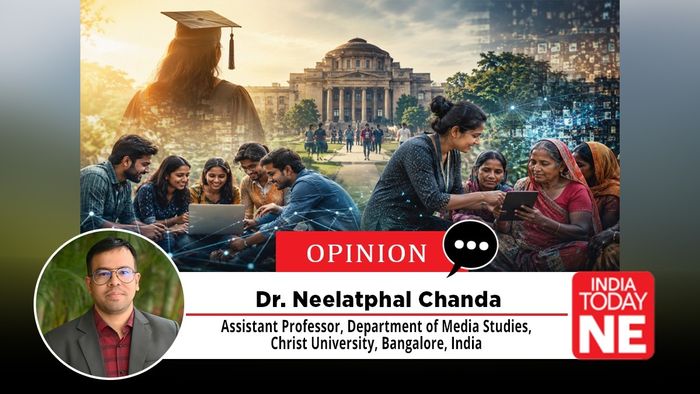
- Jun 19, 2026,
- Updated Jun 19, 2026, 1:17 PM IST
"Education is not preparation for life; education is life itself." John Dewey.
Every year, thousands of students earn a degree from universities across India, carrying dreams of a better future. Within this process, they attend classes, complete projects and assignments. However, the most important grassroots question that remains unaddressed is their role in social accountability towards community transformation. As a faculty member in media and communication, I often view communication as a significant change agent, opening up possibilities for millions.
Keeping this in mind, my team and I at the Department conceptualised a dedicated project to initiate and empower students to become responsible citizens who engage with broader social causes and the community for digital literacy initiatives. The core idea of this vision emerged from embracing University Social Responsibility (USR), the belief that universities should actively contribute to community well-being, promote social development, and address real-world challenges. This initiative has been scaffolded with the core tenets of India’s National Education Policy of 2020, which emphasises community engagement, local knowledge systems, and the idea that education must be rooted in its social context. It motivates institutions to look beyond classroom engagement and to measure transformation in a more socially responsible manner. The concept has its roots in Corporate Social Responsibility (CSR), which corporations are doing. In a similar manner, universities, too, have a responsibility to direct youth-led initiatives toward solving community problems and improving lives.
As someone who teaches media studies, it must be central to the USR conversation. We live in the age of info-abundancy, and people are flooded with millions of texts. When it appears in familiar language, people find it challenging to debunk those messages. A university that teaches media and information literacy to its enrolled students must provide meaningful tools for broader social change within its community. USR, in this context, means leading the way for broader public-centred engagement through civic service. University Social Responsibility (USR) offers transformative benefits to its students. When they engage with communities at the grassroots level, they can relate to the daily encounters of individuals, which cannot be conceptualised or contextualised within the binary of textbooks. This process helps them develop empathy, teamwork, and problem-solving skills, which are essential for navigating an AI-driven society.
For many people within the university’s adjoining spaces, it appears a distant establishment, with large buildings, a gated society, and isolated, exclusive ecosystems cut off from the broader public. However, the institution’s core vision and mission are to serve the society around it. A university should not be limited to epistemic processes of knowledge generation; it should also ensure that knowledge reaches people who need it most.
Many of these students, who come from urban and elite backgrounds, may have limited exposure to the realities faced by marginalised communities. University Social Responsibility offers them a window into issues related to livelihoods, gender equity, digital inclusivity, and sustainability. These are lived experiences that empower them not only to become skilled professionals but to be responsible citizens. Through this process, the University embeds socially responsible practices in defining socially relevant teaching, innovation, and research, and in promoting institutional culture.
The National Educational Policy 2020 is a driving force, and through its vision of holistic education, experiential learning, and community engagement, the core philosophy of USR becomes highly relevant and meaningful for social responsibility. As India aspires to become a knowledge-driven society, the accomplishments of universities cannot be measured or scaled solely in terms of publications, rankings, and other quantitative metrics. The impact needed to be extended much beyond that, touching the lives of millions in a responsible manner, strengthening the community, and driving social problems from the grassroots is the crucial call.
As faculty members, USR asks us to rethink the future of university education, not remaining isolated within the boundaries of the classroom, but rather residing with the people who need it most. When knowledge diffuses across communities, university education and the practice of University Social Responsibility (USR) attain their highest purpose: addressing societal challenges and contributing to broader social transformations. At the end, I must say that meaningful contributions and the university’s legacy may not depend on degrees, but on the positive, transformative spaces it has embedded.
Disclaimer Note: The author has used the Grammarly application and OpenAI for proofreading and editing.