Unrest, Youth and the Blind Spots
The brutal lynching of a Hindu man in Bangladesh earlier this month should have jolted South Asia’s conscience. Instead, it was met largely with silence, evasive framing, or worse—rationalisation. Dipu Chandra Das was not killed in the shadows of a riot. He was dragged out by a mob, accused of blasphemy, lynched, his body tied to a tree and set on fire.
- Dec 21, 2025,
- Updated Dec 21, 2025, 3:57 PM IST
The brutal lynching of a Hindu man in Bangladesh earlier this month should have jolted South Asia’s conscience. Instead, it was met largely with silence, evasive framing, or worse—rationalisation. Dipu Chandra Das was not killed in the shadows of a riot. He was dragged out by a mob, accused of blasphemy, lynched, his body tied to a tree and set on fire. This was not spontaneous anger. It was ritualised violence, meant to terrorise and to send a message well beyond its immediate victim.
What followed was equally disturbing. Sections of the commentariat, especially those who had spent the last few months celebrating Bangladesh’s so-called “Gen-Z uprising,” rushed to describe the lynching as an aberration—an unfortunate by-product of political transition. The implication was unmistakable: do not allow inconvenient facts to puncture a fashionable narrative.
That reflex reveals more about the storytellers than about the street.
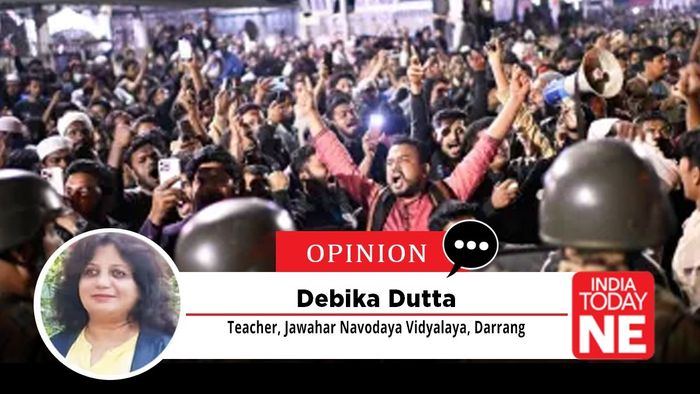
Over the past several months, unrest in Bangladesh and Nepal has been presented to Indian audiences as a youthful awakening—leaderless, progressive, emancipatory. In opinion columns, academic discussions and social-media commentary, these movements were framed as South Asia’s democratic renaissance, often contrasted with India’s alleged authoritarian drift. The vocabulary was familiar and flattering: decentralisation, resistance, empowerment, the moral clarity of youth.
Nowhere was this enthusiasm more pronounced than within sections of the Left-liberal ecosystem, including academic and activist circles in Assam. Geographical proximity to Bangladesh lent the narrative a sense of immediacy and moral certainty. Familiarity was mistaken for insight. Events across the border were interpreted less through evidence and more through expectation.
Reality, however, has proved less accommodating.
In Bangladesh, the political vacuum following the fall of Sheikh Hasina did not merely release democratic aspiration. It also exposed long-suppressed fault lines—religious, cultural and ideological—that had been contained, however imperfectly, by a strong state. As authority weakened, violence did not remain confined to symbols of power or instruments of the old regime. It turned outward and downward. Hindu homes were burnt, temples vandalised, cultural institutions such as Chhayanaut attacked, and individuals accused of blasphemy lynched in chilling public spectacle.
These are not stray incidents. They form a discernible pattern. Over the past year, multiple reports have documented repeated attacks on Hindu minorities—murders, assaults, property destruction and custodial deaths. Even Bangladesh’s interim authorities have acknowledged a spike in violence against minorities since the political transition. Yet these realities rarely intrude upon celebratory accounts of a “youth-led revolution.”
The reason is not lack of information. It is narrative investment.
Acknowledging the targeting of minorities complicates a storyline many commentators had already endorsed. It forces an uncomfortable admission: that movements born of legitimate grievances can be infiltrated, redirected or exploited by forces with very different objectives. It is easier to speak of instability during transition than to confront the role played by Islamist elements, street-level radicalism and communal hostility that thrive when state authority recedes. It is easier to attribute violence to unnamed “miscreants” than to accept that minorities often pay the price when political upheaval loses restraint.
A similar indulgence has marked the interpretation of protests in Nepal. Demonstrations driven by youth frustration over corruption and governance failures were quickly elevated into symbols of democratic renewal. Acts of arson, violence against public property and fatal clashes were brushed aside as excesses of passion rather than examined as warning signs. Once again, ordinary citizens—those bearing the cost of disorder—disappeared from the moral frame.
None of this is an argument against protest or dissent. Democracies depend on both. But it is intellectually careless to assume that every youth-driven movement is, by definition, progressive, secular or humane. Movements are not morally virtuous by age alone. Their character is revealed by whom they protect, whom they excuse and whom they silence when power momentarily shifts to the street.
This is where the Indian discourse, particularly in Assam, deserves closer scrutiny.
For months, sections of the state’s intelligentsia and activist class spoke approvingly of Bangladesh’s “Gen-Z moment,” at times romanticising it as a corrective force against authoritarianism. Seminars were organised, essays circulated and digital platforms amplified the claim that a more inclusive, plural Bangladesh was taking shape. Warnings about minority vulnerability were dismissed as exaggeration or ideological prejudice. Those raising concerns were frequently labelled alarmist, reactionary or politically motivated.
Such dismissal was not merely analytical error; it was a failure of responsibility. Assam, perhaps more than any other Indian state, understands how events in Bangladesh reverberate socially and emotionally across borders. The region’s history—of migration,
displacement, cultural anxiety and communal tension—has been shaped by political developments in its eastern neighbour. To treat violence against Hindus in Bangladesh as a distant or abstract concern is to ignore lived realities in Assam, Tripura and West Bengal.
In the aftermath of a lynching carried out in full public view, earlier certainties now appear profoundly misplaced.
What we are witnessing is not merely a failure of analysis but a moral asymmetry. Violence is condemned or contextualised depending on the identity of the victim and the ideological comfort of the perpetrator. When minorities suffer in contexts that complicate domestic political narratives, empathy becomes conditional and outrage carefully calibrated. The language of human rights is invoked selectively, its universality quietly abandoned.
This asymmetry has consequences beyond commentary. It shapes public perception, influences policy debate and erodes trust in intellectual institutions. When communities see their fears dismissed or minimised, they retreat further into grievance and suspicion. The space for reasoned dialogue narrows, replaced by polarisation that benefits no one.
There are also strategic implications that cannot be ignored. Political disorder that enables radicalisation and minority persecution creates long-term instability. Weak institutions and emboldened mobs do not remain confined within national borders. South Asia’s recent history offers enough examples of how quickly local unrest can acquire regional consequences. Analysts who romanticise upheaval while ignoring its human cost risk mistaking volatility for virtue.
Ironically, this narrative indulgence harms even the legitimate aspirations of young protesters in Bangladesh and Nepal. By refusing to confront the violent elements operating alongside broader movements, sympathetic commentators leave space for extremists to entrench themselves. Silence, in such moments, becomes a form of complicity—unintended perhaps, but consequential nonetheless.
The lynching of Dipu Chandra Das demands more than ritual condemnation or carefully worded statements. It requires an honest reckoning with how political narratives are constructed, defended and insulated from inconvenient truths. Political transitions do not suspend moral responsibility, and youth movements do not acquire ethical immunity by virtue of age or intent.
If moments of upheaval cannot safeguard the most vulnerable, they are not milestones of democratic renewal. They are warnings—ignored at great cost, and always too late.