Venezuela and the Perils of Escalation
Venezuela faces worsening political and economic instability amid rising tensions. Calls for dialogue between government and opposition grow urgent to restore peace
- Jan 04, 2026,
- Updated Jan 04, 2026, 2:32 PM IST
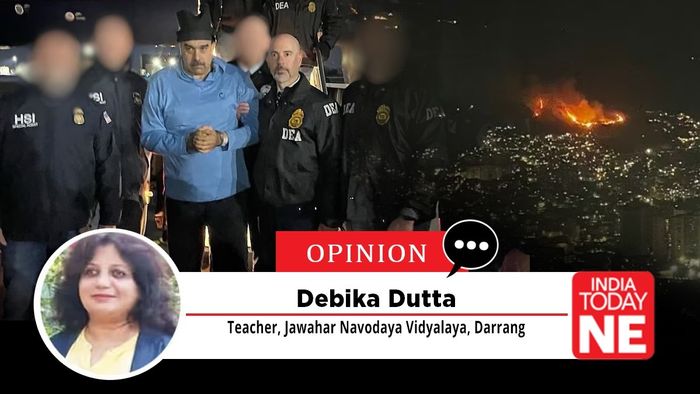
In the early hours of January 3, explosions over Caracas shattered the uneasy calm surrounding Venezuela’s long-running standoff with the United States. As official statements, counterclaims, and speculation flooded global media, one conclusion emerged with unsettling clarity: a confrontation once contained within the boundaries of coercive diplomacy has crossed into a far more dangerous terrain. The line separating pressure from force no longer appears intact.
This crisis did not materialise overnight. For nearly two decades, Washington has regarded Caracas not simply as an adversarial government, but as a challenge to U.S. political and strategic primacy in Latin America. Nicolás Maduro, inheriting Hugo Chávez’s political legacy, also inherited the hostility it provoked. The American response combined sanctions, criminal indictments, diplomatic isolation, and open backing of opposition figures—tools designed to weaken without provoking open conflict. The events of this week suggest that this calibrated approach has reached its breaking point.
Sanctions, intensified after 2017, struck Venezuela’s oil industry, financial system, and governing elite. International economic data indicate that the country’s GDP shrank by more than 70 per cent between 2013 and 2021. Hyperinflation hollowed out savings, shortages became routine, and millions fled the country. Endemic corruption and policy failures undeniably aggravated the collapse, but external pressure deepened and prolonged it. Yet despite repeated predictions of imminent collapse, Maduro weathered a failed uprising in 2019, covert destabilisation attempts, and sustained diplomatic isolation. By the early 2020s, even Washington quietly acknowledged that “maximum pressure” had reached its limits.
This recognition led to a cautious recalibration. Partial sanctions relief, time-bound oil licences, and tentative diplomatic engagement signalled a shift from confrontation to conditional pragmatism. That strategy rested on a crucial assumption: escalation would remain off the table. The explosions over Caracas have shattered that premise.
Washington’s justification draws partly on legal reasoning. U. courts have indicted senior Venezuelan officials, including Maduro, on charges related to narcotics trafficking and corruption. From an American perspective, these are criminal matters, not acts of war. International law, however, does not recognise domestic indictments as legitimate grounds for extraterritorial enforcement against a sitting head of state. Sovereignty and immunity are not procedural technicalities; they exist precisely to prevent powerful nations from converting legal claims into instruments of coercion. When law enforcement is accompanied by force, the danger to global norms becomes acute.
Supporters of a hard line argue that Venezuela represents an exceptional case—a so-called “narco-state” whose leadership has forfeited legitimacy. Yet exceptionalism is a perilous doctrine. Once unilateral action is normalised under moral or legal pretexts, it rarely remains confined. Other powers observe closely, absorb the logic, and eventually replicate it in their own theatres of interest.
Venezuela’s importance is not limited to ideology or governance. It possesses the world’s largest proven oil reserves and has deepened strategic ties with China, Russia, and Iran. In an era of sharpening great-power rivalry, Caracas is a strategic pivot, not a peripheral irritant. Precisely for this reason, miscalculation carries global consequences.
Yet strategic significance cannot justify strategic recklessness. Latin America’s collective memory of US intervention breeds scepticism even among governments critical of Maduro. Sudden destabilisation risks regional spillovers—refugee surges, political fragmentation, and renewed instability. History offers sobering lessons: removing a leader rarely resolves structural crises. Libya stands as a stark reminder of how intervention, however justified at the outset, can unravel into prolonged disorder.
For the United States, the reputational costs are immediate and tangible. Actions perceived as unilateral or legally dubious weaken Washington’s claim to be a defender of international norms and hand rhetorical ammunition to rival powers. In a multipolar world, legitimacy is not a moral luxury; it is a strategic asset.
The deeper tragedy is that alternatives existed. Sustained multilateral diplomacy, regionally mediated negotiations, targeted humanitarian engagement, and patient de-escalation offered imperfect but lawful pathways forward. Force may accelerate outcomes, but it also magnifies risks beyond calculation.
History does not judge such moments by their immediacy, but by the wisdom with which power is exercised. When pressure hardens into force, clarity in the short term may purchase instability in the long run. For Venezuela, the coming days may shape its political and social future. For the United States, they may reveal how power is wielded when authority is contested. And for the world, they serve as a reminder that global norms rarely collapse overnight—they erode gradually, until necessity becomes habit, and habit hardens into precedent.