Washington's romance with Pakistan's military is quietly dismantling the architecture of its own credibility
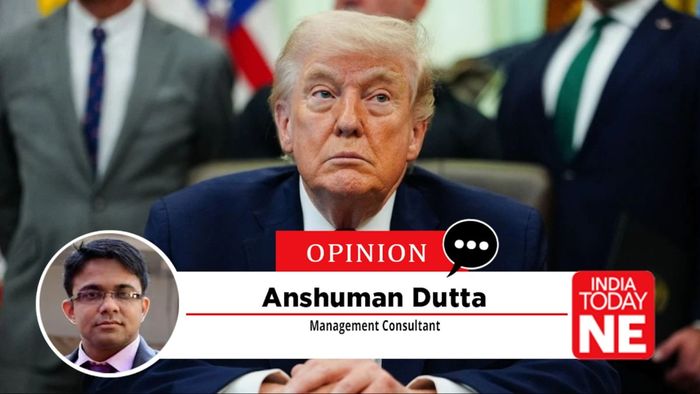
There is a photograph that will likely outlast the diplomacy it represents. Donald Trump, the most transactional president in American history, standing in the Oval Office not with Pakistan's elected Prime Minister, but with its army chief. Beaming. Effusive. Calling him "my favourite field marshal."
- Apr 23, 2026,
- Updated Apr 23, 2026, 9:17 AM IST
There is a photograph that will likely outlast the diplomacy it represents. Donald Trump, the most transactional president in American history, standing in the Oval Office not with Pakistan's elected Prime Minister, but with its army chief. Beaming. Effusive. Calling him "my favourite field marshal."
For students of South Asian history, the image needed no caption. They had seen it before in different decades, different uniforms, same logic. For the rest of the world watching, it was a data point in an emerging pattern: that the United States, the self-proclaimed guardian of the rules-based international order, has quietly decided that strongmen are easier to deal with than democracies.
The question worth asking the one that is conspicuously absent from the celebratory coverage in Islamabad and the diplomatic cables flowing between Rawalpindi and Washington is not whether this relationship is useful. It clearly is, in the narrow, transactional sense that Trump prizes. The question is what America is paying for it. And whether the bill, when it eventually comes due, will be payable at all.
Pakistan has pulled off something remarkable. In the span of roughly twelve months, it has transformed itself from a pariah state shunned by Joe Biden, suspected of Taliban collusion, barely a footnote in Washington's strategic calculus into the indispensable mediator of the most combustible crises of the moment.
It helped de-escalate a near-nuclear confrontation between India and Pakistan. It brokered a ceasefire between the United States and Iran. It hosts the first direct U.S.-Iran talks in decades. Its army chief speaks directly to the American president. Trump has floated visiting Islamabad to sign a deal a diplomatic honour that most treaty allies would envy.
The architecture of this transformation was not accidental. It was engineered with extraordinary precision by Field Marshal Asim Munir a man whose background in military intelligence has clearly informed his approach to statecraft. The playbook was elegant in its simplicity: deliver things Trump values publicly (Nobel Peace Prize nomination, terrorist handovers, mineral access pledges), establish personal rapport with a president who mistakes flattery for friendship, and position Pakistan as a bridge so essential that questioning its reliability becomes politically inconvenient.
It worked. And that is precisely the problem.
Here is what is not being said loudly enough in Washington's foreign policy corridors: the man Trump calls his favourite field marshal has deep, documented personal ties to Iran's Islamic Revolutionary Guard Corps. He reportedly maintained close relationships with senior IRGC commanders, including figures since eliminated in U.S. and Israeli strikes. He was the first foreign military chief to visit Tehran following the most recent U.S.-Iran escalation not in civilian clothes, but in full uniform.
Think about that architecture for a moment. The same individual is simultaneously the trusted back-channel of the American president and a figure with established personal networks inside the military command structure of America's principal adversary in the Middle East. He is, in the most literal sense, the sole interpreter between two parties who cannot speak to each other directly.
In intelligence tradecraft, that position has a name. It is not "honest broker."
The Foundation for Defense of Democracies has said plainly what polite diplomatic commentary refuses to: that Munir's ties to the IRGC should be a "massive red flag" for the Trump administration. Pakistan, they note, was a "perfidious ally" in Afghanistan backing the Taliban while collecting American aid, facilitating a peace deal in Doha that turned out to be window dressing for the Taliban's return to power.
The 2020 Doha Agreement is not a minor footnote here. It is the template. Pakistan brokers the deal. America claims the win. The strategic consequences, the collapse of twenty years of effort, the abandonment of Afghans who trusted American promises fall entirely on Washington's ledger.
The template is being re-run in real time. The venue has changed. The cast has changed. The structure has not.
What India Sees
There is a secondary casualty in this story that receives insufficient attention: the systematic destruction of what was, until recently, one of the most consequential strategic partnerships in the post-Cold War order.
The United States spent fifteen years, across multiple administrations, building a relationship with India predicated on shared democratic values, countering Chinese influence in Asia, and establishing New Delhi as the anchor of a free and open Indo-Pacific. It was patient, careful work. It involved defence frameworks, technology transfer agreements, intelligence sharing, and the cultivation of personal relationships at the highest levels.
All of it is now under strain. India watched as Trump publicly credited himself and Pakistan for brokering the ceasefire in the May 2025 conflict, a claim New Delhi flatly rejected. It watched as the Oval Office was opened to Pakistan's military chief before Australia's Prime Minister had secured a phone call. It watched as Munir was feted more warmly than India's own envoys. It watched as Washington imposed tariffs while simultaneously offering Islamabad its most favourable trade terms.
India has not forgotten. It has simply drawn conclusions. The Major Defense Partnership framework is unsigned. Technology co-development is faltering. New Delhi is recalibrating quietly, methodically, in the way that a democracy of 1.4 billion people recalibrates when it decides it cannot trust the consistency of a partner.
This is not recoverable through a presidential phone call. Strategic trust, once broken, rebuilds over years and decades, not news cycles. And India, with its own growing economic and military weight, is not a country that will wait indefinitely for Washington to remember that it exists.
There is an even larger architecture quietly assembling itself in the background of this bilateral romance one that carries implications for the non-proliferation order that the United States built and has, until recently, defended.
In September 2025, Pakistan and Saudi Arabia signed a Strategic Mutual Defense Agreement. Its language that any attack on one signatory would be treated as an attack on both directly echoes NATO's Article 5. When a Saudi official was asked whether the agreement included access to Pakistan's nuclear arsenal, the response was: "This is a comprehensive defensive agreement that encompasses all military means." Pakistan's defence minister, speaking to parliament, was less circumspect. He said that what Pakistan has in its capabilities "will absolutely be available" under the pact.
CSIS has noted carefully that one of the agreement's principal implications is a heightened international focus on the credibility of Saudi Arabia's nuclear non-proliferation commitments and its potential shortcut to a nuclear weapon via Islamabad. The International Campaign to Abolish Nuclear Weapons has gone further, observing that the perception of a tradable nuclear umbrella "sends the signal that nuclear deterrence is becoming a commodity, not an exceptional arrangement."
Turkey is reportedly in advanced discussions to join this pact. Analysts in Seoul, Riyadh, and Ankara are already describing the emerging architecture as an "Islamic NATO."
Now consider what this means in the context of America's embrace of Munir. Washington is not merely accepting a useful tactical partner. It is, implicitly, validating and accelerating the construction of a parallel security architecture one that exists precisely because Gulf states have concluded that the United States can no longer be relied upon as the region's security guarantor. The Saudi-Pakistan pact was accelerated by Israel's strike on Qatar, which hosts America's largest military base in the Middle East. The signal was unmistakable: if a U.S. ally can be struck with impunity, the U.S. umbrella has holes.
By cosying up to the man at the centre of this architecture while remaining strategically incoherent about what it implies, Washington is not managing this problem. It is funding it.
China's Quiet Win
There is a thread running through all of this that American commentary has been remarkably reluctant to pull. China supplied approximately 81% of Pakistan's arms imports between 2020 and 2024. Pakistan's most advanced military platforms from fighter jets to submarines are Chinese. The BeiDou satellite navigation system, which links Pakistan's military hardware to Beijing's command and control infrastructure, means that Pakistani operational planning is, at a technical level, not independent of China at all.
The United States is, in effect, embracing as a trusted partner a military that is operationally integrated into Chinese defence supply chains, doctrine, and infrastructure. It is sharing intelligence, coordinating strategy, and providing diplomatic cover to an institution whose primary external military patron is America's principal strategic competitor.
China needs to do very little here. The irony is almost too neat: Washington's attempt to use Pakistan as a hedge against Chinese influence in South Asia is occurring within a framework where Pakistan's military is more dependent on Beijing than at any point in history.
Perhaps the most corrosive long-term implication of the Trump-Munir relationship is what it signals about American values or the absence of them in the conduct of foreign policy.
Munir's consolidation of power inside Pakistan has been methodical and, by most independent assessments, deeply damaging to Pakistani democracy. Constitutional amendments have granted him sweeping authority, lifetime immunity from prosecution, and command of all three military services until at least 2030, potentially 2035. The former Prime Minister who won the most votes in the last election is in prison. Media censorship is at its most intense in a generation. Opposition figures are routinely detained.
Previous periods of close U.S.-Pakistan military collaboration under General Zia-ul-Haq in the 1980s, under Pervez Musharraf after 2001 produced the same pattern: American strategic convenience entrenched Pakistani military dominance, weakened civilian institutions, and created the conditions for the very instability that made Pakistan dangerous in the first place.
America always discovers this too late. The mujahideen became Al-Qaeda's host. Musharraf's Pakistan became the sanctuary from which the Taliban reconstituted. The pattern is not incidental to the relationship it is structural to it. U.S. support for Pakistan's military amplifies the military's power, which weakens civilian oversight, which removes accountability, which creates the conditions for the next betrayal.
Trump, who openly admires what he calls "strong" leaders, is not blind to this dynamic. He is indifferent to it. But indifference at the presidential level does not insulate the United States from the consequences at the strategic level. It simply means those consequences will be absorbed by a future administration that had no hand in creating them.
The most honest assessment of America's current Pakistan policy comes, improbably, from Trump himself or rather, from the Trump of 2018, who observed with characteristic bluntness that after fifteen years and $33 billion in aid, Pakistan had delivered "nothing but lies and deceit."
He was right then. Nothing structural has changed since. Pakistan's military has not altered its fundamental calculus. It has not severed its ties with China. It has not dismantled the infrastructure of militant groups it has historically cultivated. It has not restored civilian democratic governance. What it has done is identify what this particular American president values flattery, visible wins, personal rapport, and the appearance of dealmaking and delivered those things with surgical precision.
This is not a partnership. It is management. Islamabad is managing Washington, not the other way around.
The bill will come due in one of several ways. A peace deal with Iran, brokered through Pakistan, that mirrors the Doha template paper commitments, strategic window-dressing, consequences deferred until the next administration. A fracture with India that permanently shifts New Delhi into a posture of strategic autonomy, weakening the Indo-Pacific architecture at the moment China is most actively challenging it. A proliferation incident in the Middle East that traces its origins to the nuclear shadows cast by the Saudi-Pakistan pact, which Washington was too distracted to confront. Or simply a quiet, undramatic drift in an America that discovers, years from now, that its credibility in Asia has eroded not through a single catastrophic event but through the accumulated weight of choices that prioritised the transaction over the relationship.
Credibility in foreign policy is not about military power. The United States has more military power than any nation in history. It is about predictability, the confidence of allies and adversaries alike that American commitments mean something, that American values shape American behaviour, and that American strategic interests are not for sale to whoever most recently praised the president.
Every time Washington elevates a military strongman over a democratic ally, it tells the world something. Every time it forgives a "perfidious ally" its history of betrayal in exchange for short-term tactical gains, it tells the world something. Every time it allows a bilateral relationship to be defined by the personal rapport between two leaders rather than the institutional architecture of two states, it tells the world something.
The world is listening. It is drawing conclusions. And in the chancelleries of Delhi, Tokyo, Seoul, Canberra, and every other capital that has staked its security on the consistency of American commitment, those conclusions are arriving at the same place.
America can be managed. Its attention can be redirected. Its institutional memory can be erased by flattery. Its strategic patience has a very short shelf life.
That is a perception, once established, that no amount of military spending can reverse.
The United States does not need fewer partners. It needs a clearer understanding of which partnerships are investments and which are liabilities wearing the costume of opportunity. Pakistan's military has always been both, simultaneously, to whoever was paying attention. The tragedy of the current moment is not that Washington chose partnership with Islamabad. It is that it chose to stop asking what that partnership was actually worth and to whom.
The views expressed in this piece draw on publicly available reporting, think-tank analyses from RAND, CSIS, Brookings, the Foundation for Defense of Democracies, the Council on Foreign Relations, and the Observer Research Foundation, as well as reporting by War on the Rocks, Al Jazeera, CNN, and Fox News Digital.