Wearing many hats: Dialectical thinking in the age of social media
Public discourse today presents an unusual paradox. Never before have so many people had the opportunity to speak publicly, yet rarely has public reasoning seemed so fragile. Social media has democratised expression, but it has also compressed time and attention. Statements appear instantly, reactions follow instantly, and reflection often disappears in the rush.
- Mar 22, 2026,
- Updated Mar 22, 2026, 6:12 PM IST
Public discourse today presents an unusual paradox. Never before have so many people had the opportunity to speak publicly, yet rarely has public reasoning seemed so fragile. Social media has democratised expression, but it has also compressed time and attention. Statements appear instantly, reactions follow instantly, and reflection often disappears in the rush.
In such a setting, a peculiar assumption governs most conversations: every statement is treated as a declaration of belief. A comment is expected to represent a fixed ideological position, and deviation from that expectation is often read as inconsistency, bias, or provocation.
Yet the intellectual traditions that shaped human thought, both in India and in the West, rarely treated ideas in such rigid terms. They approached knowledge through a much older and more patient method: dialectical inquiry, the testing of arguments through examination, contradiction, and reflection.
The ancient Greeks understood this method well. Socrates famously walked through the streets of Athens asking deceptively simple questions. He rarely asserted a doctrine. Instead, he exposed the contradictions hidden within others' arguments. His aim was not victory in debate but the discovery of clarity through questioning.
Indian philosophical traditions developed equally sophisticated structures for examining ideas. Classical debates across schools—from Nyāya logic to Advaita Vedānta and Buddhist philosophy, followed a disciplined method of argumentation. A philosopher would first present the purvapaksha, the opponent’s position, often in its strongest form. Only then would he offer the siddhanta, his own conclusion after examining the argument's internal strengths and weaknesses.
This method demanded intellectual generosity. One had to understand the opposing view deeply before critiquing it.
Buddhist philosopher Nāgārjuna advanced this approach further through rigorous dialectics. Rather than replacing one doctrine with another, he often demonstrated how rigid philosophical claims collapse under the weight of their own logic. Truth emerged not through dogmatic assertion but through the careful dismantling of conceptual illusions.
Even the Upanishadic tradition hints at a similar intellectual humility through the expression “neti, neti” — not this, not that. Knowledge advances by eliminating inadequate explanations until a deeper insight emerges.
In all these traditions, the thinker does not merely defend a position. He examines the architecture of thought itself.
When viewed in this historical context, the modern expectation that every statement must represent a final personal belief appears somewhat narrow.
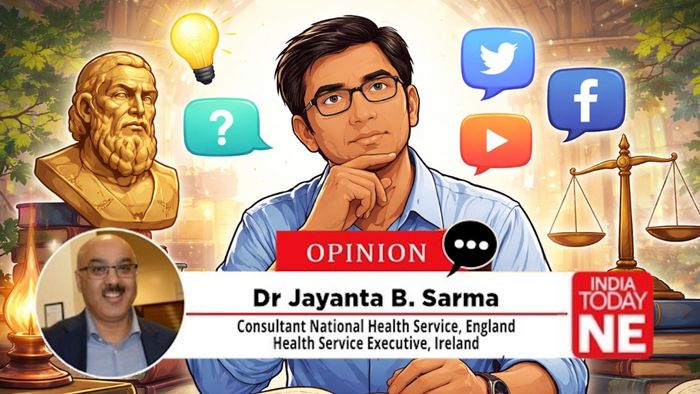
This tension becomes particularly visible in contemporary social media discussions. Like many who write and reflect publicly, I sometimes encounter arguments that appear logically weak, prejudiced, or internally inconsistent. On occasion, my response has been to adopt a particular perspective, what one might loosely call wearing a “hat”—that exposes the weakness of the argument under discussion.
The position taken in such moments is not necessarily a final conviction. Rather, it functions as a dialectical probe, a way of pushing the argument's logic slightly further so that its underlying assumptions become visible.
In effect, the response acts as a mirror.
Yet mirrors can be uncomfortable objects. They reveal what the viewer may not have noticed. And in the fast-moving arena of social media, a mirror is easily mistaken for an attack.
Here lies a small but persistent paradox. The dialectical thinker may move between perspectives to illuminate different aspects of a problem, but the modern audience often expects a single stable ideological identity.
The public sphere increasingly rewards certainty and allegiance, whereas intellectual inquiry often requires movement and experimentation.
What appears to be an inconsistency may in fact be the deliberate testing of ideas from multiple angles.
This tension is not entirely new. Many influential thinkers have operated in precisely this space between assertion and examination.
Socrates unsettled the comfortable assumptions of Athens. Nietzsche disturbed the moral certainties of Europe. In India, figures such as B. R. Ambedkar interrogated social structures by exposing the philosophical foundations that sustained them. Each of these thinkers used provocation not as an end in itself but as a method of intellectual inquiry.
Provocation, when used responsibly, is not hostility. It is an invitation to examine hidden assumptions.
Of course, such an approach has limits. No individual can compel others to rethink their beliefs, nor is it anyone’s responsibility to correct every flawed argument encountered in public discourse.
At best, one can offer a moment of pause, an interruption in the flow of unexamined assertions.
Whether that pause leads to deeper reflection depends on the reader.
The practice of dialectical engagement, therefore, carries an unavoidable risk. A comment intended as a philosophical probe may be interpreted as a personal position. A thought experiment may appear as a contradiction.
Yet perhaps this is simply the cost of intellectual curiosity in an age that prefers quick certainty.
The deeper question is whether public discourse benefits more from uniform agreement or from the patient testing of ideas.
Civilisations that valued philosophical inquiry, from the academies of Athens to the debate halls of ancient India, understood that knowledge advances not merely through affirmation but through examination.
In a world increasingly driven by immediate reactions, the quiet discipline of questioning may appear unfashionable. Yet it remains essential.
Ideas mature when they are tested.
And sometimes, the most useful contribution one can make to a conversation is not a final answer, but a well-placed mirror that allows us to see our own thinking more clearly.
(Author’s note: Dr Jayanta Biswa Sarma writes on politics, institutions, and society through the lenses of history, philosophy, and systems thinking, drawing on both Indian and Western intellectual traditions. Artificial intelligence tools may be used in preparing this article as research and editorial aids. All arguments, interpretations, and final editorial judgement remain the author’s responsibility)