When distance no longer decides our destiny
For a landlocked State like Tripura, distance has never been a statistic. It has shaped how our people travelled, traded, studied and dreamed. I remember meeting a student from a small village near Kailashahar, a small town in northern Tripura and close to the India–Bangladesh border, who told me that going to Delhi for higher studies once felt like crossing countries, not States.
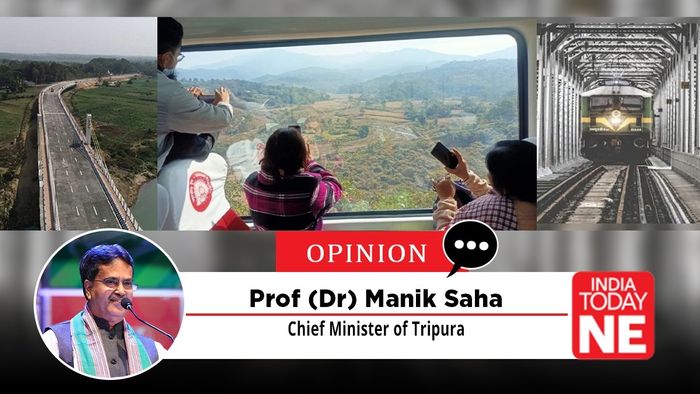
- Feb 10, 2026,
- Updated Feb 10, 2026, 7:07 PM IST
For Tripura and the North-east, connectivity is more than infrastructure. It is dignity, opportunity and belonging. Chief Minister Prof (Dr.) Manik Saha reflects on how the Modi government’s infrastructure push is bringing the region closer to the rest of India and why new gateways like Guwahati’s airport terminal matter deeply for Tripura’s future.
For a landlocked State like Tripura, distance has never been a statistic. It has shaped how our people travelled, traded, studied and dreamed. I remember meeting a student from a small village near Kailashahar, a small town in northern Tripura and close to the India–Bangladesh border, who told me that going to Delhi for higher studies once felt like crossing countries, not States. Today, that journey is shorter, surer and less intimidating. For many young people in Tripura, the map of opportunity has finally begun to expand.
Connectivity is not just about roads, railways or flights. It is about belief. It is about whether a young student feels that opportunity can be found close to home or only far away. It is about whether a farmer can reach markets on time, whether an entrepreneur can think beyond State borders and whether a citizen feels truly included in the nation’s progress.
Under the leadership of Prime Minister Narendra Modi, the North-East has undergone a transformation that is redefining its relationship with the rest of India. What was once viewed through the lens of remoteness is now being approached with confidence and clarity. Infrastructure is no longer an afterthought. It is a statement of intent.
For Tripura, this shift is deeply personal. Access has always been our greatest constraint. Today, improved highways, expanded rail networks and stronger air links are steadily easing the sense of isolation that once shaped everyday life. Distances are shrinking not only on maps, but in how people imagine their futures.
Inter-state connectivity within the North-East has become the backbone of this change. When States are better connected to one another, growth is shared and resilience deepens. Equally critical is seamless linkage with mainland India. One without the other leaves integration incomplete. Together, they create momentum.
Guwahati occupies a pivotal place in this journey. It has long been the gateway to the North-East. Today, it is emerging as a true connector between the region and the rest of the country. The new terminal at Lokapriya Gopinath Bardoloi International Airport (LGBIA) reflects this evolution. Designed for scale, efficiency and ease, it strengthens air connectivity across the region.
Developed by Adani Airport Holdings Limited (AAHL), the terminal is more than an infrastructure upgrade. It is an enabler of movement, commerce and confidence. For Tripura, improved access through Guwahati means faster connections to markets, institutions and opportunities across India. It shortens journeys and widens horizons.
Infrastructure works quietly, but its impact is profound. When access improves, investment follows. When movement becomes easier, ambition grows. Tripura is already witnessing this shift. Agriculture, tourism, education, logistics and health services are gaining momentum as connectivity allows the State’s strengths to travel further.
This transformation aligns closely with the Modi government’s vision of Aatmanirbhar Bharat. Self-reliance does not mean standing apart. It means building strength at home so that we engage the world on equal terms. As Tripura integrates more deeply with national economic networks, it contributes more confidently to India’s growth.
The infrastructure push in the North-East is also fostering emotional integration. When people travel more easily across states, understanding deepens. When goods and services move faster, trust builds. Connectivity creates shared stakes in progress.
For Tripura, the gains are tangible. Lower logistics costs, improved service delivery and wider access to opportunity are changing how the State performs and how it is perceived. Our cultural richness, natural beauty and human capital can now engage more openly with the rest of the country.
The North-East is no longer waiting to be noticed. It is stepping forward with assurance. As connectivity strengthens, its voice in India’s growth story grows clearer.
Distance no longer decides our destiny. Connectivity does. And Tripura is ready to move ahead, alongside a North-east that is increasingly connected, confident and firmly part of Viksit Bharat’s promising future.
(Prof (Dr.) Manik Saha is the Chief Minister of Tripura, focused on strengthening inter-State connectivity and integrating the Tripura State more deeply into India’s economic and infrastructure-led growth.)